

Premium solar generators can make RV camping quieter and more flexible, but the right choice depends on what you plan to power. A compact 1kWh unit is easier to lift and store; a 3.6kWh station offers more reserve for larger loads but can be much heavier. The picks below compare battery capacity, AC output, included panels, RV-friendly ports, and practical trade-offs so you can match a system to your travel style.
Quick Comparison
| Product | Capacity and AC Output | Solar Panel | Best For |
|---|---|---|---|
| Jackery Solar Generator 1000 v2 | 1,024Wh; 1,500W | 200W included | Portable power for lighter loads |
| SolarPlay Q3600 | 3,840Wh; 3,600W | 400W included | High-capacity RV power with a TT-30 outlet |
| Jackery HomePower 3600 Plus | 3,584Wh; 3,600W | Not included in the supplied product details | Expandable capacity and wheeled transport |
| ABOK Ark3600 | 3,840Wh; 3,600W | 400W included | Expandable power with a 30A AC outlet |
| Jackery Explorer 2000 v2 | 2,042Wh; 2,200W | Two 200W panels included | A balance of capacity and manageable weight |
Our Picks: Best premium solar generators for RV camping reviews
Jackery Solar Generator 1000 v2: A Lighter Choice for Everyday RV Loads

The Jackery Solar Generator 1000 v2 pairs a 1,024Wh power station with a 200W solar panel. Its 1,500W AC output and 3,000W surge rating give it room for several everyday devices and some higher-draw appliances, provided their startup and running demands stay within the station’s limits.
At 23.3 pounds, it is the easiest pick here to lift into an RV storage area or move between the campsite and the vehicle. It has two AC outlets, USB ports, a 12V car port, and LED lights. The LiFePO4 battery is rated for 4,000 charge cycles while retaining more than 70% of its original capacity, according to the supplied product information.
The app offers charging modes, including an emergency fast-charge setting. That faster mode needs to be enabled in the app; the standard charging mode is slower and is intended to support battery health. The supplied listing data marks this kit as unavailable, so confirm that it can be purchased before planning around it. The station and panel may also ship separately.
This is a sensible match for campers who prioritize weight and mainly need to charge phones, laptops, lights, and modest appliances. Its 1,024Wh capacity is more limited than the larger stations below, and it does not list a TT-30 or 30A RV outlet, so check your RV’s connection needs before buying.
Pros:
- Lightweight at 23.3 pounds, with a foldable handle
- Includes a 200W solar panel
- 1,500W AC output with a 3,000W surge rating
- LiFePO4 battery and app-based charging controls
Cons:
- Less stored energy than the 2kWh and 3.6kWh options
- The supplied listing data marks the kit as unavailable
Verdict: Choose the Jackery 1000 v2 if easy lifting matters more than multi-day reserve, but verify availability and confirm that its outlets suit your RV setup.
SolarPlay Q3600: A High-Capacity Option with an RV-Friendly TT-30 Outlet

The SolarPlay Q3600 combines a 3,840Wh LiFePO4 battery with 3,600W of continuous AC output and a 5,500W surge rating. A 400W solar panel is included. That large capacity gives you a bigger energy reserve than the smaller Jackery models, while its 17 output ports let you charge several kinds of devices at once.
For RV use, a standout feature is its NEMA TT-30 outlet. That can be useful for compatible RV connections, but check your RV’s plug, power requirements, and the station’s operating instructions before connecting it. The unit also has four standard AC outlets, USB ports, and DC outputs.
The trade-off is portability: the station weighs 93.7 pounds. Integrated wheels and a telescoping handle help you roll it, but it is not a lightweight unit to lift in and out of an RV. The product information also describes a quiet operating mode and an AC-plus-solar charging option. Solar charging speed will depend on sunlight, panel placement, and the system’s input limits.
This is the strongest fit in this group for campers who want substantial stored energy and a direct TT-30 connection. It is less appealing if you need to carry the power station over rough ground or lift it into a high storage compartment.
Pros:
- Large 3,840Wh capacity and 3,600W continuous output
- Includes a 400W solar panel
- Has a NEMA TT-30 outlet for compatible RV setups
- Wheels and a telescoping handle help with rolling transport
Cons:
- Heavy at 93.7 pounds
- Its size and weight may be inconvenient for frequent loading
Verdict: The Q3600 is a compelling option if you want high capacity and a TT-30 outlet, as long as you have room for a heavy, wheeled power station.
Jackery HomePower 3600 Plus: Expandable Capacity for Longer Trips
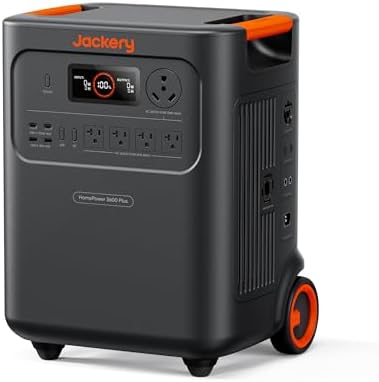
The Jackery HomePower 3600 Plus has a 3,584Wh LFP battery and 3,600W AC output. Its capacity can expand to 21kWh per unit, according to the supplied specifications. That makes it worth considering if your energy needs may grow or if you want the option to add storage rather than replace the whole system.
This is a power station rather than a solar bundle in the product details provided, so plan for a compatible solar panel setup separately. Jackery lists solar, AC, gas-generator, and hybrid AC-plus-DC charging options. The product information states that hybrid charging can reach a full charge in two hours, while actual charging times depend on the available input and conditions.
Wheels and a telescoping handle make it easier to move than a large box without wheels, though the supplied information does not give a weight. The station is designed for high-demand backup as well as outdoor use. Its 3,600W rating is substantial, but it does not automatically mean every RV air conditioner or appliance will work; check both running and startup wattage.
One important connection detail: the description lists 120V and 240V operation in parallel, not as a simple stand-alone 240V output. For RV camping, consider this model if expandable energy storage is a priority and you are comfortable sourcing a compatible solar setup.
Pros:
- 3,584Wh capacity with 3,600W AC output
- Expandable to 21kWh per unit, according to the supplied details
- Wheels and a telescoping handle simplify movement
- Supports multiple charging methods
Cons:
- A solar panel is not listed as included
- Its large capacity may be more than needed for light-use campers
Verdict: Pick the HomePower 3600 Plus if you value expandable storage and rolling transport, and factor a compatible solar panel into your total setup.
ABOK Ark3600: Expandable Power with a 30A AC Outlet

The ABOK Ark3600 is a 3,840Wh LiFePO4 power station with 3,600W of rated output and a stated 4,500W peak. The bundle includes a 400W solar panel, and the station accepts up to 2,000W of solar input. It can also expand to 11,520Wh, which may appeal to campers who want a system that can scale up.
Its output panel includes one 30A AC outlet, four 20A AC outlets, USB ports, and several 12V outputs. The 30A outlet may suit a compatible RV connection; confirm connector type and electrical requirements for your specific RV before buying. Wheels and a telescoping handle should make moving the station easier, while Bluetooth app controls provide a way to monitor it.
Although the product description presents it as an outdoor and emergency-power option, this is still a large-capacity unit. Check your available storage space and consider how you will secure it during travel. The supplied listing information flags both the power station and solar panels as out of stock, so verify availability before counting on this bundle for a trip.
Compared with the SolarPlay Q3600, the Ark3600 offers a similar battery capacity and rated output, plus expandable storage. The Q3600 listing specifies a TT-30 outlet, while the Ark3600 specifies a 30A AC outlet; do not assume the connections are interchangeable without checking the product details.
Pros:
- 3,840Wh capacity and 3,600W rated output
- Includes a 400W solar panel
- Expandable to 11,520Wh, according to the supplied details
- Wheels, telescoping handle, and Bluetooth app controls
Cons:
- The supplied listing information says the station and panels are out of stock
- Its large capacity will take up more space than compact stations
Verdict: The Ark3600 could suit an RV owner seeking expandable capacity and a 30A outlet, but confirm stock and connection compatibility before choosing it.
Jackery Explorer 2000 v2: A More Portable 2kWh Solar Bundle

The Explorer 2000 v2 offers 2,042Wh of capacity and 2,200W of AC output. This bundle includes two 200W solar panels. At 39.5 pounds, it is far lighter than the 3.6kWh stations here, while providing roughly twice the stored energy of the 1,024Wh Jackery 1000 v2.
Three AC ports and a USB-C PD port rated up to 100W support a mix of appliances and personal electronics. The LiFePO4 battery is designed for long service life, and the station has a 20ms UPS switchover feature for backup use. That feature is most relevant to equipment that needs power to continue through a brief interruption; check whether your specific devices are compatible with the setup.
The product information gives a six-hour solar charging estimate with 400W of panels, though real-world results vary with sunlight and panel placement. It also describes quiet charging modes. The power station and panels may ship separately, and Jackery’s supplied connection guidance says to use the straight DC8020 plug for its solar panels rather than the L-shaped plug.
This model is a strong middle ground if you want more capacity than a compact station without moving a nearly 100-pound unit. It does not list a TT-30 or 30A RV outlet, so it is better suited to powering individual devices through its listed outlets than to an assumed direct RV hookup.
Pros:
- 2,042Wh capacity with 2,200W AC output
- Includes two 200W solar panels
- 39.5-pound weight is more manageable than the larger stations
- USB-C PD charging and 20ms UPS switchover
Cons:
- Does not list a TT-30 or 30A RV outlet
- The station and panels may arrive separately
Verdict: The Explorer 2000 v2 is a practical pick for campers who want a useful capacity boost and included solar panels without stepping up to a much heavier 3.6kWh station.
How to Choose a Solar Generator for RV Camping
Match battery capacity to your daily energy use
Battery capacity, measured in watt-hours, gives you a rough idea of how much energy a station can store. Add up the watt-hours you expect to use for lights, phones, laptops, a fridge, and other gear over a typical day. Remember that the power station’s usable energy can be lower than its listed capacity, and real runtime depends on the devices and how they are used. A 1kWh model is easier to carry, while 2kWh and 3.6kWh choices give you a larger reserve.
Check running watts, startup watts, and RV connections
Output wattage tells you how much power the station can supply at one time. Motors and compressors may need more power to start than they use once running, so check both startup and running requirements for appliances such as refrigerators or air conditioners. If you want to connect an RV directly, check the exact outlet type and your RV’s electrical requirements. A TT-30 outlet and a 30A AC outlet should not be treated as interchangeable without confirming the connectors and instructions.
Decide whether you need a bundled solar panel
A panel included in a bundle makes it easier to get started, but panel wattage affects how quickly you can recharge in good sunlight. A 200W panel is more compact than a 400W panel but may take longer to replenish a large battery. If the station does not include panels, check its solar input limits, connector requirements, and compatible panel options before ordering.
Think about weight, storage, and campsite setup
Consider where the power station will ride in your RV and how often you will move it. A 23-pound unit is easier to lift than a 93-pound model, while wheels and a telescoping handle can help with heavier stations on firm ground. Check the available storage area, allow room to access ports, and secure the unit for travel. Portable panels also need a suitable spot in the sun and may need to be repositioned as the light changes.
Consider battery type and expansion needs
The models in this list use LiFePO4 or LFP batteries, which are designed for repeated charging. Compare the stated cycle information, warranty coverage, and expansion options rather than relying on battery chemistry alone. If your power needs could increase, an expandable station may be useful, but check which additional batteries or components are required and whether they fit your budget and storage space.
Plan for charging time and backup use
Solar recharge times depend on sunlight, panel angle, shading, and the station’s solar input limit. AC charging may be faster when shore power is available, while a hybrid charging option can combine inputs on compatible systems. If you need backup power for sensitive equipment, check the switchover time and confirm that the device can use the station safely. Never exceed the station’s output ratings.
Frequently Asked Questions
Can a solar generator run an RV air conditioner?
It depends on the air conditioner’s running and startup wattage, the power station’s output, and how long you need it to run. A high-output station may handle some loads, but capacity and surge ratings alone do not guarantee compatibility. Check the appliance label and the power station’s instructions before connecting it.
Is a 1,000Wh power station enough for RV camping?
It can be enough for lighter use, such as charging phones and laptops, running lights, and powering modest devices. It will offer less reserve for a fridge or several days of use than a 2kWh or 3.6kWh model. Estimate your daily energy needs before choosing.
Do these solar generator bundles include panels?
The Jackery 1000 v2 listing includes a 200W panel, the SolarPlay Q3600 and ABOK Ark3600 include 400W panels, and the Explorer 2000 v2 bundle includes two 200W panels. The supplied HomePower 3600 Plus details do not list a panel as included, so plan to check compatible panel options separately.
What does a TT-30 outlet do?
A NEMA TT-30 outlet is a 30A connection commonly used with compatible RV setups. The SolarPlay Q3600 specifically lists this outlet. Always confirm your RV’s plug and electrical requirements, and follow the power station manufacturer’s instructions before connecting.
Can solar panels recharge a power station while camping?
Yes, if the station supports solar input and the panels are compatible. Charging speed changes with sunlight, shade, panel angle, and the station’s input limit. Position portable panels in a sunny location and check the product instructions for cables and connection requirements.
Which is the easiest model to move?
The Jackery Solar Generator 1000 v2 is the lightest listed option at 23.3 pounds. The Explorer 2000 v2 weighs 39.5 pounds. The SolarPlay Q3600 weighs 93.7 pounds, though its wheels and telescoping handle help with rolling it on suitable ground.
Final Recommendation
For many RV campers, the Jackery Explorer 2000 v2 offers the most balanced combination of capacity, weight, and included solar panels. Choose the SolarPlay Q3600 if you need a larger reserve and a TT-30 outlet and can manage its weight. If easy lifting is your top concern, the Jackery 1000 v2 is the compact option, but verify availability and make sure its smaller capacity fits your needs.