

A cabin solar battery should match your daily energy use, system voltage, available space, and the coldest conditions where it will operate. The LiFePO4 options below range from compact 100Ah batteries sold in a two-pack to large-capacity 300Ah-plus models, with features such as Bluetooth monitoring, low-temperature protection, and expandable configurations. Compare the details carefully, and confirm that your charge controller, inverter, and wiring are compatible before you buy.
Quick Comparison
| Battery | Capacity | Standout features | Best fit |
|---|---|---|---|
| GoKwh 12V 320Ah LiFePO4 Battery | 320Ah; 4,096Wh | Bluetooth monitoring, 200A BMS, 4P4S expansion | A large-capacity single battery with app monitoring |
| Dyness 12V 100Ah LiFePO4 Battery, 2-Pack | Two 100Ah batteries | Low-temperature charging protection, 100A BMS per battery | A modular setup that can grow with your cabin system |
| Power Queen 12V 320Ah Mini Bluetooth Battery | 320Ah; 4.096kWh | Compact design, Bluetooth app, IP65 protection | High capacity where installation space is limited |
| ECO-WORTHY EnergyRock 12V 314Ah 2-Pack | 314Ah per battery; sold as a 2-pack | Metal case, Bluetooth monitoring, safety switch | A protected battery enclosure and high capacity |
| ECOBOSS 12V 300Ah LiFePO4 Battery | 300Ah; 3,840Wh | 200A BMS, low-temperature charging protection, IP65 rating | A large-capacity battery with stated expansion options |
Our Picks: Best LiFePO4 batteries for cabin solar systems reviews
GoKwh 320Ah: A high-capacity pick with Bluetooth monitoring

The GoKwh is a 12.8V, 320Ah battery with a stated capacity of 4,096Wh. Its built-in Bluetooth 5.0 lets you check battery level, voltage, current, and temperature from a phone. That can be useful at a cabin when the battery bank is installed in a utility area that is not easy to access.
Its 200A BMS is listed as protection against overcharging, over-discharging, short circuits, excessive current, and overheating. The product description also specifies a low-temperature cutoff below -4°F during discharge. It supports 4P4S expansion, so it may suit a system that could grow over time, provided the complete bank is assembled according to the manufacturer’s instructions.
The main trade-off is that a single 12V battery may not be the right starting point for every cabin. Larger inverters and longer cable runs may favor a higher-voltage system, which requires checking the battery’s permitted configuration and compatibility with the rest of your equipment. Also, the listed cold-weather protection refers to discharge; verify charging-temperature limits before relying on it in a cold cabin.
Pros:
- Large 320Ah capacity and stated 4,096Wh of energy
- Bluetooth monitoring includes voltage, current, temperature, and battery level
- 200A BMS with several stated electrical protections
- Supports 4P4S expansion
Cons:
- The listed low-temperature cutoff is for discharge; confirm charging limits separately
- A 12V design may not suit every cabin inverter or higher-voltage system
Verdict: Choose the GoKwh if you want a high-capacity 12V battery with app monitoring and expansion options, and its charging limits fit your cabin’s climate.
Dyness 100Ah two-pack: A modular choice for a growing system

This Dyness option is sold as two 12V, 100Ah batteries. Each is listed at 25.3 pounds and measures 13.0 by 6.77 by 8.43 inches, which may make the pair easier to place in a compact battery area than one very large unit. The product description says up to four batteries can be connected in series and four in parallel; check the manufacturer’s instructions and your system design before combining batteries.
Each battery has a stated 100A BMS and low-temperature charging protection. Charging is set to disconnect below 32°F and resume at 41°F, while the product also lists a power cutoff at -4°F. These details make temperature limits especially important if the battery bank will be in an unheated cabin or exposed to winter conditions.
Compared with the 300Ah-plus options here, the two 100Ah batteries offer less capacity per battery but more flexibility in placement and configuration. The description cites 4,000-plus deep cycles and a 10-year lifespan; treat those as manufacturer claims, and consider how your actual charging, temperature, and usage conditions may affect service life. The listing identifies the batteries as IP65 waterproof, but an appropriate installation location and wiring protection still matter.
Pros:
- Two separate batteries can offer more placement flexibility
- Low-temperature charging cutoff and restart temperatures are specified
- 100A BMS in each battery
- Supports series and parallel expansion as described by the manufacturer
Cons:
- Each battery has less capacity than the large-format options in this guide
- Combining batteries requires careful attention to system design and instructions
Verdict: The Dyness two-pack is a sensible option if you want smaller battery units, clear cold-charging limits, and the ability to build a bank in stages.
Power Queen 320Ah Mini: High capacity for a tighter battery space

The Power Queen Mini is a 12V, 320Ah battery with a stated energy capacity of 4.096kWh. Its compact design is described as saving 35% of space compared with a standard 300Ah battery, making it worth considering when a cabin’s battery compartment is tight. Confirm the battery’s actual dimensions against your available space before ordering.
Bluetooth 5.0 connects to the Power Queen app for monitoring state of charge, voltage, current, and status. The listing also describes a remote power on/off function, a 200A BMS, 2,560W output, and IP65 protection against dust and water splashes. It supports 4P4S expansion, with the product description giving a maximum system configuration of 51.2V and 1,280Ah.
The manufacturer lists a -20°C cutoff for cold-weather protection, but the description does not clarify the specific charging and discharging behavior at that threshold. Ask the manufacturer or consult the full manual if the battery will operate in freezing conditions. Its 2,560W output rating is also something to compare directly with your inverter’s continuous and surge needs rather than treating as a guarantee that every appliance will run.
Pros:
- 320Ah capacity in a design described as space-saving
- Bluetooth app monitoring and remote on/off control
- Listed 200A BMS and 2,560W output
- IP65 protection and 4P4S expansion support
Cons:
- The low-temperature cutoff details are less specific than some alternatives
- Check inverter requirements against the listed output rating
Verdict: Consider the Power Queen Mini if space is limited and you want a large battery with Bluetooth features, but verify its cold-weather behavior and inverter compatibility first.
ECO-WORTHY EnergyRock 314Ah: A metal-cased two-pack with a safety switch
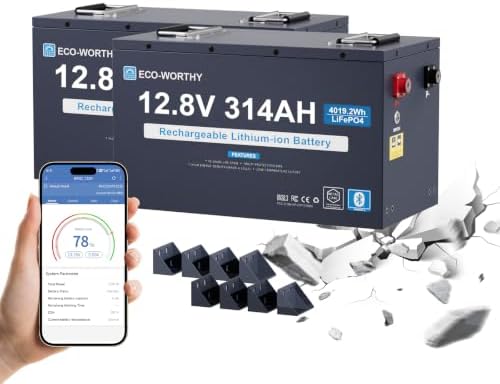
The ECO-WORTHY EnergyRock is listed as a two-pack of 12V, 314Ah batteries. The metal enclosure is designed to add physical protection, and the product description says the case includes mounting feet and a safety switch. A metal case can be a practical design feature in a cabin installation, but it does not remove the need to secure the batteries and follow electrical and fire-safety guidance.
Each battery is described as having Bluetooth 5.1 monitoring, Grade A cells, a 200A BMS, and protection against overcharge, over-discharge, overcurrent, short circuit, and temperature issues. The listing provides solar charge-controller settings: 14.6V absorption, float disabled or set to 13.8V if it cannot be disabled, and equalization disabled. Confirm those settings against the current product manual and your charge controller before use.
The listing describes a low-temperature protection feature but does not give the temperature thresholds in the supplied product details. That makes it important to check the manual if you expect winter charging or operation. Also verify exactly how the two batteries are intended to be connected and whether their combined configuration matches your inverter and charge controller.
Pros:
- Two high-capacity batteries, each listed at 314Ah
- Metal enclosure, mounting feet, and a safety switch
- Bluetooth monitoring and a stated 200A BMS per product description
- Solar charge-controller settings are provided in the listing
Cons:
- The supplied details do not state exact low-temperature protection thresholds
- Confirm the intended wiring and total capacity for the two-battery configuration
Verdict: The EnergyRock may suit a cabin owner who values a metal enclosure and a two-battery package, as long as the cold-weather limits and wiring plan check out.
ECOBOSS 300Ah: A large battery with specified cold-charging limits

The ECOBOSS is a 12V, 300Ah battery with a stated 3,840Wh capacity. Its 200A BMS is listed as supporting 200A continuous discharge and up to 100A charging, along with protection against overcharge, over-discharge, overcurrent, short circuits, and temperature changes. Those figures can help you compare it with your inverter and charging equipment, but check both devices’ requirements before planning a system.
This battery has clearly stated cold-charging limits: charging stops below 32°F and resumes at 41°F. The listed charging range is 32°F to 113°F, and the discharge range is -4°F to 149°F. It also has an IP65 rating and supports up to a 4S4P configuration, with the product description stating a maximum system capacity of 51.2V, 1,200Ah, and 61.44kWh.
The product claims 15,000-plus cycles, but cycle life depends on operating conditions and should be treated as a manufacturer specification rather than a guaranteed lifespan. Unlike the GoKwh and Power Queen options, Bluetooth monitoring is not listed in the supplied details. If checking battery status on your phone is important, compare that omission with the monitoring features of the other picks.
Pros:
- Large 300Ah capacity and stated 3,840Wh of energy
- 200A continuous-discharge rating and 100A maximum charge rating are specified
- Cold-charging cutoff and restart temperatures are provided
- IP65 rating and stated 4S4P expansion support
Cons:
- Bluetooth monitoring is not listed in the supplied product details
- Cold-temperature protection pauses charging below its stated threshold
Verdict: The ECOBOSS is a strong candidate if you want a large 12V battery, defined cold-charging limits, and expansion options, and you do not need listed Bluetooth monitoring.
How to Choose a LiFePO4 Battery for a Cabin Solar System
Estimate your daily energy use
Start by listing the devices you expect to run, how much power each uses, and how many hours a day it will operate. Add the estimated energy use together, then allow for periods with limited sunlight and the amount of backup time you want. A battery’s amp-hour rating is useful, but the watt-hour figure can make it easier to compare stored energy across batteries. The actual energy you can use will depend on the battery’s operating limits and your system setup.
Match the battery voltage to your system
Check the voltage required by your inverter, charge controller, and any existing battery bank before choosing a battery. A product’s ability to connect in series or parallel does not mean every configuration is suitable for every system. Follow the manufacturer’s limits for battery count, wiring, and configuration, and make sure components are designed to work together.
Check BMS limits against your inverter and loads
The battery management system (BMS) helps protect the battery from conditions such as excess current, overcharging, and low temperature. Compare its continuous discharge and charging limits with your equipment’s requirements. Also consider the startup surge from appliances with motors or compressors, since a continuous rating alone does not describe every load an inverter may need to handle.
Understand cold-weather charging protection
Cold temperatures can affect whether a LiFePO4 battery should be charged. Product protections vary: some listings provide specific charging cutoff and restart points, while others describe low-temperature protection without giving the exact limits. If your cabin is unheated, look for clearly stated charging-temperature information and confirm how the battery behaves during both charging and discharging. Do not assume that a discharge cutoff also protects against cold-weather charging.
Plan for solar charging compatibility
Your solar charge controller must support the battery type and the charging settings recommended by the battery maker. Check the manual for voltage settings and any limits on charging current. One product in this guide lists specific absorption, float, and equalization settings; those are product-specific details, not universal settings for every LiFePO4 battery.
Measure the installation space and protect the bank
Measure the battery compartment, including room for cables and safe access to switches or terminals. Compare the measurements and weight of each battery with the space you have. A metal case or an IP rating may offer useful protection, but it does not replace a secure installation, suitable wiring, and protection against water, impact, or other hazards at your site.
Decide whether monitoring and expansion matter
Bluetooth monitoring can make it easier to check battery status when the bank is out of sight, but app features and connection range vary by product. Expansion claims also differ, and a larger bank requires compatible batteries, wiring, charge equipment, and inverter capacity. Choose a configuration that meets your current needs while leaving a practical path to grow if the manufacturer allows it.
Frequently Asked Questions
How much battery capacity does a cabin solar system need?
It depends on the energy use of your appliances and how long you want to operate without enough solar production to recharge. Estimate daily watt-hour use, then plan for the backup time you need. The battery capacity alone does not determine how long your system will run; inverter losses and battery operating limits also matter.
Can I connect these batteries in series or parallel?
Some products in this guide state that they support series and parallel connections, but the permitted configurations differ. Follow the exact product instructions and confirm that your charge controller and inverter support the planned bank. Do not assume that batteries from different models can be safely combined.
Can a LiFePO4 battery charge in freezing temperatures?
Charging limits vary by battery. The Dyness and ECOBOSS listings specify charging cutoffs below 32°F and restart points at 41°F. Other listings provide less detail about charging temperatures, so check the product manual before using a battery in a cold cabin.
Is Bluetooth monitoring necessary?
No. Bluetooth is a convenience for checking information such as voltage, current, or state of charge, when those details are supported by the app. It may be useful if the battery is difficult to reach, but it is not a replacement for compatible charging equipment or a well-designed system.
What does a 200A BMS rating mean?
It describes a current limit associated with the battery’s management system, but the exact meaning and other limits can vary. Check the product’s continuous discharge and maximum charge specifications, and compare them with your inverter and charging equipment. Also consider appliance startup needs, not just typical running power.
Should I choose one large battery or a two-pack?
A large battery may simplify the number of units in a bank, while smaller units can give you more flexibility in placement or expansion. Compare total capacity, dimensions, wiring requirements, and the manufacturer’s approved configurations. The best choice depends on your available space and system plan.
Final Recommendation
For a single high-capacity battery with app monitoring, the GoKwh 320Ah stands out for its stated 4,096Wh capacity and 200A BMS. The Dyness two-pack is a more modular choice with clearly specified cold-charging protection, while the ECOBOSS offers a large capacity and detailed charge-temperature limits. The Power Queen Mini is worth considering where space is tight, and the ECO-WORTHY EnergyRock may appeal if you want a metal case and safety switch. Before choosing any of them, match the battery to your cabin’s energy needs, climate, inverter, charge controller, and installation space.