

Choosing the best LiFePO4 battery for an RV solar system depends on how much energy you use, how much room you have, and whether you camp in cold weather. The options below range from a high-capacity 460Ah battery to compact 314Ah models and a two-battery bundle. Compare usable energy, BMS limits, low-temperature protection, and fit before choosing—especially if you already own an inverter or solar charge controller.
Quick Comparison
| Battery | Capacity and energy | Standout features | Best suited for |
|---|---|---|---|
| LiTime 12V 460Ah Self-Heating Battery | 460Ah; 5,888Wh | Self-heating, Bluetooth, 5A active balancing, 3,200W max continuous output | High-energy RV systems and cold-weather use |
| ECO-WORTHY 12V 314Ah Battery | 314Ah; 4,019.2Wh | Bluetooth, status LEDs, low-temperature charging protection, 200A BMS | Campers wanting capacity and simple status checks |
| ECO-WORTHY EnergyRock 314Ah 2-Pack | Two batteries; 314Ah per battery | Metal cases, safety switches, Bluetooth, low-temperature protection | RV owners planning a larger battery bank |
| HumsiENK 12V Mini 300Ah (314Ah) Battery | Listed as 300Ah/314Ah; about 4.01–4.19kWh in product details | Compact case, Bluetooth, 200A BMS, low-temperature cutoff | Installations where space and weight matter |
| 12.8V 314Ah LiFePO4 Battery 2-Pack | Two batteries; 4,019.2Wh per battery | Bluetooth, 200A BMS, low-temperature cutoff | Buyers comparing a two-battery bundle |
Our Picks: Best LiFePO4 batteries for RV solar systems reviews
LiTime 460Ah: Best for High Energy Capacity and Cold-Weather Preparation

LiTime’s 12V 460Ah battery is the highest-capacity single unit in this group. It stores 5,888Wh and lists a maximum continuous output of 3,200W, which may suit an RV that runs several appliances or needs longer stretches between charging. Check that your inverter and wiring are compatible with the battery’s output.
Its built-in heating has Regular and Energy-Efficient modes. Regular mode starts heating below 41°F and stops at 50°F, helping prepare the battery for charging in cold conditions. The battery also has Bluetooth 5.0 monitoring, a 30-day history, a configurable minimum state-of-charge reserve, and over-the-air updates. Its 5A active balancing is intended to help maintain cell consistency.
The trade-off is size: the battery uses a Group 8D case measuring 20.47 × 10.55 × 8.66 inches. Measure your battery compartment and check its weight limit before buying. The product information also lists protection against low-temperature charging and discharging, but owners should still follow the manufacturer’s charging instructions and system requirements.
Pros:
- Largest stated single-battery capacity in this selection
- Self-heating modes for cold-weather charging preparation
- Bluetooth monitoring with usage history and reserve settings
- Lists a 3,200W maximum continuous output
Cons:
- Large Group 8D dimensions may not fit smaller RV compartments
- Its high capacity may be more than a modest solar setup needs
Verdict: Choose the LiTime if you need substantial stored energy and value built-in heating, provided its size and electrical specifications suit your RV.
ECO-WORTHY 314Ah: Best for On-Battery Status Checks

This ECO-WORTHY battery offers 314Ah and 4,019.2Wh of stored energy in a single 12V unit. A built-in display shows battery level and status, while Bluetooth connects to the brand’s app for remote monitoring. Having both options can be useful when you want to check the battery at the compartment or from nearby in the RV.
The 200A BMS includes low-temperature charging protection, along with protections for voltage, overload, and temperature conditions. The product information says charging is cut off below 19.4°F. Its listed dimensions are 16.3 × 8.46 × 10.24 inches, and its stated weight is 60.4 pounds, so compare those measurements with your available space and lifting needs.
The battery supports several series and parallel configurations according to the product details. That flexibility can help with some system plans, but do not assume every arrangement is suitable for your RV: confirm permitted configurations, charging settings, and compatibility with your other batteries and equipment before connecting units.
Pros:
- 314Ah capacity and 4,019.2Wh of stored energy
- Combines Bluetooth monitoring with an on-battery status display
- Low-temperature charging cutoff is specified in the product details
- Product information lists support for multiple bank configurations
Cons:
- Its listed weight may make installation harder in a tight compartment
- Configuration limits need to be checked before expanding a battery bank
Verdict: This is a practical option if you want a large single battery with both app monitoring and a built-in status display.
ECO-WORTHY EnergyRock 2-Pack: Best for a Metal Enclosure
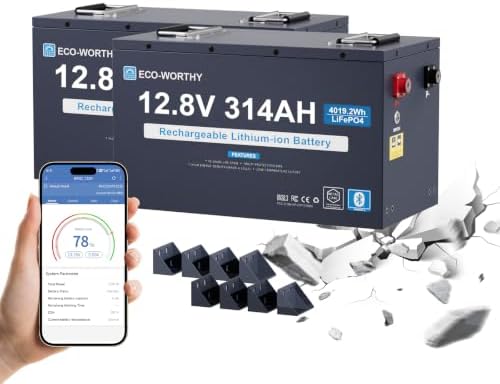
This EnergyRock listing is for a two-battery package, with each battery described as a 12V 314Ah LiFePO4 unit. Its metal enclosure and mounting feet are intended to provide a sturdier installation option. The product information also describes the case as heat-resistant and says it can be installed without an extra battery box, though you should still follow RV installation and ventilation requirements.
Each battery has Bluetooth monitoring and a 200A BMS. A low-current safety switch can cut off battery output for installation or maintenance. The manufacturer also describes the enclosure and internal cell holders as helping resist road vibration—an important consideration in a vehicle that is regularly moving.
A two-battery package may be useful if you are building a larger bank, but it also needs more room and careful planning. Confirm the included quantity, wiring layout, allowed series or parallel configuration, and charger settings before purchase. The product listing includes specific recommended charging settings, so use the manufacturer’s instructions rather than assuming your existing controller is configured correctly.
Pros:
- Two batteries are included in the listed package
- Metal cases with mounting feet and built-in safety switches
- Bluetooth app monitoring and a 200A BMS per product description
- Designed with RV vibration and installation in mind
Cons:
- A two-battery bank needs more space and additional wiring
- Confirm the included quantity and permitted system configuration before ordering
Verdict: Consider the EnergyRock bundle if you want two metal-cased batteries and have the room and compatible equipment for a larger bank.
HumsiENK Mini: Best for a Compact Battery Compartment

HumsiENK’s battery is designed for installations where a standard large-format battery may be awkward to fit. Its listed dimensions are 15.1 × 9.7 × 7.6 inches, and its stated weight is 59.5 pounds. The product information describes an internal aluminum frame and a durable ABS case, with shock resistance as part of its design.
The capacity needs a closer look before you buy. The title gives 300Ah, while the product details also refer to 314Ah and give energy figures of about 4.01kWh and 4.19kWh. Because those figures do not match, confirm the exact capacity and energy rating on the current product listing. It also has a 200A BMS, Bluetooth monitoring, and low-temperature charging protection.
The product details describe a maximum 4S4P configuration. That could offer expansion options for a properly planned system, but the final arrangement must match the manufacturer’s limits and your RV equipment. The stated five-year coverage is another listed feature; check its terms and exclusions before treating it as a substitute for system compatibility checks.
Pros:
- Compact dimensions compared with the larger 460Ah option
- Bluetooth monitoring for voltage, current, capacity, and temperature
- 200A BMS and low-temperature cutoff are listed
- Product details describe 4S4P expansion support
Cons:
- Capacity and energy figures differ across the product information
- Confirm the case dimensions and weight against your RV compartment and mounting plan
Verdict: The HumsiENK is worth considering when compact dimensions are a priority, but verify the exact capacity before comparing it with other batteries.
12.8V 314Ah 2-Pack: Best for Buyers Comparing Bundle Options

This listing is for a two-pack of 12.8V 314Ah LiFePO4 batteries. The product information gives 4,019.2Wh per battery, a 200A BMS, and Bluetooth monitoring for power, voltage, temperature, and cycle count. It also lists a low-temperature cutoff that stops charging at 32°F and a high-temperature charging cutoff at 149°F.
The stated weight is 57.28 pounds per battery, with listed dimensions of 15.16 × 7.59 × 9.84 inches. That makes compartment fit an important check, even though the individual units are relatively compact for their stated capacity. The listing describes 4S4P expansion, but RV owners should confirm the permitted setup and ensure their inverter and charger match the final battery-bank arrangement.
One important limitation in the product details is that the batteries are not intended for starting engines or powering golf carts. The supplied product data also marks this listing as unavailable, so check the current listing before planning a purchase around this bundle. Do not assume a two-pack will be ready to install without checking wiring, charging, and mounting requirements.
Pros:
- Two 314Ah batteries are listed in the package
- Bluetooth monitoring includes several battery status details
- Low- and high-temperature charging cutoffs are specified
- Product details list a five-year warranty
Cons:
- The supplied listing information marks the product as unavailable
- Not intended for engine starting or golf cart use
Verdict: This bundle may suit an RV solar bank if it becomes available and its configuration fits your system, but verify availability and compatibility first.
How to Choose a LiFePO4 Battery for an RV Solar System
Estimate Your Daily Energy Use
Start by adding up the energy your appliances use over a typical day. Pay special attention to items that run for long periods or draw high power, such as refrigerators, fans, and inverter-powered appliances. The battery’s watt-hours help you compare stored energy, while amp-hours should be considered alongside the battery’s voltage. A larger capacity can extend time between charges, but it may not be useful if your solar panels cannot replenish it.
Match the Battery to Your Inverter and Loads
Check the battery’s output limits against the inverter and the devices you plan to run. The LiTime listing specifies a maximum continuous output, while the other product details often list BMS current ratings. A BMS rating is not a complete substitute for checking all operating limits. Confirm the manufacturer’s specifications for continuous and peak output, and make sure your cables, fuses, and inverter are suitable for the system.
Check Low-Temperature Charging Protection
LiFePO4 batteries need suitable charging conditions. If you camp in cold weather, check whether the battery stops charging at low temperatures or includes a heating feature. These products use different approaches: some list a low-temperature cutoff, while the LiTime includes self-heating modes. Read the exact temperature limits and charging instructions for the model you choose, and do not assume every battery has the same protection.
Measure the Battery Space and Plan the Mounting
Measure the compartment’s width, height, and depth, and leave room for cables and safe access. Compare those measurements with the battery’s listed dimensions. Weight matters too, particularly when installing a heavy unit in a cabinet or storage space. For a moving RV, use a secure mounting plan that follows the manufacturer’s instructions and can handle travel vibration.
Confirm Charger and Solar Controller Compatibility
Your solar charge controller, converter, and any shore-power charger must be compatible with LiFePO4 batteries. Check that the charging profile and settings follow the battery maker’s instructions. If you plan to combine batteries, confirm which series or parallel arrangements are supported and whether the batteries need to match in model, age, and capacity. Never assume that two batteries can be connected just because their voltage is similar.
Choose the Monitoring Features You Will Use
Bluetooth monitoring can help you check battery status without opening an RV compartment. Some options also include a built-in display, which can be handy when you are near the battery. Consider whether you want to see voltage, current, state of charge, or temperature, and check the app’s stated range and features. Monitoring is useful, but it does not replace a correctly sized battery bank or a compatible charging system.
Compare the Full System Cost and Expansion Plan
Compare the cost of the complete setup, not just the battery. A larger unit or multi-battery package may require different mounting, wiring, fusing, or charging equipment. If you may expand later, confirm the battery’s supported configurations and whether the manufacturer allows adding units at a later stage. Also check warranty terms, included accessories, and the exact quantity in any bundle.
Frequently Asked Questions
How much battery capacity does an RV solar system need?
It depends on your daily energy use and how long you want to go between charges. Add up the watt-hours used by your appliances, then consider your solar production and the amount of backup capacity you want. A 314Ah battery and a 460Ah battery serve different needs, so size the system around your actual use rather than choosing by amp-hours alone.
Can I charge a LiFePO4 battery with my existing RV solar controller?
Only if the controller supports LiFePO4 charging and can be set to the battery manufacturer’s recommended profile. Check the controller manual and the battery instructions before connecting them. The same compatibility check applies to a converter or shore-power charger.
Can I connect two 12V batteries together?
Some batteries support series or parallel connections, but the permitted setup depends on the model. Check the product instructions for approved configurations, limits, and any matching requirements. Also make sure your inverter and charging equipment are compatible with the resulting bank.
What is the benefit of a self-heating battery?
A self-heating battery uses built-in heating to prepare for charging in cold conditions. The LiTime option in this list includes two heating modes and specifies the temperatures at which its Regular mode starts and stops. Compare those details with the temperatures you expect to encounter and follow the battery’s instructions.
Do I need Bluetooth monitoring?
No, but it can make it easier to check battery status from nearby without opening the compartment. Some batteries also have a built-in display. Choose the monitoring features that fit how you use your RV, and remember that an app does not replace proper system sizing or charging settings.
Can I use these RV batteries to start an engine?
Do not assume so. The product information for the two-pack in this list specifically says it is not for engine starting. Check the intended use and specifications for any battery before using it as a starting battery.
Final Recommendation
For the most stored energy in one battery and built-in cold-weather heating, the LiTime 460Ah is the standout option, as long as its Group 8D size fits your RV. The ECO-WORTHY 314Ah is a strong alternative if you want a status display and Bluetooth monitoring, while the EnergyRock bundle is worth considering for a planned two-battery installation. Before ordering any option, verify its exact capacity, availability, dimensions, charging requirements, and compatibility with your RV’s inverter and solar equipment.