

When the grid goes down, a dual fuel generator gives you a choice that a gas-only model cannot: run it on gasoline when you have it, or switch to propane when you do not. For a home, that flexibility matters, and so does having the right outlets for a transfer switch. In this guide we compare five dual fuel portable generators, from a smaller 8000-watt unit up to 13,000-watt machines built for whole-home backup. You will see who each one suits, where each falls short, and how to pick the right size for your house.
Quick Comparison Table
| Product | Gasoline Power | Start | Best For |
|---|---|---|---|
| Westinghouse 12500 Watt Dual Fuel Portable Generator | 9,500 running / 12,500 peak watts | Key fob remote, electric, recoil | Easy everyday home backup |
| Westinghouse 14500 Peak Watt Dual Fuel Portable Generator | 11,500 running / 14,500 peak watts | Push-button and remote | Automatic transfer switch setups |
| DuroMax XP13000HX 13,000-Watt Dual Fuel Generator | 13,000 watts | Push button | Whole-home power with quick fuel switching |
| WEN 8000-Watt Dual Fuel Portable Generator | 6,500 running / 8,000 surge watts | Electric start | Essential circuits and RV use |
| DuroStar DS13000MX 13,000-Watt Dual Fuel Generator | 13,000 watts | Remote electric start | Whole-home power with remote start |
Our Picks: Best dual fuel generators for home use reviews
Westinghouse 12500: Easy Remote Start and a Practical Outlet Panel
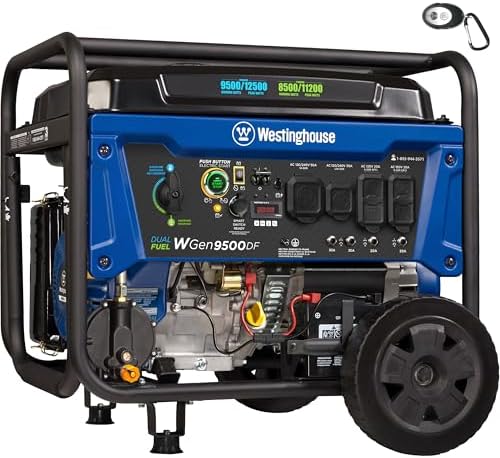
This is the pick if you want a large generator that is easy to live with. The included key fob lets you start it from a distance during a storm, and electric and recoil starts are there too, so you have more than one way to get it running. Output drops a bit on propane, from 9500 running watts on gasoline to 8500, so plan your loads around the fuel you expect to burn.
The panel covers the usual home backup jobs: two GFCI household outlets, a 30-amp transfer switch outlet, and a 50-amp RV outlet, all with rubber covers. A digital display shows voltage, frequency, and lifetime hours, which helps you keep up with maintenance. It ships with a battery charger, oil, a funnel, and tools, so setup is light. The trade-off is the 6.6-gallon tank, which is smaller than the tank on the bigger Westinghouse, so expect more refueling stops.
Pros:
- Key fob, electric, and recoil start options
- Transfer switch ready 30-amp and RV-ready 50-amp outlets
- Digital display shows voltage, frequency, and lifetime hours
- Battery charger, oil, funnel, and tool kit included
Cons:
- Smaller fuel tank than the larger Westinghouse
- Output drops on propane
Verdict: Choose the Westinghouse 12500 if you want easy starting and a practical outlet panel for a transfer switch or an RV.
Westinghouse 14500: Portable Power That Pairs With Automatic Switching

Pick this one if you want backup power that acts more like a standby unit. It works with the Westinghouse WATS200 automatic transfer switch, sold separately, so your house can switch over on its own when the power drops. That is unusual for a portable generator and the main reason to choose it over the others here. It makes 11,500 running and 14,500 peak watts on gasoline.
The 9.5-gallon tank is rated for up to 19 hours at 25 percent load, which suits long outages better than the smaller tanks in this group. Low harmonic distortion means cleaner power for phones, computers, and TVs, and a built-in CO sensor shuts the unit down when carbon monoxide climbs. The 50-amp and 30-amp outlets also work with an interlock kit or a manual transfer switch. The catch is that you will need to buy the transfer gear separately.
Pros:
- Works with the WATS200 automatic transfer switch
- Up to 19 hours at 25 percent load on the 9.5-gallon tank
- Built-in CO sensor and automatic low-oil shutdown
- Cleaner power for phones, computers, and TVs
Cons:
- The automatic transfer switch is sold separately
Verdict: Choose the Westinghouse 14500 if you want the closest thing to automatic standby power and plan to add the WATS200 switch.
DuroMax XP13000HX: Big Wattage With Quick Fuel Switching

The DuroMax is for you if you want the most rated wattage and the simplest fuel swap. It is rated at 13,000 watts, and a front-facing interface lets you change between gasoline and propane in seconds, with no digging around the engine. CO Alert is built in for added safety, and the 500cc engine uses all copper windings.
The power panel is generous: four GFCI household outlets, a 30-amp outlet, a 30-amp twist-lock, and a 50-amp outlet that makes it transfer switch ready. Start-up is by push button. Next to the DuroStar below, the specs look nearly identical, but the supplied details list push-button start and no remote start. If that does not bother you, it is a strong whole-home option.
Pros:
- Switch between gasoline and propane in seconds
- Four GFCI outlets plus 30-amp and 50-amp outlets
- All copper windings and a 500cc engine
- CO Alert for added safety
Cons:
- No remote start mentioned in the listing
Verdict: Choose the DuroMax if you want 13,000 watts and fast fuel switching and can live without remote start.
WEN 8000: A Smaller Dual Fuel Option for Essential Circuits

The WEN is the smaller, more manageable choice. It makes 6500 rated watts on gasoline and 5850 on propane, which is enough for a handful of essentials rather than a whole house. The 340cc engine starts with a switch, and a wheel kit comes in the box, which helps when you have to roll it out of the garage.
The WEN Watchdog sensor shuts the generator off if it detects dangerous carbon monoxide levels. The 6.7-gallon tank gives up to 10.5 hours at half load, and the outlets include four household plugs, an RV-ready 30-amp outlet, a transfer-switch-ready twist-lock, and a 12V socket. Compared with the 13,000-watt models, you give up the 50-amp outlet and a lot of raw power. In return you get a lighter-duty machine that suits a smaller backup plan.
Pros:
- Wheel kit included
- CO shutdown sensor
- Up to 10.5 hours at half load on the 6.7-gallon tank
- RV-ready and transfer-switch-ready outlets plus a 12V socket
Cons:
- Much lower wattage than the 13,000-watt models
- No 50-amp outlet
Verdict: Choose the WEN if your needs are modest and you want a lighter-duty, easier-to-roll generator with CO shutdown.
DuroStar DS13000MX: 13,000 Watts With Remote Electric Start

This one matches the DuroMax on paper, with 13,000 watts, a 500cc engine, and gasoline or propane fuel. The difference is remote electric start, which lets you start it without standing next to it in bad weather. A front-facing selector switches fuels quickly, and CO Alert shuts the generator down if dangerous carbon monoxide levels are detected.
The 50-amp outlet makes it transfer switch ready, so you can power the whole home through a switch. The steel frame and reinforced power panel are built for harsh weather and heavy use. The supplied details do not list a tank size or run time, and they say little about the other outlets, so check those on the Amazon page before you decide. Choose it over the DuroMax if remote start matters to you.
Pros:
- Remote electric start
- CO Alert shuts the generator down when levels are dangerous
- 50-amp outlet for transfer switch connection
- Steel frame and reinforced power panel
Cons:
- Tank size and run time are not listed in the supplied details
Verdict: Choose the DuroStar if you want 13,000 watts with the convenience of remote start.
How to Choose a Dual Fuel Generator for Your Home
Start With the Wattage You Need
Add up the running watts of everything you want to power at once, such as the refrigerator, lights, furnace fan, and a few outlets. Then allow extra for the surge that motors need when they start. A smaller unit like the WEN can cover a short list of essentials, while the 13,000-watt models are aimed at running much more of the house. Check the label on each appliance, and ask a licensed electrician to help size the load if you plan to power household circuits. Buying too small means tripped breakers and a long list of things you must turn off. Buying too large means more fuel and more weight than you need.
Gasoline Versus Propane
Dual fuel means you can use either fuel, but the output is not the same. The Westinghouse 12500 makes 9500 running watts on gasoline and 8500 on propane, and the WEN drops from 6500 to 5850. Gasoline gives the most power, while propane is cleaner burning and stores well. Check the propane rating, not just the gasoline number, if you expect to rely on a propane tank.
Transfer Switch and Outlet Options
If you want to power your house circuits, look for a 30-amp or 50-amp outlet that matches a transfer switch or interlock kit. Most of the picks here include one. The Westinghouse 14500 goes a step further by working with an automatic transfer switch, which is sold separately. Have a licensed electrician install the transfer switch or interlock kit. Never plug a generator into a wall outlet with a double-ended cord, because that backfeeds the power lines and can seriously hurt or kill utility workers and neighbors. If you only need extension cords for a few items, the standard household outlets will matter more.
Carbon Monoxide Safety
Always run a generator outdoors, in an open area, and well away from doors, windows, and vents. Never run one in a garage, basement, or any enclosed space, even with the door open. A carbon monoxide shutdown feature adds a safety net, and several of these models include one: the Westinghouse 14500, the DuroMax, the WEN, and the DuroStar. It does not replace smart placement, and you should still keep working battery-powered or battery-backup CO alarms inside your home.
Run Time and Tank Size
A bigger tank means fewer trips to refuel during a long outage. Run time depends on the load, so a rating at half load or a quarter load is only a guide. The Westinghouse 14500 lists up to 19 hours at 25 percent load, and the WEN lists up to 10.5 hours at half load. When a listing does not give a run time, treat that as a question to check before you buy.
Starting Method and Upkeep
Push-button start is handy, and remote start is even better when the weather is bad. Some models also keep a recoil starter as a backup. Look for low-oil shutdown, and think about how easy the unit will be to roll and store. Regular oil changes and a test run now and then keep a generator ready when you need it.
Frequently Asked Questions
What does dual fuel mean on a generator?
A dual fuel generator can run on gasoline or propane. You pick the fuel that is easiest to get at the time. Expect slightly lower output on propane.
Can a portable generator power my whole house?
It depends on the generator size and what you plug in. The 13,000-watt models are marketed for whole-home power through a transfer switch. Even then, you should choose which loads to run so you do not overload the unit.
Do I need a transfer switch?
If you want to connect a generator to your home circuits, you need a transfer switch or an interlock kit installed by a licensed electrician. Never backfeed your home by plugging the generator into a wall outlet, since that endangers utility workers and can start fires. Several models here have a 30-amp or 50-amp outlet made for that purpose.
Is propane better than gasoline for a generator?
Propane burns cleaner and stores well, while gasoline gives the most power. Having both options is the main advantage of dual fuel.
Where should I run a generator?
Outdoors, in an open area, and far from windows, doors, and vents, with the exhaust pointed away from your home. Never run one in a garage or indoors. A CO shutdown feature adds protection but is not a substitute for safe placement, so keep working CO alarms in your home.
Which generator here is best for a smaller backup plan?
The WEN 8000-watt model is the lightest-duty option in this group, with a wheel kit and CO shutdown sensor. It suits a short list of essentials better than whole-home power.
Final Recommendation
For most homeowners, the Westinghouse 12500 is the easiest place to start, with simple remote starting and the outlets you need for a transfer switch. If you want automatic backup, the Westinghouse 14500 with the WATS200 switch is the standout. Go with the DuroMax or the DuroStar if you want 13,000 watts, and pick the DuroStar if remote start matters. If your needs are modest, the WEN is a smaller and simpler choice. Match the generator to your real wattage needs, have a licensed electrician install any transfer switch or interlock, and always run the generator outdoors, far from windows and doors, with CO alarms working inside.