When the power goes out in a big house, a portable unit just will not cut it. Large homes run more air conditioning, bigger appliances and more electronics, so you need a standby generator that starts on its own and carries a heavy load. We compared four whole-home options from Generac, Honeywell, Champion and Kohler, looking at output, fuel, installation and weather protection. Standby units are not a do-it-yourself job, so plan on a licensed electrician and gas fitter, local permits and a proper transfer switch.
| Product | Output | Key Feature | Best For |
|---|---|---|---|
| Generac 14kW Whole Home Generator with Cellular Capability | 14kW | Cellular monitoring through an app | Owners who want to watch the generator from anywhere |
| Honeywell 14kW Home Standby Generator | 14kW | Natural gas or propane, no concrete pad | Homes where an easy install matters |
| Champion 22,000-Watt Dual Fuel Standby Generator | 22kW on propane, 19.8kW on natural gas | Dual fuel with quiet 67 dBA operation | The largest power needs |
| Kohler 20RESCL-200SELS 20,000W Air-Cooled Generator | 20kW | Service entrance rated 200 amp switch with load shedding | A single-box setup with a long track record in tough climates |
Our Picks: Best standby generators for large homes reviews
Generac 14kW: The Connected Pick for Remote Monitoring

The Generac stands apart from the other three because it is built around staying connected. Its built-in cellular link works with the Mobile Link app, so you can check performance and get maintenance alerts while you are away. That is handy if you leave a large house empty for long stretches. Keep in mind that the app features need a premium subscription.
Cold-weather design is the other highlight. An oil level sensor watches readiness, the cold start performance is improved, and a sloped roof with a rear intake cuts the chance of ice or snow getting in. It also works with ecobee thermostats and Generac PWRcell batteries, which suits you if you plan to grow into a bigger energy setup. At 14kW, it has less output than the Champion and Kohler, so a very large home with many big appliances needs careful load planning.
Pros:
- Cellular monitoring and maintenance alerts
- Built for cold climates with snow-resistant design
- Works with ecobee thermostats and PWRcell batteries
- Oil level sensor helps keep it ready
Cons:
- App features need a premium subscription
- Lower output than the 20kW and 22kW options
Verdict: Choose this one if remote monitoring and cold-weather readiness matter more to you than the most raw wattage.
Honeywell 14kW: The Easy-Install Dual Fuel Choice
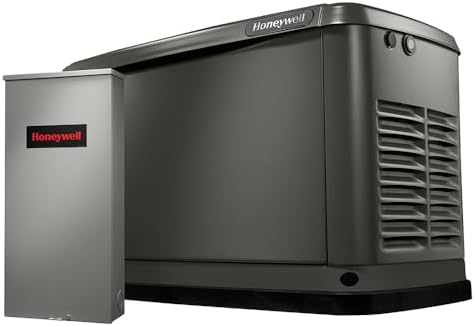
The Honeywell is the one to look at if installation hassle worries you. It comes with a composite mounting pad that sits right on soil, so you skip the concrete base. That can save time and effort compared with units that call for a poured slab, and it removes one step from site prep.
It runs on natural gas or propane, so you can match it to whatever fuel your home already has. The LCD control panel shows real-time updates in several languages, and the all-weather aluminum enclosure has enhanced locks. Its feature list is shorter than the others, and 14kW is the same output as the Generac without the cellular features. That makes it a straightforward whole-home backup, best for homes where careful load planning is acceptable.
Pros:
- Mounting pad installs on soil, no concrete needed
- Runs on natural gas or propane
- Easy-to-read LCD control panel
- Locking aluminum enclosure for harsh weather
Cons:
- No cellular or app monitoring listed
- Only 14kW, so heavy loads need planning
Verdict: A smart pick if you want dual fuel and a simpler install, and you are fine with a basic feature set.
Champion 22,000-Watt: The Highest Output for Big Homes

The Champion offers the most power here. It delivers 22,000 watts on propane and 19,800 watts on natural gas, which gives a large house more room for air conditioning, appliances and everything else running at once. Its fleX technology is meant to help manage high-demand appliances.
Installation is where it gets interesting. Power Line Carrier technology means less wiring, which can lower install costs. It also runs at a residential-friendly 67 dBA, and the 24-volt starting system works in temperatures down to -22 degrees F. The 10-year limited warranty comes with free lifetime technical support. The trade-off is that natural gas output drops a bit compared with propane, so check which fuel you will use.
Pros:
- Highest output of the group
- Lower wiring needs with Power Line Carrier technology
- Quiet 67 dBA operation and sub-zero starting
- 10-year warranty with lifetime technical support
Cons:
- Output is lower on natural gas than on propane
Verdict: Best for large homes with heavy electrical demand, especially if warranty coverage and support matter to you.
Kohler 20RESCL-200SELS: The All-In-One Air-Cooled Workhorse

The Kohler is the most complete package for a whole-house setup. It includes a 200 amp, service entrance rated automatic transfer switch with load shedding, which means fewer separate parts to buy and wire. Power reaches your home in about 10 seconds after an outage starts, and the maker describes its power quality as premium.
Its enclosure is fully corrosion-proof, built to handle even harsh seaside conditions, so it is a strong choice near the coast. It measures 48 by 26.2 by 29 inches, which helps when you are planning space. The warranty is 5 years or 2,000 hours, shorter than the Champion. It also uses a Group 51 battery, so confirm what you need to supply. Its 20kW rating sits close to the Champion but below it.
Pros:
- Includes a 200 amp service entrance rated transfer switch
- Load shedding helps manage demand
- Corrosion-proof enclosure for coastal conditions
- Starts supplying power in about 10 seconds
Cons:
- Warranty of 5 years or 2,000 hours is shorter than the Champion’s
- Needs a Group 51 battery
Verdict: A solid choice for coastal or high-humidity homes that need a switch included with the generator.
How to Choose a Standby Generator for a Large Home
Match the Output to Your Load
Start by adding up what you want running at once, such as central air, the well pump, the refrigerator, the oven and lights. Large homes often have more than one air conditioner, and those use the most power when they start. Choosing a unit with more output, like the 20kW and 22kW models here, gives you extra room. The 14kW units can still work if you plan which circuits matter most, and an electrician can run a proper load calculation.
Check the Fuel Type
Standby generators usually run on natural gas, propane or both. Natural gas comes through a utility line, so you never refuel. Propane is stored in a tank. Dual fuel models give you a choice, but output can differ by fuel, as the Champion shows. Look at which fuel your home already has before you decide.
Think About the Transfer Switch
The automatic transfer switch moves your home from utility power to generator power. Some listings include one, such as the Kohler with its 200 amp service entrance rated switch. For any other model, confirm what is and is not included before you order, since a licensed electrician must install and wire the switch.
Plan for Installation and Space
A standby unit needs a solid, level spot, and the manufacturer and local code set how far it must sit from the house, windows, doors and air intakes or vents. Exhaust contains carbon monoxide, so keep it away from openings and install CO alarms inside the home. The Honeywell includes a composite pad that goes right on soil, but the site still needs to meet code. Have a licensed electrician and a licensed plumber or gas fitter handle the hookup, and get the required permits and inspections.
Look at Noise and Weather Protection
If the generator sits near a bedroom or a neighbor, check the noise level. The Champion lists 67 dBA. Also check the enclosure. Aluminum and corrosion-proof housings help in rain, snow and salty air, which matters if you live near the coast or in a cold climate.
Compare Warranty and Support
A generator may sit unused for months and then need to work perfectly in a storm. Longer warranties and good technical support give you peace of mind. The Champion offers 10 years with lifetime technical support, while the Kohler offers 5 years or 2,000 hours.
Consider Smart Features
Remote monitoring lets you see whether the unit is ready and get maintenance alerts. The Generac has built-in cellular connectivity, though its app features need a premium subscription. If you travel or own a second home, this feature can be worth it.
Frequently Asked Questions
How big of a generator does a large home need?
It depends on what you want to run at once. Larger homes with several air conditioners and big appliances often call for the higher-output units here, while a 14kW unit can work if you choose circuits carefully. An electrician can help you size it.
Do standby generators start on their own?
Yes. They detect an outage and start automatically. The Kohler lists power reaching your home in about 10 seconds, and the Generac is described as detecting outages automatically.
Can I install a standby generator myself?
No. Hire a licensed electrician and a licensed plumber or gas fitter. The job involves electrical and gas connections, permits and inspections, and clearance from windows, doors and vents set by the manufacturer and local code. Some models, like the Honeywell and the Champion, are designed to make installation simpler, but a professional should still do the final hookups. Also install CO alarms in your home.
What fuel is best, natural gas or propane?
Natural gas is convenient if your home has a gas line. Propane works where there is no gas service. Dual fuel models like the Honeywell and the Champion let you use either. Output can change by fuel, so read the specs.
Are standby generators loud?
They make more noise than a quiet appliance, but many are designed to be neighbor-friendly. The Champion is listed at 67 dBA, and the Kohler is described as quiet. Placement also affects how much you hear inside.
Do I need a transfer switch?
Yes. A transfer switch is needed for safe operation so power does not flow back to the utility lines, and a licensed electrician should install it. The Kohler includes a 200 amp service entrance rated switch, and you should confirm what comes with any other model.
How cold can these generators run?
The Champion has a 24-volt starting system that works down to -22 degrees F. The Generac is designed for improved cold starts and snow protection. Check the details for your climate before you buy.
Final Recommendation
For most large homes, the Champion 22,000-Watt is the best pick because it offers the most power, dual fuel flexibility and a 10-year warranty. If you want remote monitoring and strong cold-weather design, go with the Generac. If you want the easiest install, the Honeywell is a good fit, and if you want an included transfer switch and a corrosion-proof enclosure, the Kohler is a dependable option. Whichever you choose, have licensed pros size it, pull permits, set the clearances and install it, and add CO alarms.