

Choosing a budget LiFePO4 battery for RV solar means balancing usable capacity, weight, charging compatibility, and cold-weather protection. The picks below range from compact 100Ah replacements to a larger 300Ah battery with self-heating. Compare the details with your RV’s battery space, solar charge controller, and power needs before you buy.
Quick Comparison
| Battery | Capacity | Notable features | Best fit |
|---|---|---|---|
| VEMDIA 12V 100Ah Group 31 Battery | 100Ah | 100A BMS; stated 24 lb weight | Basic Group 31 RV upgrades |
| Feuruetc 2-Pack 12V 100Ah Batteries | Two 100Ah batteries | Solar-focused listing; BMS protection | Building a larger bank with two batteries |
| VEMDIA 12V 100Ah Smart BMS Battery | 100Ah | Low-temperature charging cutoff; stated 24 lb weight | RV use in cooler conditions |
| VATRER POWER 12V 300Ah Battery | 300Ah | Self-heating; app monitoring; 200A BMS | Longer stays and larger power needs |
| Dumfume 12V 100Ah Group 31 Battery | 100Ah | 100A BMS; stated 21.6 lb weight | Weight-conscious RV upgrades |
Our Picks: Best budget LiFePO4 batteries for RV solar reviews
VEMDIA 12V 100Ah Group 31: A straightforward RV battery upgrade

This VEMDIA is a 12V, 100Ah LiFePO4 battery in a Group 31 format. Its listed dimensions are 12.9 by 6.69 by 8.5 inches, and the listed weight is 24 pounds. That compact size and lighter weight can make it easier to handle than a comparable lead-acid battery, though you should still measure your battery compartment before ordering.
The built-in 100A BMS is described as protecting against overcharging, over-discharging, over-current, overheating, and short circuits. The listing describes charging by a compatible lithium charger, solar charge controller, or alternator. It recommends a 14.6V, 20A charger, but your RV’s charging equipment must also be suitable for LiFePO4 chemistry.
The manufacturer lists different cycle-life figures at different depths of discharge, including 6,000 cycles at 100% DOD and 15,000 at 60% DOD. Treat those as stated specifications rather than a guarantee of service life; real results depend on use, temperature, charging, and storage. This model is a practical option if you want a single 100Ah battery and do not need a built-in low-temperature charging cutoff.
Pros:
- Group 31 format with listed dimensions for checking fit
- 100A BMS protection is built in
- Can be charged through solar, an alternator, or a compatible lithium charger
- Manufacturer lists support for series and parallel expansion
Cons:
- No low-temperature charging cutoff is specified in the supplied product details
- Confirm your charge controller and alternator setup are compatible before installation
Verdict: Choose this VEMDIA if you want a basic 100Ah Group 31 battery and can manage cold-weather charging through your RV’s system or battery location.
Feuruetc 2-Pack: Two batteries for a larger solar bank

This listing is for a two-pack of 12V, 100Ah LiFePO4 batteries. Having two batteries gives you more flexibility than buying one: you can keep them as separate batteries or use a supported configuration to build a larger bank. Check the manufacturer’s connection rules and your RV system design before wiring them together.
The product description positions these batteries for solar use and says they are compatible with solar panels in the 200W-to-400W range. It also recommends a 300W panel. Those figures are not a substitute for checking your charge controller’s limits, battery charging specifications, and expected solar conditions. The listing describes a smart BMS with protection against overcharging, overheating, and short circuits, but does not give the BMS current rating or battery dimensions in the supplied information.
This pair may suit an RV owner who already knows they need more than one 100Ah battery. The main trade-off is that the listing provides fewer details for checking fit and electrical limits than some of the single-battery options here. Confirm the measurements, BMS specifications, and permitted series or parallel arrangements with the seller before purchase.
Pros:
- Two 100Ah batteries are included
- Product is described for RV and solar-system use
- Maintenance-free LiFePO4 design
- BMS protection is included
Cons:
- Supplied details do not state battery dimensions or BMS current rating
- Verify connection limits and solar-controller compatibility before installation
Verdict: Consider this two-pack if your RV needs a larger battery bank, but confirm the missing fit and electrical specifications before committing to the setup.
VEMDIA Smart BMS 100Ah: A better fit for cooler-weather planning

This 12V, 100Ah VEMDIA battery shares a Group 31 format with the first pick, with listed dimensions of 12.9 by 6.7 by 8.5 inches and a weight of 24 pounds. Its most useful distinction is the smart BMS with automatic low-temperature charging cutoff. The product description says charging is prevented below 32°F (0°C), which can help protect the cells in cold conditions.
The battery also has a 100A BMS and is described as supporting charging with a compatible lithium charger, solar panels, or an alternator. The manufacturer lists a 14.6V, 20A charger for a roughly five-hour charge. Actual charging time will depend on the charger, battery state, and system conditions. The listing gives cycle-life estimates that vary by depth of discharge, so compare those figures on the same basis rather than treating the highest number as a standard operating expectation.
Compared with the first VEMDIA, this model’s stated cold-charge cutoff is a practical advantage for RVs used in chilly weather. It is not a self-heating battery, however; a cutoff prevents charging under the stated condition but does not warm the battery or ensure charging can continue. Check where the battery will be installed and how your charging system behaves in low temperatures.
Pros:
- Automatic charging cutoff below 32°F is specified
- Group 31 dimensions and listed 24-pound weight
- 100A smart BMS provides multiple types of protection
- Supports solar, charger, and alternator charging, according to the listing
Cons:
- Low-temperature cutoff is not the same as self-heating
- Charge time depends on the charger and system conditions
Verdict: Pick this VEMDIA over the simpler 100Ah model if you want a specified low-temperature charging cutoff for cooler-weather RV use.
VATRER POWER 300Ah: More capacity with built-in self-heating

At 300Ah, this VATRER POWER battery offers three times the stated capacity of the 100Ah options in this guide. It is aimed at RV owners who need longer stretches between charging or want to run more onboard equipment. Its BMS is listed at 200A and includes protections for high and low temperatures, along with cell balancing. An app can display battery information such as voltage, current, temperature, and fault alerts.
Its self-heating feature is designed for cold charging conditions. According to the product description, the heating function activates when a charger is connected, the charging current exceeds 10A, and the battery temperature is below 32°F. It stops heating when the battery reaches 41°F, after which normal charging resumes. That is more involved than a simple low-temperature cutoff, but it depends on the stated charging conditions. The listing recommends a 14.6V charger and describes solar charging as another option.
This is the capacity-focused choice, not the simplest small-battery replacement. The supplied details do not include its dimensions or weight, so verify that it will fit your RV and that your wiring, charger, and solar system can handle the battery. The listing also says it is not suitable for use as golf cart batteries in a series connection; that restriction is a reminder to follow the exact manual for your intended application.
Pros:
- 300Ah capacity for larger RV power needs
- Self-heating feature is described for cold charging conditions
- App monitoring includes key battery readings and fault alerts
- 200A BMS with multiple protective functions
Cons:
- Dimensions and weight are not provided in the supplied details
- Self-heating depends on the stated charger and current conditions
Verdict: Choose this VATRER POWER model if you need a high-capacity battery and want self-heating and app monitoring, after confirming fit and system compatibility.
Dumfume 100Ah Group 31: A lighter option for weight-conscious RVs
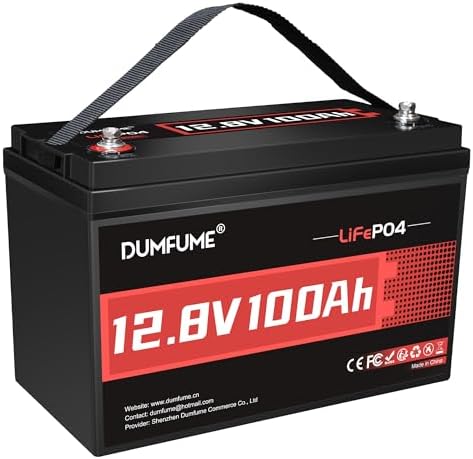
The Dumfume is a 12V, 100Ah Group 31 battery with a listed energy capacity of 1,280Wh and a stated weight of 21.6 pounds. Its lighter weight may appeal if you are replacing a heavy lead-acid battery or trying to keep your RV’s battery system easier to handle. The supplied details do not include the battery’s dimensions, so check its exact measurements against your battery compartment rather than relying on the Group 31 label alone.
A built-in 100A BMS is described as protecting against overcharging, over-discharging, short circuits, overheating, and overcurrent. The listing also gives cycle-life estimates at several depths of discharge and supports series and parallel connections up to 4S4P. Those are manufacturer specifications, and any expanded bank must follow the manual and match your system’s voltage and current requirements.
The product description specifically says not to use this battery as a starting battery, golf cart battery, or for jacks. That makes it important to keep its intended role clear: use it as a house or solar-storage battery, not to start an engine or power applications the listing excludes. The casing is described as weather-resistant but not waterproof, so it needs protection from water exposure.
Pros:
- Listed weight is 21.6 pounds
- 100Ah capacity and 1,280Wh stated energy
- 100A BMS protection is built in
- Manufacturer lists support for series and parallel expansion
Cons:
- Exact dimensions are not included in the supplied details
- Not intended for starting, golf cart, or jack use, and the case is not waterproof
Verdict: The Dumfume is a useful option if low listed weight matters and you need a 100Ah house battery, provided its dimensions and intended use suit your RV.
How to Choose a LiFePO4 Battery for RV Solar
Match capacity to how you use your RV
A 100Ah battery is a common starting point for a modest RV house bank, while a 300Ah battery is intended for greater capacity. Think about what you need to run, how long you stay away from shore power, and how often you can recharge. Capacity alone does not tell you how long a battery will run a specific appliance; inverter losses and the appliance’s power use matter too.
Check dimensions, weight, and installation space
Measure the battery compartment, including room for cables and any required clearance. Group 31 is a useful format reference, but compare the stated dimensions with your RV’s space before ordering. Also check the battery’s weight and how you will secure it. One listing here does not provide dimensions, so verify them before relying on a fit.
Confirm charging compatibility
Your solar charge controller, converter, and alternator charging setup all need to work with LiFePO4 batteries. Check the battery’s charging voltage and current requirements against your equipment, and confirm the correct battery setting or charging profile. A battery’s ability to accept solar or alternator charging does not mean every RV system is automatically compatible.
Understand BMS limits and cold-weather features
The BMS helps protect a battery, but its current rating and temperature functions differ by model. A low-temperature cutoff stops charging below a stated temperature; self-heating uses energy to warm the battery under stated conditions. These features are not interchangeable. If you camp in cold weather, check the manual for charging limits and make sure the battery can be kept within its permitted temperature range.
Plan carefully before connecting batteries together
Some of these products are described as supporting series or parallel connections, but allowed configurations vary. Follow the battery maker’s instructions for connection count, wiring, and matching batteries. Series connections raise system voltage, while parallel connections increase capacity; both require compatible equipment. Do not assume that two batteries can be connected in any configuration just because they share the same nominal voltage.
Compare cycle-life claims on the same terms
Cycle-life figures often depend on depth of discharge, temperature, and charging conditions. A higher number at a lower depth of discharge is not directly comparable to a number measured at a deeper discharge. Treat advertised cycle counts as manufacturer claims, and consider whether the warranty, instructions, and support information are clear enough for your needs.
Use the battery for its intended purpose
RV solar batteries are typically used to power house loads, not start an engine. Check the product’s stated limits before using it for a starter, golf cart, lift, jack, or other high-draw equipment. Also protect the battery from water if its enclosure is described as weather-resistant but not waterproof.
Frequently Asked Questions
Is a 100Ah LiFePO4 battery enough for an RV?
It can suit an RV with modest power needs, but the right capacity depends on your appliances, daily use, and charging access. Estimate your energy use and compare it with the battery capacity and your solar system’s expected output before deciding.
Can I connect these batteries to my RV solar panels?
The product descriptions identify solar charging as an option, but you still need a compatible solar charge controller and correct settings for LiFePO4 chemistry. Check the battery’s charging requirements and the limits of your controller before connecting it.
Can I charge a LiFePO4 battery in freezing weather?
Charging limits vary by model. The VEMDIA smart BMS listing specifies a charging cutoff below 32°F, while the VATRER POWER model describes self-heating under particular charging conditions. Follow the manual for your exact battery, and do not assume that every model has cold-weather protection.
Is a 100A BMS suitable for every RV setup?
Not necessarily. The BMS rating is one limit to consider, but your inverter, wiring, appliances, and charging equipment also have current limits. Compare the battery’s specifications with your system and ask a qualified installer if you are unsure.
Can I use an RV LiFePO4 house battery to start my engine?
Do not assume that a house battery can serve as an engine starter. One battery in this guide specifically excludes starting use, and the other listings do not establish that they are suitable for it. Use a battery designed and approved for the intended starting application.
What is the difference between low-temperature cutoff and self-heating?
A low-temperature cutoff prevents charging when the battery is too cold. Self-heating uses power from a connected charging source to warm the battery under the conditions stated by its manufacturer. A cutoff does not warm the battery, and self-heating is not guaranteed to operate outside its listed conditions.
Final Recommendation
For a straightforward 100Ah Group 31 upgrade, the VEMDIA smart BMS model stands out for its specified low-temperature charging cutoff. The Dumfume is worth considering if its listed low weight matters, while the Feuruetc two-pack may suit an RV that needs a larger bank and has room for two batteries. If you need substantially more capacity and want self-heating, the VATRER POWER 300Ah model offers the most features here, but verify its fit and charging requirements first.