

Choosing the best water filter for heavy metals starts with knowing which metals are in your water and where you want filtered water: throughout the home or mainly at the kitchen tap. The whole-house systems below use different combinations of sediment, carbon, and KDF media, but their claims and stated capacities vary. Treat those claims as a starting point, then check the product’s documentation against your water test and the contaminants you need to reduce.
Quick Comparison
| Product | Filtration highlights | Stated capacity | Best fit |
|---|---|---|---|
| iSpring Heavy Metals Whole House Filter with Clear Housing | 5-micron sediment, GAC/KDF, and CTO stages | Up to 30,000 gallons or six months | People who want a visible first-stage filter housing |
| Express Water Ultimate Protection 3-Stage System | Reusable 50-micron spin-down prefilter, plus two specialty filter stages | Up to 100,000 gallons | Homes that need a reusable prefilter for larger particles |
| iSpring PFAS & Heavy Metals Whole House System | 5-micron sediment, PFAS-focused media, and GAC/KDF | Up to 100,000 gallons or 12 months | Households looking to address PFAS as well as certain metals |
| Purcooflow 3-Stage Heavy Metal Reduction System | Sediment, KDF, and coconut-shell CTO carbon stages | — | DIY installers who value drain valves and standard-size cartridges |
| iSpring WGB32B-KS Heavy Metals Whole House System | 5-micron sediment, GAC/KDF compound filter, and CTO carbon block | Up to 100,000 gallons; stated as about a year for a family of four | Shoppers comparing a familiar three-stage layout and 15 GPM flow rate |
Our Picks: Best water filter for heavy metals reviews
iSpring Heavy Metals Whole House Filter with Clear Housing

This three-stage whole-house system combines a 5-micron polypropylene sediment filter, a GAC/KDF composite filter, and a CTO filter. The product description says the middle stage reduces lead, mercury, chlorine, chloramine, radon, and other listed contaminants. The final carbon stage is intended to reduce residual chlorine, fine impurities, tastes, and odors.
The clear first-stage housing makes it easier to see when sediment has collected, though appearance alone cannot tell you whether the other cartridges are still working as intended. The system is described as serving a family of four, with a stated capacity of up to 30,000 gallons or six months. Actual replacement timing can depend on water quality and use.
Compared with the iSpring PFAS-focused model below, this system has a lower stated capacity and does not list a dedicated PFAS filter. It may suit a household seeking whole-home sediment and chlorine treatment alongside the listed heavy-metal reduction claims. It does not reduce total dissolved solids, so it is not a substitute for reverse osmosis when TDS reduction is the goal. Check the manufacturer’s contaminant data and certification details before relying on it for a specific metal.
Pros:
- Three stages combine sediment, GAC/KDF, and CTO filtration.
- Clear first-stage housing helps you monitor visible sediment buildup.
- Product description gives a capacity and replacement interval to plan around.
- Designed for whole-home use at taps, showers, and appliances.
Cons:
- Its stated capacity is lower than several other systems in this roundup.
- Does not reduce TDS, so confirm the exact contaminant claim you need before buying.
Verdict: Consider this iSpring if visible sediment monitoring and a three-stage whole-house setup matter more to you than the higher stated capacity offered by some alternatives.
Express Water Ultimate Protection System with Reusable Prefilter

The Express Water system stands out for its reusable 50-micron spin-down sediment prefilter. That stage is designed to catch larger particles before water reaches the specialty filters, which may be useful in a home with noticeable sediment. The product description also mentions transparent sediment housing, pressure gauges, one-inch connections, and quick-change cartridges.
Express Water lists a capacity of up to 100,000 gallons and describes the system as reducing impurities, chlorine, and other unwanted substances. However, the manufacturer doesn’t identify specific heavy metals or give a metal-by-metal reduction figure. If lead, arsenic, or another particular contaminant is your main concern, confirm that the exact model has supporting test data for it before buying.
The reusable prefilter is a practical distinction from the disposable sediment cartridges used by the other picks, but it still needs maintenance. We couldn’t find a replacement interval for the other filter stages. Compared with the iSpring options, this model offers less detail about specific metal claims, so it is best approached as a whole-house filtration option rather than a guaranteed solution for a named contaminant.
Pros:
- Reusable 50-micron spin-down prefilter catches larger particles.
- Includes pressure gauges and transparent sediment housing, according to the manufacturer.
- Uses one-inch standard connections and quick-change cartridges.
- Lists capacity of up to 100,000 gallons.
Cons:
- The manufacturer doesn’t name specific heavy metals or give metal-reduction figures.
- No service interval is provided for the specialty cartridges.
Verdict: Choose this system if a reusable prefilter is your priority, but verify the manufacturer’s contaminant data before selecting it specifically for heavy-metal reduction.
iSpring PFAS and Heavy Metals Whole House System

This iSpring model adds a dedicated PFAS-focused filter to a three-stage whole-house setup. Its first stage captures sediment as small as 5 microns. The second uses a filter described as SGS-tested media targeting PFAS, including PFOA and PFOS, while the third uses KDF and GAC media to reduce listed contaminants such as lead, mercury, chlorine, chloramine, and hydrogen sulfide.
The manufacturer’s description claims up to 99% reduction for PFAS, but that figure applies to the specified PFAS claim and should not be read as a reduction rate for every contaminant. Check the test conditions and the exact model documentation to see whether they match your water and the contaminants you are targeting.
The system uses standard 20-by-4.5-inch housings and one-inch NPT ports, which may make installation and cartridge sourcing more straightforward for compatible plumbing. It lists capacity of up to 100,000 gallons or 12 months, depending on use and water conditions. Like the other whole-house picks, it does not reduce TDS. This is the most targeted choice here if PFAS is also on your list, but it has more specialized filtration than a household needs if the only issue is sediment or chlorine.
Pros:
- Combines a PFAS-focused filter with a GAC/KDF stage listing several heavy metals.
- Lists a 5-micron sediment stage and standard-size housings.
- States a capacity of up to 100,000 gallons or 12 months, depending on conditions.
- Product description identifies SGS testing for the PFAS filter media.
Cons:
- Does not reduce TDS.
- The stated PFAS reduction figure should not be assumed to apply to metals or every water condition.
Verdict: This is the strongest match in the group for households seeking a whole-house system that addresses listed heavy metals and PFAS, provided the supporting test data fits your needs.
Purcooflow Three-Stage Heavy Metal Reduction System
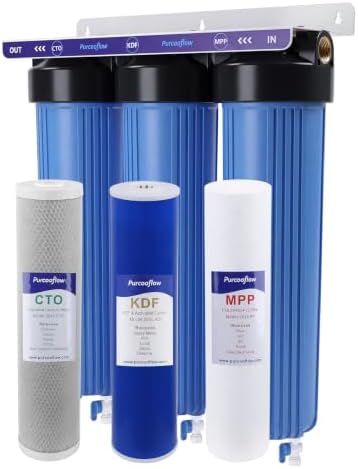
This three-stage system uses a polypropylene sediment cartridge, a KDF media filter, and a coconut-shell CTO carbon block. Its listing describes the KDF stage as targeting iron, manganese, lead, mercury, and arsenic, while the carbon stage is intended to reduce residual chlorine, tastes, and odors. These are product claims, so confirm the supporting documentation for the specific contaminants in your water.
Its design details focus on maintenance and installation. Each housing has a bottom drain valve for flushing sediment and relieving pressure, and the system has one-inch NPT brass ports. It comes with a preassembled bracket, housing wrench, mounting screws, and Teflon tape. The housings are described as fitting standard 20-by-4.5-inch cartridges, which may give you more replacement options than a proprietary cartridge setup.
A notable limitation is that we couldn’t find capacity, filter life, or flow rate figures for this system. That makes it harder to estimate ongoing upkeep or compare its performance with systems that provide those figures. It may appeal to hands-on installers, but shoppers should ask the manufacturer for contaminant-specific test information and service guidance before using it as the main defense against a known metal problem.
Pros:
- Three stages target sediment, listed metals, and chlorine-related taste and odor.
- Drain valves are designed to make housing maintenance less messy.
- Uses standard-size 20-by-4.5-inch cartridges, according to the manufacturer.
- Includes an installation kit with a bracket, wrench, screws, and tape.
Cons:
- We couldn’t find capacity, filter life, or flow rate figures for this system.
- Confirm metal-specific test data before relying on the listed reduction claims.
Verdict: Consider this system if its drain-valve design and standard cartridge size suit your installation, but get clear answers about capacity and testing first.
iSpring WGB32B-KS Whole House Heavy Metals System

The WGB32B-KS uses a familiar three-stage layout: a 5-micron sediment filter, a GAC/KDF compound filter, and a coconut-shell CTO carbon block. The product description says the middle stage reduces lead, mercury, hydrogen sulfide, pesticides, herbicides, chlorine, and other listed substances. It also states a flow rate of up to 15 gallons per minute.
The manufacturer lists capacity of up to 100,000 gallons and describes that as enough for a family of four for about a year. Actual cartridge life will depend on incoming water and household use. The description says the sediment and CTO filters meet NSF/ANSI standards, but that statement alone does not establish independent certification for reduction of every metal. Look for the exact certification and contaminant listing if you need a verified reduction claim.
This model does not reduce TDS. At the time of writing, this product was unavailable. Compared with the newer iSpring PFAS model, this one does not list a dedicated PFAS stage. It may still be worth comparing if its stated flow and three-stage design fit your requirements.
Pros:
- Three stages address sediment, listed chemical contaminants, and chlorine-related taste and odor.
- Lists a flow rate of up to 15 GPM and capacity of up to 100,000 gallons.
- Uses 20-by-4.5-inch cartridges and one-inch NPT connections.
- Product description includes installation guidance and U.S.-based technical support.
Cons:
- Does not reduce TDS, and the stated standards information does not by itself confirm metal-specific certification.
Verdict: This is a useful comparison point for its listed flow rate and capacity, but only pursue it if its documentation matches your contaminant needs.
How to Choose a Whole-House Water Filter for Heavy Metals
Start with a water test
Find out which contaminants are present before choosing a filter. A certified lab test can help identify the metals and levels in your water; private well owners should use testing suited to their water source. If your water comes from a public system, check its water quality report, but remember that a report may not describe conditions inside your home’s plumbing. A filter that targets one metal may not be the right choice for another.
Match the claim to the specific contaminant
“Heavy metals” is a broad label, not a single treatment claim. Look for documentation that names the contaminant you need to reduce, such as lead or mercury, and explains the test method and conditions. Independent certification to a relevant standard can help support a claim, but check that the exact model and contaminant are included. Do not assume that a system’s general filtration claims mean it reduces every metal.
Choose whole-house or drinking-water treatment
A whole-house filter treats water as it enters the home, which can be useful if you want filtered water at multiple taps and showers. It may not provide the same level of contaminant-specific treatment as a system designed for drinking water at a single tap. If your concern is drinking or cooking water, compare the whole-house option with a properly certified point-of-use filter, such as an under-sink system.
Check flow rate and plumbing fit
Look at the system’s stated flow rate, inlet and outlet size, and housing dimensions. A filter must fit your plumbing and provide enough flow for the home’s normal demand. The products here list different connection and housing details, and some do not provide a flow rate at all. Confirm clearance for installation and cartridge changes before ordering.
Understand capacity and replacement needs
Capacity figures and suggested replacement intervals are estimates, not guarantees for every home. Sediment levels, water chemistry, and daily use can affect cartridge life. A transparent housing can show visible sediment buildup, but it cannot measure a cartridge’s remaining ability to reduce dissolved contaminants.
Know what the system does not remove
Several systems in this group state that they do not reduce total dissolved solids. TDS is a broad measurement of dissolved substances and is not a direct test for a specific heavy metal. If you need TDS reduction or treatment beyond what a whole-house carbon and KDF system offers, ask a water-treatment professional whether reverse osmosis or another method is appropriate for your test results.
Plan for installation and upkeep
Whole-house filters connect to the main water line and may need plumbing work, shutoff access, and room to remove the housings. Review the installation instructions and warranty terms, and consider a licensed plumber if you are not comfortable modifying the plumbing. Drain valves, standard cartridge sizes, and included installation parts can make maintenance easier, but they do not replace regular cartridge changes.
Frequently Asked Questions
Can a whole-house water filter remove all heavy metals?
No single general claim proves removal of every metal. Treatment depends on the contaminant, its form and level, the filter media, and the conditions used in testing. Match the filter’s documented claims to a water test and look for supporting data for each metal you want to reduce.
Is a whole-house filter enough for lead in drinking water?
It may be part of a treatment plan, but do not assume it is enough without checking the system’s lead-specific test data and certification. Lead can also enter water through plumbing inside a home. If you have a confirmed lead concern, follow guidance from your local health department or water provider and choose treatment supported for that use.
Do these filters remove total dissolved solids?
Three iSpring systems whose supplied descriptions address TDS state that they do not reduce it. TDS is different from a test for a specific metal, so use the right test and select treatment based on the result.
What is the difference between KDF and carbon filtration?
KDF and carbon are different filter media, and products may combine them for different treatment goals. Carbon is commonly used for chlorine, taste, and odor claims, while the products here describe KDF as part of their heavy-metal and chemical filtration stages. The exact performance depends on the product design and supporting test data.
How often do whole-house filter cartridges need to be replaced?
Follow the manufacturer’s instructions for the exact system and cartridge. The products in this roundup list different capacities and intervals, and real service life can vary with water quality and household use. Visible sediment is not a reliable way to judge whether a cartridge still reduces dissolved contaminants.
Can I install a whole-house filter myself?
Some systems are designed for DIY installation and include instructions or installation parts, but they still connect to your home’s main water line. Review the required tools, pipe connections, and warranty terms. If you are unsure about plumbing work or leak prevention, hire a qualified plumber.
Which product is the best choice if I am also concerned about PFAS?
The iSpring PFAS and Heavy Metals Whole House System is the only product in this selection with a dedicated PFAS-focused filter described by the manufacturer. Check its test details for the particular PFAS and conditions you care about, and verify its separate claims for each metal.
Final Recommendation
For a whole-house system that lists both heavy-metal reduction and a dedicated PFAS stage, the iSpring PFAS & Heavy Metals model is the most targeted option in this group. If you mainly want a reusable prefilter for larger particles, consider Express Water, but confirm its metal-specific performance before buying. For any system, let your water test and the manufacturer’s contaminant-specific documentation guide the final choice.