

A fridge-friendly water filter can make tap water taste better and keep chilled water close at hand, but the right choice depends on how much water your household uses and which contaminants you want to reduce. These five options range from compact pitchers to larger dispensers, with different filter capacities and features. Check your fridge’s shelf and door clearance before choosing a model, and match its filtration claims to your water needs.
Quick Comparison
| Product | Capacity | Filter life | Notable feature | Best for |
|---|---|---|---|---|
| Waterdrop WFD-40L Water Filter Dispenser | 35 cups | Up to 200 gallons or 2 months | Sliding lid and filter-change indicator | Households that want a large dispenser |
| ZeroWater 32-Cup Water Filter Dispenser | 32 cups | — | Integrated TDS meter | People focused on reducing dissolved solids |
| PUR 30-Cup Countertop Water Filter Dispenser | 30 cups | Up to 40 gallons or 2 months | Pull-down spout | Easy pouring from a larger dispenser |
| PUR 7-Cup Water Filter Pitcher | 7 cups | Up to 40 gallons or 2 months | Filter-change light | Smaller fridges and households |
| Brita Large 10-Cup Elite Water Filter Pitcher | 10 cups | About 6 months | Elite filter reduces lead and microplastics | Everyday use with fewer filter changes |
Our Picks: Best water filter jug for fridge reviews
Waterdrop WFD-40L: A slim, high-capacity fridge dispenser

The Waterdrop WFD-40L is a large dispenser designed to store chilled filtered water in the fridge. Its 35-cup capacity includes 19 cups in the main body, so it can serve several people without constant refilling. The slim shape measures 14.37 by 5.55 by 9.95 inches; measure your refrigerator before buying, since a narrow footprint does not guarantee a fit on every shelf.
A sliding cover makes refilling easier and helps keep refrigerator odors out, while the handle and curved base make the dispenser easier to lift and move. Its filter uses carbon fiber and is rated for up to 200 gallons or two months. A replacement indicator helps you keep track of when to change it. The filter is certified to NSF/ANSI 42 and 372, and the manufacturer reports chlorine reduction of up to 97.4% in third-party testing.
This is a practical pick if you want a large supply and a faster refill routine: the manufacturer says the filter can finish filtering within five minutes. One important limitation is that this system does not lower total dissolved solids (TDS). If reducing TDS is a priority, consider a different option, such as the ZeroWater dispenser. As with any large dispenser, its capacity is useful only if it fits your fridge and is comfortable for you to refill.
Pros:
- Large 35-cup capacity for shared household use
- Slim design with a sliding refill cover
- Filter rated for up to 200 gallons or two months
- Includes a filter-change indicator
Cons:
- Does not reduce TDS
- Requires careful measurement to confirm fridge fit
Verdict: Choose the Waterdrop if you want a high-capacity fridge dispenser and do not need TDS reduction.
ZeroWater 32-Cup Dispenser: A pick for TDS reduction
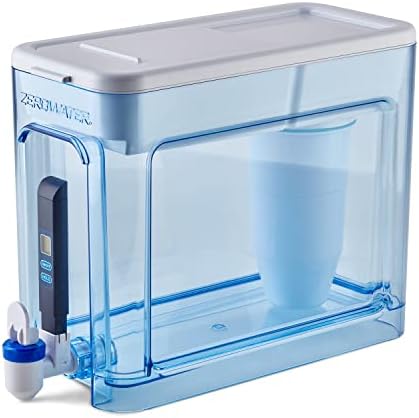
ZeroWater’s 32-cup dispenser is built for households that want more than a basic taste-and-odor filter. Its five-stage filter uses ion exchange and is designed to remove virtually all TDS. An integrated meter lets you check the dissolved-solids reading, and the manufacturer advises changing the filter when the meter reads 006.
The filter is IAPMO certified to reduce PFOA/PFOS, lead, chromium, and mercury. The dispenser is BPA-free and comes with one filter and a TDS meter. That meter is useful for tracking dissolved solids, but it is not a complete test of water safety: a low reading does not tell you whether every possible contaminant is present or absent.
This is the clearest alternative to the Waterdrop if TDS reduction is central to your choice. Its large capacity suits regular use, although the best fit depends on your refrigerator’s interior dimensions. Since the filter’s lifespan is not given here as a fixed gallon or time figure, expect to use the meter’s reading as the replacement cue rather than rely on a calendar schedule.
Pros:
- Five-stage filtration designed to reduce virtually all TDS
- Integrated meter provides a filter-change cue
- IAPMO certified to reduce PFOA/PFOS, lead, chromium, and mercury
- Large 32-cup capacity
Cons:
- Filter replacement timing is tied to the meter reading, not a stated fixed schedule
- Its larger dispenser format needs space in the fridge
Verdict: Pick ZeroWater if you want a large dispenser with a built-in TDS meter and a filter designed for broad dissolved-solids reduction.
PUR 30-Cup Dispenser: Convenient pouring for a family fridge

The PUR 30-cup dispenser offers a middle ground between a small pitcher and the largest models here. Its pull-down spout lets you pour without lifting the whole container, which can be handy when it is full. A carrying handle helps with refills, and the dispenser is dishwasher safe for easier cleaning.
The included Genuine PUR filter is rated for up to 40 gallons or two months of regular use. Its 2-in-1 filtration is IAPMO certified to reduce chlorine, mercury, copper, and zinc, which can affect taste and odor. PUR also says its genuine dispenser replacement filters are certified for this system, so check compatibility when buying replacements rather than assuming another filter will perform the same way.
Compared with Waterdrop, PUR has a smaller stated capacity and a shorter filter-life rating, but its pull-down spout gives it a distinct serving advantage. It does not have the TDS meter found on the ZeroWater model. This dispenser makes the most sense if you want a larger volume of filtered water ready to pour and prefer a built-in spout over lifting a pitcher.
Pros:
- 30-cup capacity with a pull-down spout
- Carrying handle makes refilling easier
- Dishwasher-safe design
- Filter rated for up to 40 gallons or two months
Cons:
- Filter life is shorter than the Waterdrop’s stated gallon capacity
- Replacement filters should be compatible with this specific system
Verdict: Choose the PUR dispenser if easy, spout-based pouring matters more to you than maximum capacity or TDS monitoring.
PUR 7-Cup Pitcher: A compact choice for limited fridge space

For a smaller household or a crowded refrigerator, this 7-cup PUR pitcher takes up less space than a dispenser. It has a stay-tight lid for filtering and pouring, and its fridge-friendly shape is intended to fit easily into everyday routines. The pitcher also has a filter-change light, so you do not have to track replacement timing entirely from memory.
The included Genuine PUR filter is rated for up to 40 gallons or two months. Its 2-in-1 filtration is IAPMO certified to reduce chlorine and other chemical and physical substances that may be found in tap or bottled water. Dishwasher-safe components make cleanup simpler, though you should follow the care instructions for the specific parts.
Its main trade-off is capacity: seven cups means more frequent refills than any of the larger dispensers in this roundup. But a smaller pitcher is easier to move and can be a sensible fit when refrigerator shelf space is tight. It is also a more straightforward choice than the ZeroWater model if you do not need a meter or the stated TDS-reduction focus.
Pros:
- Compact 7-cup design for smaller fridges
- Filter-change light offers a useful reminder
- Filter rated for up to 40 gallons or two months
- Dishwasher-safe components
Cons:
- Smaller capacity means more frequent refills
- Does not offer the larger serving volume of a dispenser
Verdict: Choose this PUR pitcher if you want a compact fridge filter and do not need to store a large supply at once.
Brita Large 10-Cup Elite Pitcher: Longer filter life and broad reduction claims

Brita’s 10-cup Elite pitcher is sized for everyday fridge use, with enough capacity to fill three 24-ounce reusable bottles. It measures 10.7 inches high, 5.4 inches wide, and 10.1 inches deep, making it easier to check shelf fit before you buy. The pitcher is made without BPA and has an easy-fill lid.
The included Elite filter is WQA and NSF/ANSI certified, and Brita says it reduces 99% of lead along with microplastics and other substances, including chlorine taste and odor, cadmium, mercury, benzene, and asbestos. The filter is rated for about six months, and an electronic indicator helps remind you when it is time to replace it. Elite filters work with Brita pitchers and dispensers except Stream models.
Compared with the PUR 7-cup pitcher, Brita holds more water and has a longer stated filter interval. It is still much smaller than the large dispensers, so households that go through a lot of water may need to refill it often. If your main concern is reducing a specific contaminant, confirm the filter’s certification and claims match your needs before choosing it.
Pros:
- 10-cup capacity in a fridge-friendly shape
- Elite filter rated for about six months
- Electronic indicator helps track filter changes
- Filter is certified to reduce lead and other listed substances
Cons:
- Smaller capacity than the large dispenser options
- Elite filters are not compatible with Brita Stream models
Verdict: Choose the Brita Elite if you want a mid-size pitcher, a longer stated filter interval, and certified reduction claims that fit your water concerns.
How to Choose a Water Filter Jug for Your Fridge
Measure your fridge before choosing capacity
Capacity is useful only if the jug or dispenser fits where you plan to keep it. Measure the height, width, and depth of the shelf, and leave room to remove the lid or refill the reservoir. A slim dispenser can still be too tall or too deep for your fridge. If you have limited shelf space, a compact pitcher may be easier to manage than a high-capacity model.
Match filtration claims to your water concerns
Filter systems do not all target the same substances. Some are designed to improve chlorine taste and odor, while others have claims for reducing metals or dissolved solids. Check the filter’s certification and the specific substances it is certified to reduce. If you have concerns about your tap water, use a water-quality report or test to help identify what matters for your home.
Consider the filter’s rated life and replacement cue
Filter life may be listed by time, gallons, or both. A filter-change light or meter can make replacement easier to track, but the reminder works differently from model to model. For example, the Waterdrop has a replacement indicator, the PUR pitcher has a filter-change light, and ZeroWater uses a TDS meter with a recommended change point. Check which replacement filters fit the system before you commit.
Choose a format that suits how you pour
A pitcher is easy to lift and pour, but it needs refilling more often. A larger dispenser stores more water and can reduce refill trips; a spout can make serving easier without lifting the full container. Think about who will use it, how much water your household drinks, and whether you are comfortable lifting a full jug.
Think about cleaning and everyday handling
Look for practical touches such as a secure lid, easy-fill opening, carrying handle, or dishwasher-safe parts. These features matter most when you refill and clean the jug often. Follow the care instructions for the model you choose, and make sure the design is easy for you to move in and out of the fridge.
FAQs
Which fridge water filter is best for a large household?
A dispenser is often more convenient when several people use filtered water throughout the day. The Waterdrop holds 35 cups, the ZeroWater holds 32 cups, and the PUR dispenser holds 30 cups. Measure your fridge first, since these larger models need more space than a pitcher.
Does the Waterdrop WFD-40L reduce TDS?
No. The manufacturer says this system does not lower total dissolved solids. If TDS reduction is important to you, the ZeroWater dispenser is designed to reduce virtually all TDS and includes a meter to track the reading.
How often do fridge water filters need to be changed?
It depends on the filter. The models here range from PUR filters rated for up to 40 gallons or two months to the Brita Elite filter rated for about six months. Waterdrop gives a rating of up to 200 gallons or two months, while ZeroWater recommends replacing its filter when the meter reads 006.
Can a TDS meter prove that water is safe to drink?
No. A TDS meter measures dissolved solids, but it does not identify every substance in water or confirm that water is safe. Use it as a filter-change guide for the ZeroWater system, not as a complete water-quality test.
Which option is easiest to pour from?
The PUR 30-cup dispenser has a pull-down spout, so you can pour without lifting the full container. A pitcher may be easier to lift when it is full or to move between the fridge and table, depending on your preference.
Are replacement filters interchangeable between brands?
No. Filter fit and certification depend on the system. Use a replacement filter designed for your specific pitcher or dispenser, and check compatibility before buying. PUR notes that its genuine dispenser filters are certified for its 30-cup system, while Brita Elite filters exclude Stream models.
Final Recommendation
For a large fridge dispenser with a long stated filter life, the Waterdrop WFD-40L is a strong fit as long as you do not need TDS reduction. Choose ZeroWater if reducing dissolved solids and monitoring a TDS reading are your priorities. If you prefer a smaller jug, the Brita Elite offers a useful balance of capacity and filter life, while the compact PUR pitcher suits tighter spaces. Measure your fridge and compare each filter’s certified claims with your water needs before deciding.