

For a small RV solar setup, a compact LiFePO4 battery can save space and weight while providing dependable storage for lights, fans, and other off-grid essentials. The right choice depends on more than capacity: check the battery’s dimensions, cold-weather charging protection, BMS rating, and whether its shape fits your storage compartment. These five 12V, 100Ah options include slim models for tight spaces and compact batteries with more traditional footprints.
Specifications below are based on the product information provided. Confirm the latest details and compatibility with your RV’s charger, solar controller, and inverter before buying.
Quick Comparison
| Battery | Form factor | Notable features | Best fit |
|---|---|---|---|
| ECOBOSS Slim 12V 100Ah | 2.76-inch-thin metal case; 18.9 × 11.02 inches | 100A BMS; mounting brackets | Long, shallow mounting spaces |
| ECOBOSS MINI 12V 100Ah | Group 24 size; 20.3 lb | 120A BMS; low-temperature charging protection; IP65 | Compact battery bays and cold-weather safeguards |
| GRNOE 12V 100Ah | Compact design; exact dimensions not listed | Temperature protection; stated cycle-life range | Solar storage when you can confirm fit and charging needs |
| HQST Group 22NF Mini 12V 100Ah | Group 22NF mini; 21 lb | LED meter; low- and high-temperature protection | Buyers wanting a compact battery with a built-in meter |
| Litime Slim Self-Heating 12V 100Ah | 2.44-inch-thin metal case; 19.69 × 11.02 inches | Self-heating; Bluetooth; IP65 | Shallow spaces and trips in cold conditions |
Our Picks: Best compact LiFePO4 batteries for small RV solar setups reviews
ECOBOSS Slim 12V 100Ah: A space-saving pick for shallow compartments

This ECOBOSS battery puts 100Ah of capacity in a slim metal case measuring 2.76 inches thick. Its footprint is long and wide, at 18.9 by 11.02 inches, so it may fit a shallow RV storage area where a box-shaped battery would not. Check all three dimensions against your compartment before ordering.
The listed 100A BMS is designed to protect against overcharging, over-discharging, overcurrent, short circuits, and temperature issues. The battery also comes with triangular mounting brackets for flexible installation. Its 1,280Wh capacity is in line with the other 100Ah options here, so the main advantage is its shape rather than extra energy storage.
The slim profile can be useful when you have a suitable wall or floor location, but the length and width still need room. The product information lists a 15,000-cycle figure, which is a manufacturer claim rather than a guarantee of real-world service life. As with any lithium battery, confirm mounting, charging, and wiring requirements before installation.
Pros:
- Thin profile for shallow mounting spaces
- Metal case and included mounting brackets
- 100A BMS with several listed protections
- 100Ah capacity in a 1,280Wh battery
Cons:
- Long footprint may not suit smaller battery bays
- Product information does not list a low-temperature charging cutoff
Verdict: Choose this ECOBOSS model if your main challenge is finding a shallow, secure mounting spot and its long dimensions fit your RV.
ECOBOSS MINI 12V 100Ah: A compact Group 24 battery with cold-charge protection

This ECOBOSS MINI has a more conventional Group 24 shape than the slim batteries in this guide. It measures 8.98 by 5.43 by 8.19 inches and weighs 20.3 pounds, making it a practical option when your RV has a small but box-shaped battery compartment. Its listed 1,280Wh capacity provides the same nominal energy as the other 100Ah choices here.
The 120A smart BMS is rated higher than the 100A systems listed for the two ECOBOSS slim models and the Litime slim battery. That rating may matter for a system with higher current demands, but it does not by itself confirm compatibility with your inverter. Check your equipment’s continuous and surge requirements against the battery’s full specifications.
For cold-weather use, the product information says charging stops below 32°F and resumes at 41°F. That automatic protection can help prevent charging in temperatures outside the listed range, but it is not the same as a self-heating feature. The battery is also listed as IP65 waterproof and supports series and parallel connections; follow the manufacturer’s instructions before building a larger bank.
Pros:
- Compact Group 24 dimensions and a listed weight of 20.3 lb
- 120A BMS
- Low-temperature charging protection
- IP65 rating and stated series/parallel support
Cons:
- Does not have the thin profile of the slim models
- Cold protection pauses charging rather than actively warming the battery
Verdict: This is a strong fit if your RV takes a Group 24-style battery and you want a compact case with listed cold-charge protection.
GRNOE 12V 100Ah: A basic solar-storage option with temperature protection

The GRNOE is a 12V, 100Ah LiFePO4 battery intended for energy storage, including solar systems and RV use. Its listed compact design may appeal to a space-conscious owner, but the supplied product information does not give exact dimensions or weight. Get those measurements before buying if your RV compartment has tight limits.
The manufacturer describes temperature protection and gives different cycle-life figures at different depths of discharge: 4,000 cycles at 100% depth of discharge, 6,000 or more at 80%, and 15,000 or more at 60%. Those figures are useful for comparing the stated claims, but they depend on operating conditions and should not be read as a promise of a particular lifespan.
One important setup note is that some units may arrive in a protected state and need activation with a 14.6V LiFePO4 charger that supports activation. The product information warns against standard lead-acid or automotive chargers and chargers with repair or desulfation modes. That makes it especially important to confirm your RV charging equipment is suitable. The listing also says not to use this battery as a starting battery, golf cart battery, or jack battery.
Pros:
- 100Ah capacity intended for energy storage and solar use
- Temperature protection is listed
- Cycle-life claims are provided for several discharge levels
- Product information specifies a 36-month warranty period
Cons:
- Exact dimensions and weight are not provided in the supplied details
- Some units may require a compatible activation charger before use
Verdict: Consider the GRNOE if its confirmed dimensions fit and your charging system meets its stated requirements; skip it if you need a straightforward drop-in choice without checking those details.
HQST Group 22NF Mini 12V 100Ah: A compact option with an LED meter
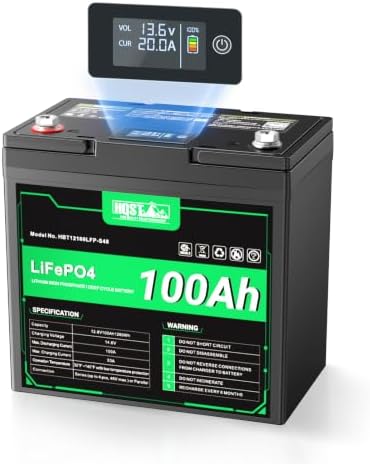
HQST’s Group 22NF Mini battery offers 100Ah and 1,280Wh in a listed 21-pound package. Its Group 22NF format can work well when a full-size battery is too bulky, though the group label alone is not enough to confirm fit. Compare the actual product dimensions with your RV’s battery space and mounting setup.
An integrated LED meter gives you a direct way to check battery information at the unit. The BMS is described as managing cell balance and protecting against overcurrent, overcharging, over-discharging, and short circuits. HQST lists 100A continuous discharge, which is worth checking against the loads you plan to run.
This model includes both low- and high-temperature protection. Charging is listed as stopping below 23°F or above 140°F, while discharging stops below 5°F or above 158°F. These safeguards are useful details for owners who camp in changing weather, but they do not heat the battery. The stated cycle life is 4,000 or more cycles, lower than some competing manufacturer claims in this group.
Pros:
- Group 22NF Mini form factor and listed 21 lb weight
- Built-in LED meter
- Temperature limits are given for charging and discharging
- Supports stated series and parallel configurations
Cons:
- No self-heating feature is listed
- Its stated cycle count is more modest than the highest claims in this roundup
Verdict: Pick the HQST if you want a compact battery with an onboard meter and clearly stated temperature cutoffs, and its dimensions match your compartment.
Litime Slim Self-Heating 12V 100Ah: A thin battery for cold-weather trips

The Litime battery has the thinnest listed profile in this roundup at 2.44 inches, with a footprint of 19.69 by 11.02 inches. Its metal case and mounting brackets are designed for wall or floor installation, making it a useful option when a normal battery box will not fit. Its long footprint still needs careful measuring.
The standout feature is self-heating. The product information says heating can start when the battery has at least 20% state of charge without a charger, or with a 10A-or-higher charger without draining the battery. That may be useful during cold trips, but check the manufacturer’s instructions for the exact conditions and charging setup needed.
Bluetooth monitoring lets you check state of charge, voltage, and charging status from a phone. The 100A BMS and IP65 rating add protection features, while the listed cycle-life figure is up to 15,000 cycles. These are product claims, not a guarantee of how long a battery will last in a specific RV. Compared with the ECOBOSS slim option, Litime is thinner and adds self-heating and Bluetooth, but it still needs a long, broad mounting surface.
Pros:
- Thinnest listed profile in this group at 2.44 inches
- Self-heating options for cold-weather charging situations
- Bluetooth monitoring for state of charge, voltage, and charging status
- Metal case, mounting brackets, and IP65 rating
Cons:
- Long footprint may not fit narrow battery compartments
- Heating conditions and charger requirements need attention
Verdict: The Litime is the best match here if you need a very thin battery and value built-in heating and phone monitoring for cold-weather RV use.
How to Choose a Compact LiFePO4 Battery for a Small RV Solar Setup
Measure the battery space, not just the old battery
Measure the available length, width, and height, then leave room for cables, terminals, mounting hardware, and safe access. A slim battery can be thin but still too long or wide for a particular compartment. Also check how the manufacturer allows the battery to be mounted; do not assume every model can be installed in any position.
Match capacity to the energy you use
Each battery in this roundup is rated at 100Ah, with 1,280Wh listed for several models. Capacity helps estimate how much energy is stored, but your actual runtime depends on your appliances and how often you use them. Make a list of the devices you plan to run and their typical use before deciding whether one battery is enough.
Check BMS and inverter requirements
The BMS helps protect the battery, but its current rating is not the same as a guarantee that it will work with every inverter or appliance. Compare the battery’s continuous discharge rating and your inverter’s continuous and surge demands. Also check whether your RV system requires a particular battery configuration or communication feature.
Plan for cold-weather charging
LiFePO4 batteries have specific temperature limits for charging. Some models stop charging below a stated temperature, while the Litime includes a self-heating feature with its own operating conditions. If you camp in cold weather, compare the listed protection details and confirm how the battery should be charged and stored in low temperatures.
Make sure your charging equipment is compatible
Check the battery maker’s instructions for your solar charge controller, converter, and any other charging source. The GRNOE product information specifically warns against standard lead-acid chargers and repair or desulfation modes, and notes that some units may need a compatible activation charger. Do not assume an existing charger is suitable just because it worked with a lead-acid battery.
Consider monitoring and installation needs
An onboard LED meter or Bluetooth connection can make it easier to check battery status, but monitoring features do not replace correct system sizing. Think about whether you can mount the battery securely, keep its connections accessible, and protect it from conditions outside its stated limits. Follow the product instructions for wiring, fusing, and any series or parallel connections.
Compare cycle-life claims with the warranty and terms
Cycle-life figures are manufacturer claims and can vary with depth of discharge, temperature, charging, and other conditions. Compare the stated warranty and service terms as well as the cycle figure, and read the complete product details before purchase. A larger number alone does not tell you how a battery will perform in your specific RV.
Frequently Asked Questions
Is a 100Ah LiFePO4 battery enough for a small RV?
It depends on what you power and how long you use it. A 100Ah battery may suit a modest setup, but high-draw appliances or extended use can require more storage. Estimate your daily energy needs before choosing one battery or planning an expandable system.
Which battery here is the thinnest?
The Litime Slim Self-Heating model has the thinnest listed profile at 2.44 inches. The ECOBOSS slim battery is 2.76 inches thick. Compare their full footprints with your available mounting area, since both are long and wide compared with box-shaped options.
Do all of these batteries heat themselves in cold weather?
No. The Litime model lists self-heating. The ECOBOSS MINI and HQST list temperature protection that can pause charging in certain conditions, while the supplied details for the other models describe temperature protection without listing a self-heating function. Check the current manufacturer specifications for details.
Can I use my RV’s lead-acid charger with a LiFePO4 battery?
Do not assume it is compatible. Check the battery and charger instructions before connecting them. The GRNOE product information specifically cautions against standard lead-acid and automotive chargers and chargers with repair or desulfation modes.
Can I connect two of these batteries together?
Some models list support for series or parallel connections, but that does not mean every battery can be mixed with any other battery. Follow the manufacturer’s instructions, including requirements for matching batteries and system limits, before connecting a bank.
What is the difference between a slim battery and a mini battery?
A slim battery is shaped for shallow spaces and usually has a long, flat case. A mini battery is closer to a small box-shaped battery and may suit a standard-style battery bay. The best shape depends on your compartment, mounting options, and cable clearance.
Final Recommendation
For the widest mix of compact features, the Litime Slim Self-Heating battery stands out with its thin profile, self-heating, and Bluetooth monitoring. If your RV has a Group 24-style battery compartment, the ECOBOSS MINI offers a compact shape, 120A BMS, and listed low-temperature charging protection. For any model, measure carefully and confirm that your RV’s charging equipment and electrical loads are compatible before buying.