

For RV solar, the best-value LiFePO4 battery is not always the one with the biggest capacity or the longest advertised cycle life. You also need to match the battery to your solar charge controller, inverter, available space, and travel habits. These five options range from compact 100Ah batteries to a much larger LiTime setup, with features such as Bluetooth monitoring, low-temperature protection, and expandable configurations. Compare the details carefully—especially bundle capacity and charging limits—before choosing.
Quick Comparison
| Battery | Capacity and format | Standout feature | Best suited for |
|---|---|---|---|
| BUKNUWO 12V 100Ah Bluetooth Battery | 12.8V, 100Ah | Bluetooth monitoring and 100A BMS | RV owners who want battery status on a phone |
| Feuruetc 2-Pack 12V 100Ah Solar Batteries | Two 12V, 100Ah batteries | Bundle designed for solar applications | Shoppers planning a two-battery setup |
| LiTime 12V 460Ah Group 8D Battery | Large-capacity, Group 8D; listed as a 2-pack | 250A BMS and high stated energy capacity | High-demand RV or off-grid systems |
| VEMDIA 12V 100Ah Group 31 Battery | 12V, 100Ah | Group 31 format and 100A BMS | Lead-acid replacements in compatible spaces |
| VEMDIA 12V 100Ah Smart BMS Battery | 12V, 100Ah, Group 31 | Smart BMS with low-temperature charging cutoff | RV owners who want added cold-weather protection |
Our Picks: Best value LiFePO4 batteries for RV solar reviews
BUKNUWO 12V 100Ah: Best for Bluetooth Monitoring

The BUKNUWO is a 12.8V, 100Ah battery with a built-in 100A BMS and Bluetooth 5.0 monitoring. Its companion app is described as showing charge level, voltage, current, temperature, and protection status within a stated range of about 33 feet. That can make it easier to keep an eye on the battery without relying only on a separate monitor.
The manufacturer lists the battery at 22 pounds and says it supports up to 4S4P connections. Those features make it a flexible option for an RV owner building a modest system now and considering expansion later. The listed cycle-life figures vary by depth of discharge, so treat the longest figure as a condition-specific claim, not a guarantee of service life.
One important limitation is the 100A BMS: your inverter and other loads must stay within the battery’s discharge capability. The product description also gives a charging temperature range, including a lower charging limit of 32°F. Check that your solar controller and installation plan prevent charging below that temperature.
Pros:
- Bluetooth app provides several useful battery readings.
- Relatively light at a stated 22 pounds.
- 100A BMS includes multiple listed protections.
- Supports series and parallel expansion, subject to setup requirements.
Cons:
- 100A discharge limit may not suit high-draw inverter loads.
- Bluetooth monitoring has a stated short-range connection.
Verdict: Choose the BUKNUWO if phone-based monitoring and a lighter 100Ah battery matter more to you than a larger built-in capacity.
Feuruetc 2-Pack: Best for a Planned Two-Battery Solar Bank

This Feuruetc listing is for a two-pack of 12V, 100Ah LiFePO4 batteries, aimed at solar, off-grid, RV, and marine use. Buying a matched bundle can be convenient when you already know you need more than one battery. The product details describe use with solar panels in the 200W-to-400W range and recommend about 300W, but panel wattage alone does not confirm compatibility with your system.
The listing highlights deep-cycle use, low maintenance, and a built-in BMS with protection against overcharging, overheating, and short circuits. It also claims more than 15,000 cycles, but does not specify the conditions behind that figure in the supplied product information. For a fair comparison, look for the manufacturer’s cycle-life rating at a stated depth of discharge.
Before buying, confirm the bundle’s exact wiring arrangement, whether the two batteries may be connected in parallel in your intended setup, and the BMS current limit. Those details matter for inverter use and charging. The supplied description does not give a precise battery weight, dimensions, or BMS amperage, so check the listing and fit those details against your RV’s battery compartment.
Pros:
- Two 100Ah batteries are included in the listed bundle.
- Designed and marketed for solar and off-grid applications.
- Built-in BMS is described as providing several basic protections.
- Maintenance-free lithium chemistry avoids routine acid checks.
Cons:
- Supplied details do not state the BMS current rating or battery dimensions.
- Confirm connection rules and cycle-life test conditions before relying on the headline claims.
Verdict: The Feuruetc two-pack is worth considering if you want a bundled pair for a solar bank, provided its current limits, connection guidance, and physical fit work for your RV.
LiTime 460Ah Group 8D: Best for High-Capacity Power Needs
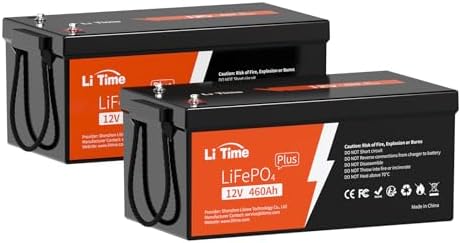
The LiTime option is aimed at systems that need far more stored energy than a typical single 100Ah battery can provide. Its title describes a 12V, 460Ah Group 8D battery in a two-pack, while the supplied product details state 5.8kWh and refer to 460Ah capacity. Because those figures do not make the pack configuration fully clear, verify whether 460Ah and 5.8kWh refer to each unit or the complete bundle before ordering.
The product details list EV-grade cells, a 250A BMS, 100% depth-of-discharge use, and expansion up to 4P4S. The claimed high capacity could suit an RV with demanding loads or a longer off-grid stay, but the physical size and weight of a Group 8D format are important practical considerations. Confirm that your battery compartment, wiring, and charging equipment can handle the selected configuration.
This battery stands apart from the other picks in scale and likely system role. It may be excessive for an RV that mainly runs lights, fans, and small electronics, while the BUKNUWO and VEMDIA 100Ah options are more straightforward for a smaller bank. The listing also notes that a large order may arrive in multiple packages, so plan for delivery and installation accordingly.
Pros:
- Large stated capacity for higher-demand or longer-duration use.
- 250A BMS is specified in the supplied product details.
- Expandable configuration is listed for growing systems.
- Designed for RV, marine, home solar, and other off-grid uses.
Cons:
- Capacity and two-pack configuration should be confirmed before purchase.
- May be more battery than a smaller RV solar setup needs.
Verdict: Consider the LiTime for a high-capacity system, but only after confirming the actual pack capacity, physical fit, and compatibility with your RV’s charging and inverter equipment.
VEMDIA Group 31 100Ah: Best for a Compact Drop-In-Style Fit

This VEMDIA battery offers 12V, 100Ah capacity in a Group 31 case. The stated dimensions are 12.9 by 6.69 by 8.5 inches, and the listed weight is 24 pounds. That format may help when replacing a compatible battery in an existing compartment, though you should measure the space and check terminal placement before assuming it is a direct fit.
A built-in 100A BMS is described as protecting against overcharging, over-discharging, overcurrent, overheating, and short circuits. The listing says it can be charged with a suitable lithium charger, solar with a controller, or an alternator. For an RV solar installation, the controller must support the battery’s charging requirements; a solar panel by itself is not a battery charger.
The product description gives different cycle-life figures at different depths of discharge, so compare those conditions rather than relying only on the largest number. It also lists series and parallel expansion, with stated limits, but any multi-battery bank should follow the manufacturer’s wiring instructions and use compatible batteries.
Pros:
- Group 31 dimensions are provided for fit checks.
- Stated 24-pound weight is lighter than many lead-acid alternatives.
- 100A BMS includes several listed protection functions.
- Supports solar charging with a compatible controller.
Cons:
- 100A BMS may limit the size of loads you can run at once.
- Cycle-life claims vary by depth of discharge.
Verdict: The VEMDIA Group 31 is a practical candidate when you need a 100Ah battery with stated dimensions and a familiar battery-box format.
VEMDIA Smart BMS 100Ah: Best for Cold-Charging Protection

This VEMDIA model is another 12V, 100Ah Group 31 battery, with stated dimensions of 12.9 by 6.7 by 8.5 inches and a weight of 24 pounds. Its key distinction is a smart BMS with automatic low-temperature charging cutoff. The supplied details say it prevents charging below 32°F, which is useful protection if the battery may encounter freezing conditions.
The listing describes a 100A BMS, several electrical protections, and expansion up to 4S4P. It also gives charging examples, including a recommended 14.6V, 20A charger, and says solar charging is supported. Treat these as product-specific guidance and confirm that your solar controller and alternator charging setup use settings suitable for LiFePO4.
As with the other 100Ah choices, the BMS current limit matters when choosing an inverter or running several appliances at once. The long cycle-life claims depend on depth of discharge, and actual battery life will also depend on how the system is charged and used. Compared with the BUKNUWO, this model emphasizes cold-charge cutoff rather than phone monitoring.
Pros:
- Automatic cutoff is listed for charging below 32°F.
- Group 31 size and dimensions are provided.
- 100A smart BMS includes multiple protection features.
- Stated support for solar, charger, and alternator charging.
Cons:
- Does not list Bluetooth monitoring in the supplied details.
- 100A BMS may not suit high-power loads or large inverters.
Verdict: Pick this VEMDIA model if cold-weather charging protection is a priority and a 100Ah Group 31 battery matches your system.
How to Choose a LiFePO4 Battery for RV Solar
Match capacity to your daily energy use
Start by listing the devices you expect to run and how long you will use them. A 100Ah battery can be a fit for lighter needs, while longer stays or higher-power appliances may call for a larger bank. Remember that the battery’s capacity is only one part of the system: your solar panels and charging sources need to replace the energy you use.
Check the BMS current limit against your loads
The battery management system (BMS) protects the cells, but it also sets limits for charging and discharging. Compare the stated continuous current limit with the demands of your inverter and appliances. A battery with a 100A BMS may not support every high-draw load, even if its capacity in amp-hours seems sufficient.
Confirm charging equipment compatibility
Your solar charge controller must support LiFePO4 charging and use settings that match the battery maker’s instructions. If your RV charges from an alternator, check whether the charging system is suitable for the lithium battery as well. Avoid assuming that equipment designed for lead-acid batteries will automatically charge a LiFePO4 battery correctly.
Plan for cold temperatures
Charging limits can be especially important in cold weather. Some batteries include a low-temperature charging cutoff, while others specify a minimum charging temperature without describing the same protection. Check the exact battery specifications and consider where the battery will sit in the RV. A cutoff feature is not a substitute for reading the manufacturer’s temperature guidance.
Measure the compartment and check the terminals
Compare the battery’s listed length, width, and height with the available space, and allow room for cables and secure mounting. Group size can help with an initial fit check, but it does not guarantee that every battery will match your existing box or terminal layout. Also consider the battery’s weight and how you will safely install it.
Understand series and parallel limits
Parallel connections increase the capacity of a battery bank; series connections increase its voltage. Not every battery supports both arrangements, and the number of batteries allowed varies by product. Follow the manufacturer’s instructions, use compatible batteries, and confirm that your inverter and charge controller match the bank’s final voltage.
Compare cycle-life claims on equal terms
Cycle-life numbers depend on how deeply a battery is discharged during each cycle. A claim at 60% depth of discharge is not directly comparable with one at 100%. Look for the depth-of-discharge condition and other stated limits, and treat long-term life figures as manufacturer claims rather than a promise of a particular lifespan.
Frequently Asked Questions
Is LiFePO4 a good choice for RV solar?
It can be a good choice for RV solar because these batteries are designed for repeated charging and discharging and do not require routine acid maintenance. You still need to confirm compatibility with your solar controller, alternator charging setup, and inverter.
How much capacity do I need for an RV?
It depends on the devices you use, how long you use them, and how often you can recharge. Estimate your daily energy needs first, then choose battery capacity and solar input that can support your travel pattern.
Can I charge these batteries with RV solar panels?
The listed products are described as suitable for solar use, but the panels must connect through a compatible charge controller. Check the battery’s charging voltage and temperature limits along with the controller’s supported battery settings.
Can I connect two 12V batteries together?
Some models support parallel or series connections, but the allowed arrangement and maximum number of batteries differ. Follow the specific manufacturer’s instructions and confirm your RV equipment is compatible with the resulting voltage and capacity.
What does a 100A BMS mean for my RV?
It is a limit to consider when matching the battery to your electrical loads. If the combined draw exceeds the BMS rating, the battery may shut down or be unable to support the load. Check the current needs of your inverter and appliances before buying.
Can I charge a LiFePO4 battery when it is freezing outside?
Charging temperature limits vary by battery. The VEMDIA smart BMS model in this list describes a cutoff below 32°F, while the BUKNUWO lists an optimal charging range starting at 32°F. Check the exact instructions for your chosen model and how it is installed.
Final Recommendation
For many RV solar setups, a 100Ah battery is a sensible starting point, and the best pick depends on the feature you value most. The BUKNUWO stands out for Bluetooth monitoring, the VEMDIA smart BMS model lists a low-temperature charging cutoff, and the Feuruetc bundle offers two batteries for shoppers planning a larger bank. If you need much more capacity, the LiTime may be worth investigating—but verify its stated capacity and two-pack configuration before you buy. In every case, match the battery’s BMS, charging limits, and physical size to your RV system.