

For RV camping with a refrigerator, cooking gear, or other high-draw appliances, a small battery pack may not be enough. The heavy-duty solar generators below pair large batteries with 3,072Wh to 3,840Wh of storage and 3,600W AC output, giving you more room to run several devices at once. The right choice depends on your RV’s power connection, the appliances you plan to use, and how you’ll recharge between stops.
Capacity is not the same as runtime: actual results depend on the devices connected, their power draw, and conversion losses. Before buying, check both the running and startup wattage of your appliances, and confirm how the power station connects to your RV.
Quick Comparison
| Power station | Battery capacity | AC output | Standout RV detail |
|---|---|---|---|
| SolarPlay Q3600 | 3,840Wh | 3,600W; 5,500W surge | Includes a 400W solar panel and a NEMA TT-30 outlet |
| EcoFlow DELTA Pro | 3,600Wh | 3,600W | Expandable capacity; multiple charging options |
| Jackery HomePower 3600 Plus | 3,584Wh | 3,600W | Expandable capacity and a wheeled design |
| Pecron F3000LFP | 3,072Wh | 3,600W | Up to 1,600W solar input and app control |
| Jackery HomePower 3000 | 3,072Wh | 3,600W; 7,200W surge | Built-in TT-30 RV port |
Our Picks: Best heavy duty solar generators for RV camping reviews
SolarPlay Q3600: Large capacity with a TT-30 outlet and included panel

The SolarPlay Q3600 stands out for its 3,840Wh LiFePO4 battery, 3,600W continuous AC output, and 5,500W surge rating. It also includes a NEMA TT-30 outlet, which may simplify connection for an RV with a compatible inlet. Always confirm your RV’s electrical requirements and use a suitable connection; the outlet alone does not guarantee compatibility with every setup.
This is the only option here that comes with a 400W solar panel. The power station supports up to 2,000W of solar input, but reaching that maximum requires a compatible solar setup beyond what the included panel provides. The unit also has wheels and a telescoping handle, though its listed weight is 93.7 pounds, so plan where it will ride and how you’ll move it at camp.
Its 17-port layout includes four AC outlets, USB-A and USB-C ports, DC outputs, and the TT-30 outlet. The manufacturer also lists a UPS mode with a switching time of 20 milliseconds or less. That can be useful for supported electronics, but it is not a substitute for checking the power needs and safety requirements of medical equipment.
Pros:
- Highest listed battery capacity in this group.
- Includes a 400W solar panel and a NEMA TT-30 outlet.
- Supports up to 2,000W solar input for a larger compatible array.
- Wheels and a telescoping handle help with moving the unit.
Cons:
- At 93.7 pounds, it is heavy to lift into or out of an RV.
- The included 400W panel is well below the unit’s maximum solar input.
Verdict: Choose the SolarPlay Q3600 if you want the largest battery here, an included panel, and a TT-30 outlet, and you have a plan for handling its weight.
EcoFlow DELTA Pro: Expandable storage for longer off-grid stays

The EcoFlow DELTA Pro offers 3,600Wh of storage and 3,600W of AC output. Its listed capacity can expand from 3.6kWh to as much as 25kWh with compatible extra batteries or Smart Generators. That makes it an option for RV owners who may want to add storage over time, though expansion means additional equipment and a larger overall setup.
Charging choices include wall power, solar, a car outlet, an EV charging station, and a compatible Smart Generator. EcoFlow lists a full recharge time of 2.7 hours from an 1,800W wall outlet, 1.8 hours from a 240V outlet, or 2.8 hours using four 400W solar panels. Those figures depend on the charging source and setup; the four-panel example requires separate compatible panels.
The DELTA Pro has 15 output methods, including five AC outlets, USB-A, two 100W USB-C ports, DC outlets, a car outlet, and an Anderson port. It does not list a TT-30 outlet in the supplied specifications, so check how you will connect your particular RV before choosing it. App control over Wi-Fi or Bluetooth lets you monitor power and adjust settings.
Pros:
- Expandable capacity for users who need more storage later.
- Multiple charging methods, including solar and EV station charging.
- Five AC outlets and a range of USB and DC connections.
- App control for monitoring power and settings.
Cons:
- Solar recharge figures rely on a multi-panel setup, which is not listed as included.
- A TT-30 outlet is not listed, so RV connection needs extra checking.
Verdict: The DELTA Pro is a strong fit if expandable storage and flexible charging matter more to you than having a built-in TT-30 outlet.
Jackery HomePower 3600 Plus: High output with room to expand
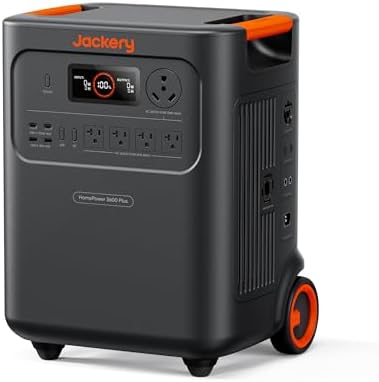
The Jackery HomePower 3600 Plus combines a 3,584Wh LFP battery with 3,600W of AC output. Its capacity can expand to 21kWh per unit, with a larger possible total when multiple units are paired. For an RV owner, that expansion could suit a longer trip or a high-energy setup, but it is more than many weekend campers need.
Jackery lists four charging options: AC, solar, a gas generator, and hybrid AC-plus-DC charging. The listed full-charge times are four hours by solar, two and a half hours by AC, and two hours with hybrid AC-plus-DC charging. The product description does not specify an included solar panel, so confirm what is in the package before planning around solar recharging.
The station has a luggage-style design with wheels and a telescoping handle. Jackery describes it as the lightest 3.6kWh LFP power station, but the supplied specifications do not give a weight. It offers 3,600W output and can reach 7,200W in parallel; confirm the required equipment and connection details before relying on parallel operation or using it with an RV.
Pros:
- 3,584Wh capacity with 3,600W AC output.
- Expandable capacity for a larger energy setup.
- Multiple charging methods, including hybrid AC-plus-DC charging.
- Wheels and a telescoping handle make it easier to roll.
Cons:
- A TT-30 outlet is not listed in the supplied specifications.
- The listed solar charging time does not state that panels are included.
Verdict: Consider the HomePower 3600 Plus if you want a large expandable battery and a wheeled design, and are comfortable confirming RV connection details separately.
Pecron F3000LFP: Fast AC charging and strong solar input

The Pecron F3000LFP has a 3,072Wh LiFePO4 battery and 3,600W pure sine wave output. It can power up to 13 devices at once through six AC outlets, USB-C and USB-A ports, a car port, and DC outputs. Its solar input supports up to 1,600W, while AC charging is listed at up to 1,800W with a stated full-charge time of two hours.
For an RV setup, the combination of AC, solar, and car charging gives you several ways to replenish the battery. The product description does not list a TT-30 outlet, though, so check whether its available outputs work with your RV or whether you need an appropriate connection accessory. It also offers app monitoring and a UPS mode listed with an 8-to-20-millisecond switch time.
The listing states that this model is unavailable at the time represented by the supplied product information. Availability can change, so check the listing before planning a purchase. Also note that connecting the F3000LFP to the specified extra battery requires a separate XT120-M cascade cable.
Pros:
- 3,600W output and 3,072Wh LiFePO4 capacity.
- Supports up to 1,600W solar input.
- Six AC outlets and 13-device simultaneous output claim.
- App monitoring and UPS mode are included in the listed features.
Cons:
- A TT-30 outlet is not listed, so RV connection may need extra planning.
- The supplied product information lists the model as unavailable.
Verdict: The F3000LFP could suit campers who value fast charging and substantial solar input, but confirm availability and RV compatibility before choosing it.
Jackery HomePower 3000: A built-in TT-30 port for RV connections

The Jackery HomePower 3000 is a 3,072Wh power station with 3,600W AC output and a listed 7,200W surge rating. Its built-in TT-30 RV port is a key distinction for campers whose RV inlet matches that connection. Confirm your RV’s electrical specifications before use, and do not assume a port makes every appliance or RV configuration compatible.
It has AC, USB-C, USB-A, and DC outputs, including two 100W USB-C ports. Jackery lists a full recharge time of two hours and 12 minutes by AC, or one hour and 42 minutes with hybrid AC and DC charging. For solar, the company lists up to 80% charge in nine hours when paired with two SolarSaga 200W panels; the description does not say those panels are included.
The HomePower 3000 is also described as smaller and lighter than comparable models of the same capacity, though the supplied details do not state its weight. A listed UPS switch time of 20 milliseconds or less may help keep suitable essential devices running during a power interruption. For camping, its capacity is lower than the SolarPlay, EcoFlow, and HomePower 3600 Plus, so compare your expected energy use rather than relying on output wattage alone.
Pros:
- Built-in TT-30 RV port.
- 3,600W AC output with a 7,200W surge rating.
- LiFePO4 battery listed for 4,000 cycles while retaining 70% capacity.
- Fast AC and hybrid AC-plus-DC charging options.
Cons:
- Its 3,072Wh capacity is lower than the other three available models listed here.
- The listed solar charging example requires separate compatible panels.
Verdict: Pick the HomePower 3000 if a built-in TT-30 port is a priority and its 3,072Wh capacity matches your planned RV power use.
How to Choose a Heavy-Duty Solar Generator for RV Camping
Match battery capacity to your trip
Battery capacity, measured in watt-hours, indicates how much energy a power station stores. A larger number can support more energy use between charges, but it does not guarantee a set runtime. Make a list of the appliances and devices you expect to run, then consider how often and for how long you’ll use each one. A refrigerator, lights, phones, and a high-draw appliance can place very different demands on the battery.
Check running and startup wattage
Output wattage describes how much power a station can deliver at once. Motors and compressors may draw more power when they start than they use while running. Compare each appliance’s running and startup needs with the station’s continuous and surge ratings. Do not assume that a large battery can compensate for an appliance that exceeds the inverter’s output limit.
Confirm your RV connection
A TT-30 outlet can be convenient if your RV uses a compatible connection, as found on the SolarPlay Q3600 and Jackery HomePower 3000 in this group. The other listings do not specify a TT-30 outlet. Check your RV’s electrical setup and the power station’s available ports before buying, and use only a suitable connection method.
Plan how you will recharge
Solar input limits vary by model, and fast solar charging may require several compatible panels. The SolarPlay includes one 400W panel, while the other product descriptions list solar charging options without stating that panels are included. If you expect to stay off-grid, compare the station’s solar input limit with the panels you can carry and the charging time you can reasonably plan for. AC, car, or generator charging may also matter between sunny periods.
Think about weight and storage space
These are large-capacity power stations, so account for storage space and how you will move the unit from your vehicle to camp. The SolarPlay’s listed weight is 93.7 pounds, even though it has wheels and a telescoping handle. Some other models also have wheels or a luggage-style handle, but their supplied details do not provide weights. Check the current product specifications before deciding whether a unit is practical for your RV.
Consider expansion and extra equipment
If your power needs may grow, compare expansion options before you buy. The EcoFlow DELTA Pro lists expansion up to 25kWh, while the Jackery HomePower 3600 Plus lists expansion up to 21kWh per unit. Expansion can add cost, space needs, and compatible accessories, so it is worth considering only if you expect to use the extra capacity.
Use safety and support details as part of the comparison
Look at the battery chemistry, listed protections, warranty information, and any special connection requirements. For example, the SolarPlay description lists LiFePO4 chemistry and safety protections, while the Pecron description says its extra battery needs a separate cascade cable. Follow the manufacturer’s instructions, keep the power station within its stated operating limits, and check the latest documentation for details that matter to your setup.
Frequently Asked Questions
Can a 3,600W power station run an RV air conditioner?
It depends on the air conditioner’s running and startup wattage and how it is connected. Compare those figures with the power station’s continuous output and surge rating. Also consider how quickly the appliance will use the stored energy; output capacity alone does not tell you how long it can run.
Which option has a built-in TT-30 outlet?
The SolarPlay Q3600 and Jackery HomePower 3000 list a NEMA TT-30 or TT-30 RV outlet. The supplied descriptions for the EcoFlow DELTA Pro, Jackery HomePower 3600 Plus, and Pecron F3000LFP do not list one. Check your RV’s connection and the manufacturer’s instructions before buying.
Does every power station here include solar panels?
No. The SolarPlay Q3600 description includes a 400W solar panel. The other product descriptions provide solar charging information but do not state that panels are included. Check the listing details to confirm what comes in the package.
Will a 3,000Wh power station run my RV for a full day?
There is no single runtime for every RV. It depends on the total power draw, how long devices run, and conversion losses. High-draw appliances can use stored energy much faster than small electronics. Estimate your daily use before relying on a power station for an entire trip.
What does a surge rating mean?
A surge rating is the higher short-term output a station may support for startup loads, while the continuous rating is the output it is designed to supply on an ongoing basis. Compare both figures with your appliances’ requirements, and follow the manufacturer’s instructions.
Can I recharge these stations while driving?
Some of these products list car charging as an option. Charging speed and compatibility depend on the station, vehicle, and charging equipment. Check the product instructions for the correct cable and charging limits before connecting anything.
Final Recommendation
For a large battery, an included solar panel, and a TT-30 outlet, the SolarPlay Q3600 is the most complete match among these options, though its 93.7-pound weight is worth planning around. If a built-in RV port is your main priority and 3,072Wh is enough for your needs, consider the Jackery HomePower 3000. For expandable storage, compare the EcoFlow DELTA Pro and Jackery HomePower 3600 Plus. Whichever model you choose, verify appliance wattage, RV connection compatibility, and the solar equipment needed before you head out.