

Indoor window security bars can add a barrier against falls and unwanted access, but the right choice depends on your window’s dimensions, mounting surface, and need for emergency escape. The options below range from fixed steel grills to pressure-mounted child-safety guards. Before buying, measure the opening and check local building rules—especially for windows in bedrooms or other sleeping areas.
Quick Comparison
| Product | Fits | Design | Best for |
|---|---|---|---|
| Prime-Line Adjustable 4-Bar Window Security Grill | 23-1/2 to 38 in. wide | Fixed, steel, screw-mounted | Permanent window protection |
| Prime-Line Adjustable 3-Bar Window Security Grill | 23-1/2 to 38 in. wide | Fixed, steel, screw-mounted | A simpler fixed-bar layout |
| Gardenova Window Safety Guards for Children | 32.5 to 62.5 in. wide | Pressure-mounted, no-drill | Wider windows and child safety |
| Fairy Baby Adjustable Window Guard | 32.7 to 36.2 in. for the one-panel size | Pressure-mounted, removable | Child safety with a no-drill setup |
| Grisham AWG Fixed Window Security Bars | 22-3/4 to 38-1/2 in. wide; specified height range | Fixed, three-bar, screw-mounted | A compact fixed-bar option |
Our Picks: Best Indoor Window Security Bars Interior reviews
Prime-Line Adjustable 4-Bar Grill: A Fixed Steel Option

This four-bar grill is an adjustable steel barrier for interior windows. Its telescoping design fits openings from 23-1/2 to 38 inches wide, and the bars are spaced 3-7/8 inches on center. The frame is made from 0.048-inch-thick plain carbon steel square tubing and comes with one-way tamper-resistant installation screws.
Its fixed, non-egress design is best suited to windows where a permanent barrier is appropriate and emergency escape is not required through that opening. The product description also notes testing requirements under ASTM F2090 and select regional building codes. That is useful information, but you should still verify the requirements that apply to your home and location.
The adjustable width makes it a practical choice for shoppers who want a screw-mounted grill rather than a pressure-mounted guard. A key tradeoff is that the grill is not designed to open for quick exit. Measure the opening carefully before ordering, and do not use it where an approved emergency-egress window is required.
Pros:
- Adjusts to openings from 23-1/2 to 38 inches wide
- Steel construction with tamper-resistant one-way screws
- Four-bar design adds a fixed barrier across the window
- Product description cites ASTM F2090 testing requirements and select regional codes
Cons:
- Fixed design does not provide emergency egress
- Requires screw installation and careful measurement
Verdict: Choose this model if you want an adjustable, fixed steel grill for an interior window where a non-egress barrier is permitted.
Prime-Line Adjustable 3-Bar Grill: A More Open Bar Layout

This three-bar security grill uses an adjustable telescoping frame to fit window openings between 23-1/2 and 38 inches wide. It is made from 0.048-inch-thick plain carbon steel square tubing, has 3-7/8-inch on-center bar spacing, and includes one-way tamper-resistant screws for installation.
Like the four-bar option above, this model is designed for interior use and provides fixed, non-egress protection. Its three-bar layout may suit shoppers who want a less crowded-looking arrangement, though it still creates a permanent barrier once installed. The product information does not identify it as an emergency-release model.
Use it only after checking the opening size, mounting requirements, and applicable building rules. Compared with the four-bar Prime-Line option, its main distinction is the number of bars; the listed width range and construction are similar. Do not assume that fewer bars make it suitable for an escape window.
Pros:
- Adjustable fit for openings 23-1/2 to 38 inches wide
- Steel tubing and tamper-resistant one-way screws
- Interior-use design for fixed window protection
- Three-bar layout offers a simpler appearance than a four-bar grill
Cons:
- Fixed non-egress design is not for required escape openings
- Requires screw installation and a compatible mounting area
Verdict: This is a sensible alternative to the four-bar grill if you prefer a three-bar layout and have confirmed that fixed, non-egress protection is appropriate.
Gardenova No-Drill Window Guard: A Wider Pressure-Mounted Choice

The Gardenova guard is designed for child safety and uses counterforce instead of a drilled, screw-mounted installation. It is listed for widths from 32.5 to 62.5 inches and has a height of 29.92 inches. The bars have 2.68-inch gaps, according to the product description.
The no-drill approach may appeal to renters or anyone who wants to avoid making holes, but pressure-mounted equipment depends on a suitable installation surface and correct setup. The listing describes compatibility with flat, fixed, bay, and sliding windows; check your window and surrounding surfaces rather than relying on the general fit claim alone. The product description also says additional pieces can be combined for wider spaces, so confirm the configuration before purchasing.
Unlike the fixed steel grills, this guard is positioned as a child-safety barrier, not a tamper-resistant security grill. The product information does not specify an emergency-egress release or cite a building-code standard. Treat it as one part of a broader safety plan, and do not use it in a way that blocks a required exit.
Pros:
- No-drill, pressure-based installation
- Listed for a wider range of window widths than the fixed grills
- 2.68-inch spacing between railings
- Product description lists several window styles as compatible
Cons:
- Fit depends on a suitable surface and correct pressure installation
- Product information does not specify emergency-egress performance or code compliance
Verdict: Consider the Gardenova for a wider window when you want a no-drill child-safety guard, but verify the mounting surface and keep required exits clear.
Fairy Baby Adjustable Guard: A Removable, No-Drill Design

This pressure-mounted window guard is designed to help reduce fall risks for children and pets. The one-panel size fits a listed width range of 32.7 to 36.2 inches, while the product is also offered in wider multi-panel sizes. Its steel construction has 2.6-inch gaps between bars, and the listing describes installation without drilling.
The guard uses pressure devices and wall protectors to hold it in place. The maker says it can be mounted horizontally or vertically and removed in an emergency, but a pressure-mounted guard should not be treated as a substitute for a code-approved egress solution. Check the exact panel size, window type, and mounting surface before relying on the stated fit.
The listing says the product was tested to withstand 150 pounds. That is a manufacturer claim, not a reason to let a child climb or lean on the guard. Compared with the fixed Prime-Line grills, this option is designed to be removable and does not require drilling, but it does not offer the same screw-mounted setup.
Pros:
- No-drill, pressure-mounted installation
- 2.6-inch bar spacing
- Available in several panel configurations for wider openings
- Product description states that the guard can be removed in an emergency
Cons:
- Pressure fit requires a compatible surface and careful setup
- One-panel size covers a narrower range than the Gardenova guard
Verdict: Pick the Fairy Baby guard if its panel size matches your window and a removable, no-drill child-safety barrier suits your needs.
Grisham AWG Fixed Bars: A Compact Three-Bar Grill
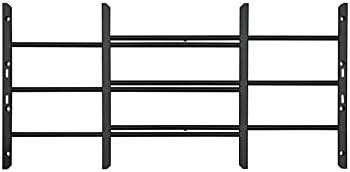
This fixed three-bar model is listed for openings 22-3/4 to 38-1/2 inches wide and 14-3/4 to 15-3/4 inches high. The product description says it can be mounted inside or outside and includes tamper-proof one-way screws. Its 2.9-inch bar spacing is intended to help reduce fall risks while adding a barrier.
The listing describes robotic welding and says the product meets building-code requirements in New York, New Jersey, and Oregon. Those statements do not establish compliance everywhere, so check local rules and the installation instructions before buying. The product is explicitly labeled non-egress and is not for bedrooms or other sleeping areas without an alternative emergency exit.
Its short specified height range makes this model different from the taller child-safety guards in this comparison. Match both the opening width and height to the product dimensions. As with the other fixed grills, the tamper-resistant screws make it a permanent-style installation rather than a quick-release guard.
Pros:
- Adjustable width from 22-3/4 to 38-1/2 inches
- Includes one-way tamper-proof screws
- 2.9-inch spacing between bars
- Product description identifies specific regional code compliance
Cons:
- Non-egress design is unsuitable where the window must serve as an emergency exit
- Height fit is limited to the listed 14-3/4 to 15-3/4-inch range
Verdict: Choose this grill only if your window matches its width and height limits and local rules allow a fixed, non-egress barrier.
How to Choose Indoor Window Security Bars
Measure the Full Window Opening
Measure the space where the guard will sit, not just the glass. Check width at more than one point if the opening is not perfectly square, and confirm the product’s height range as well as its width. The fixed grills here have different width limits, while the Gardenova and Fairy Baby guards have their own panel and opening requirements. A close measurement is not a substitute for checking the installation instructions.
Decide Whether You Need a Fixed or Removable Guard
Screw-mounted grills such as the Prime-Line and Grisham options are designed as fixed barriers. The Gardenova and Fairy Baby models use pressure-based installation and avoid drilling, with the Fairy Baby description specifically stating that it can be removed in an emergency. These approaches serve different needs; consider who uses the room and whether the window must remain accessible.
Protect Required Emergency Exits
Some fixed security bars are labeled non-egress. That means they are not designed to open as an emergency exit, so they may be unsuitable for bedrooms or other locations where an escape window is required. Check local building rules and your home’s exit plan before installing any bar. If escape access is needed, look for an appropriate hinged egress product rather than assuming a fixed or pressure-mounted guard will meet the requirement.
Consider the Mounting Surface
A no-drill, pressure-mounted guard relies on a suitable surface and correct positioning. Check whether the window frame or surrounding walls are flat, sturdy, and compatible with the product’s mounting method. Screw-mounted models require a suitable place to install their hardware. Follow the maker’s instructions, and avoid assuming that a product will fit every window type just because its listing names several styles.
Compare Bar Spacing and Intended Use
Bar spacing can matter when your main goal is to help reduce fall risks for children. The listed spacing varies across these products: the Prime-Line grills specify 3-7/8-inch on-center spacing, while Gardenova, Fairy Baby, and Grisham list narrower gaps. Consider the intended user and the product’s stated purpose, but do not treat spacing alone as proof of safety or code compliance.
Check Building Rules and Product Claims
Code requirements differ by location and by where a window is installed. Some product descriptions cite testing or regional code compliance, but that does not mean a product is approved for every home or use. Confirm current local requirements with the relevant building authority or a qualified professional, especially before fitting bars to a bedroom window.
Frequently Asked Questions
Are indoor window security bars suitable for every window?
No. Fit depends on the opening dimensions, mounting surface, and the specific product. Some windows also need to remain usable as emergency exits, which rules out fixed non-egress bars in those locations.
Can I install fixed bars on a bedroom window?
Only if local requirements and your emergency-escape plan allow it. The Prime-Line and Grisham models described here are fixed or non-egress designs. Check local building rules before installing any barrier on a sleeping-area window.
Are pressure-mounted guards as secure as screw-mounted grills?
They use different mounting methods and are intended for different needs. Pressure-mounted guards avoid drilling but depend on a compatible surface and correct setup. Screw-mounted grills attach with hardware and are designed as fixed barriers. Compare the installation instructions and intended use rather than assuming the methods are interchangeable.
How do I know which size to buy?
Measure the opening where the guard will mount and compare both the width and height with the product’s listed dimensions. For multi-panel or adjustable products, confirm the exact configuration and the allowed fit range before ordering.
Do these products open for emergency escape?
The Prime-Line grills and Grisham bars are described as fixed non-egress products. The Fairy Baby listing says its pressure-mounted guard can be removed in an emergency, but that claim does not establish that it meets local egress rules. Check the product details and applicable requirements for your specific window.
Do window bars replace adult supervision?
No. A window guard can be one part of a safety plan, but it does not replace supervision or other precautions. Do not allow children to climb or lean on a guard, and follow the manufacturer’s installation and use instructions.
Final Recommendation
For a fixed interior steel grill, the Prime-Line four-bar model is a strong option to consider if its dimensions fit and a non-egress design is allowed. The Prime-Line three-bar grill offers a similar listed width range with a different bar layout. For shoppers seeking a no-drill child-safety guard, compare the Gardenova’s wider fit range with the Fairy Baby’s panel sizes and stated removable design. The Grisham model may suit a short opening, but its height limits and non-egress warning deserve close attention. Measure carefully and confirm local requirements before choosing any window barrier.