

A water alarm can give you an early warning when a sump pit rises, a pipe drips, or water starts pooling near an appliance. The right choice depends on where you need coverage: a float-switch alarm suits a sump pit, while a compact floor sensor can sit near a washer, water heater, or crawlspace leak. Below, we compare five options by sensor style, alerts, power needs, and practical limits.
Quick Comparison
| Product | Best for | Key features |
|---|---|---|
| LUCKYDUO WiFi Sump Pump Alarm | Sump pits and tanks | High- and low-water alerts, app notifications, 110 dB siren |
| METAK 5-Pack Water Leak Detectors | Several leak-prone spots | 100 dB alarms, two AAA batteries per unit, IP66 rating |
| Basement Watchdog Compact Water Alarm | Small spaces near water sources | 360-degree sensing, 110 dB alarm, 9-volt battery |
| SABRE Water Leakage Alarm | Simple, local leak alerts | All-direction sensor, 110 dB alarm, adhesive attachments |
| HydroCheck WaterWatcher | Leaks from connected appliances | Sounds an alarm and can shut off a compatible appliance |
Our Picks: Best water alarms for basements and crawlspaces reviews
LUCKYDUO WiFi Alarm for Sump Pits and Water Tanks
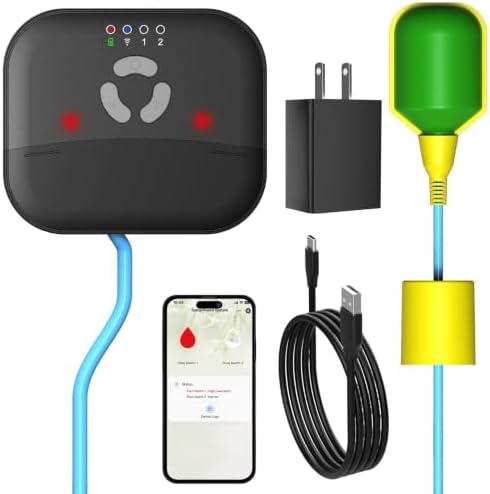
The LUCKYDUO is designed for monitoring water levels in a sump pit, septic tank, or similar tank. Its adjustable float switch can detect a rising level or a falling one, which makes it more suited to pump and tank monitoring than a simple floor sensor.
It combines a 110 dB siren and LED indicator for an on-site warning with app notifications over 2.4GHz WiFi. The housing is rated IP65, and the listed setup involves plugging in the unit, connecting it to WiFi, and mounting it. An optional second float switch can monitor high and low levels in one tank or two nearby tanks.
The main advantage is remote notification: you can receive an alert when you are away, rather than relying only on hearing an alarm in the basement. The trade-off is that this is a more involved setup than placing a battery-powered sensor on the floor. It also depends on WiFi for app alerts, and the supplied details do not specify backup power if household power is lost.
Pros:
- Can alert for both high and low water levels.
- Provides app alerts as well as a loud local siren and LED.
- Adjustable float switch suits sump pits and tanks.
- IP65-rated housing is listed for indoor and outdoor use.
Cons:
- App setup requires a 2.4GHz WiFi connection.
- The second float switch is an optional accessory, not included in the described package.
Verdict: Choose the LUCKYDUO if you want remote notifications and adjustable high- or low-water monitoring for a sump pit or tank.
METAK Five-Pack for Covering Multiple Leak-Prone Areas

This set includes five small, wireless alarms for placing near separate leak risks. Each device has front probes for drips and rear probes for floor moisture or flooding, so you can position one under a pipe or near an appliance and use others around the basement or crawlspace.
The alarms sound at 100 dB and have a mute mode. Each unit uses two AAA batteries, and the description lists a low-battery alert through a flashing red light. An IP66 rating and stainless-steel probes are useful features for damp locations, though these are local alarms rather than app-connected sensors.
A multi-pack makes sense when you need several detection points without wiring. Keep in mind that placement matters: each unit can only alert you to water that reaches its probes, and the siren will not send a notification to your phone. The package description lists a standby time of over two years, but actual battery life can vary with conditions and use.
Pros:
- Five units let you cover several areas.
- Front and rear probes detect drips and floor water.
- 100 dB alarm includes a mute mode.
- IP66 rating and low-battery alert are listed features.
Cons:
- No remote phone alerts are listed.
- Requires two AAA batteries per detector.
Verdict: Pick the METAK set if you want several battery-powered alarms for separate leak points and do not need app notifications.
Basement Watchdog Compact Alarm for Tight Spaces

This compact alarm detects water from any side and is listed as sensing as little as 1/32 inch of water. Its small size—2⅜ by 1 by 3¼ inches—makes it easy to place beside a sump pit or near a water heater, washing machine, refrigerator, sink, or air-conditioner drip pan.
The 110 dB alarm is intended to be heard across the home, and the unit uses a 9-volt alkaline battery. That battery is not included, so you will need one before installation. A battery-saver feature uses energy only when the alarm is sounding.
Unlike the LUCKYDUO, this device is a local water detector rather than a float-switch monitor for changing water levels. It also does not list phone alerts or an automatic shutoff function. Its compact design and all-direction sensing make it a straightforward option for spots where standing water could reach the unit.
Pros:
- 360-degree sensing detects water from any side.
- Small body fits in narrow spaces.
- 110 dB alarm and battery-saver feature.
- Can be placed near a range of household water sources.
Cons:
- Requires a 9-volt alkaline battery, which is not included.
- No remote alerts or appliance shutoff are listed.
Verdict: The Basement Watchdog is a good fit for a small, local detection point when you want a loud alarm without WiFi setup.
SABRE Water Alarm for Simple, Audible Leak Alerts

The SABRE is a no-wiring water alarm with an all-direction sensor. It is made for quick placement in areas where leaks are possible, such as basements, utility rooms, and laundry rooms. Adhesive attachments are included for setup.
Its 110 dB alarm is listed as audible up to 1,500 feet, a claim that describes the product’s stated alarm range rather than a guarantee in every home. The unit uses two AAA batteries, which are not included. There is no app connection or water-level float switch listed, so it is best understood as a simple local warning device.
Compared with the METAK five-pack, the SABRE offers a single alarm rather than several detection points. Compared with the Basement Watchdog, it also uses two AAA batteries instead of a 9-volt battery. Choose based on the number of spots you need to protect and which battery setup suits you.
Pros:
- All-direction water sensor.
- 110 dB local alarm.
- No wiring required and adhesive attachments are included.
- Compact approach for a single leak-prone location.
Cons:
- Two AAA batteries are required but not included.
- No app alerts or automatic shutoff are listed.
Verdict: Choose the SABRE if you want a simple, loud local alarm for one area and are comfortable checking its batteries yourself.
HydroCheck WaterWatcher for Connected Appliance Shutoff

HydroCheck’s WaterWatcher is designed to detect water near an appliance and, when connected as intended, sound an alarm and turn the appliance off. The product description lists uses such as dehumidifiers, aquariums, hydroponics, washing machines, and well pumps.
Its sensor is described as detecting small traces of water. After detection, the WaterWatcher keeps the appliance off until you manually reset it. That can help stop a connected appliance from continuing to add water after a leak, but it is not a general-purpose remote notification system based on the supplied details.
This option is more specialized than a stand-alone floor alarm. Before buying, confirm that your appliance and setup are compatible, and check how the device connects to the equipment you want it to control. The description lists a five-year warranty and customer support, but does not provide details here about the power source or alarm volume.
Pros:
- Sounds an alarm and can shut off a connected appliance.
- Manual reset keeps the appliance off after water detection.
- Listed for use with several types of appliances and equipment.
- Five-year warranty is listed in the product description.
Cons:
- Requires a compatible appliance connection to use the shutoff feature.
- Remote phone alerts are not listed.
Verdict: Consider the HydroCheck if your main concern is a leak from a compatible appliance and you want detection paired with automatic shutoff.
How to Choose a Water Alarm for a Basement or Crawlspace
Match the sensor to the water risk
A floor sensor detects water when it reaches its probes, making it a practical choice near pipes, appliances, or a low spot where water may collect. A float-switch alarm is designed to monitor the water level inside a sump pit or tank. If you need to know that a pit is rising or falling before water reaches the floor, look for a model that monitors those levels directly.
Decide whether you need remote alerts
A loud local siren can help when someone is home and close enough to hear it. App notifications add another layer when you are away, but they depend on the device’s network requirements. The LUCKYDUO listing specifies 2.4GHz WiFi for app alerts. The other alarms in this comparison describe audible alerts, not phone notifications.
Check the power source and battery needs
Battery-powered alarms can be placed without running a wire, but you need to keep the right batteries on hand and check them periodically. The METAK and SABRE alarms use AAA batteries, while the Basement Watchdog uses a 9-volt alkaline battery. The LUCKYDUO is described as a plug-in unit. The supplied HydroCheck information does not specify its power source, so check its setup requirements before choosing it.
Consider moisture and placement
Place a floor sensor where water is likely to reach its probes, such as beside a sump pit, under a water line, or near an appliance. In a crawlspace, make sure the detector can sit securely and that its alarm is not blocked. For damp locations, check the product’s stated water-resistance rating: the LUCKYDUO lists IP65 and the METAK alarms list IP66. A rating does not replace careful placement or routine checks.
Think about how you will respond to an alarm
An alarm only helps if you can hear or receive it and reach the source in time. If you are often away, remote alerts may be useful. If a specific appliance is the likely source, an alarm with a compatible shutoff function may help stop it from continuing to run. For several separate leak risks, a multi-pack can offer more coverage than a single detector.
Plan for testing and maintenance
Check the manufacturer’s instructions for testing the alarm and sensor, and make sure the device remains in its intended position. Replace batteries or address low-battery warnings when needed. For a WiFi model, confirm that the connection and app alerts are working. A water alarm is a warning tool, so it should not replace regular checks of pumps, plumbing, and appliances.
Frequently Asked Questions
Where should I place a water alarm in a basement?
Place it near likely leak sources, such as a sump pit, water heater, washing machine, exposed pipe, or appliance drain. Position a floor sensor so water can reach its probes, and follow the product instructions for mounting a float-switch alarm.
Is a float-switch alarm different from a leak detector?
Yes. A float switch monitors water level in a pit or tank and can alert at a set level. A typical leak detector senses water when it touches probes on or near the floor. Choose the type that matches the problem you want to catch.
Can these alarms send alerts to my phone?
The LUCKYDUO description lists app notifications over 2.4GHz WiFi. Phone alerts are not listed for the METAK, Basement Watchdog, or SABRE alarms. The supplied HydroCheck description focuses on an alarm and appliance shutoff, not phone notifications.
Are water alarms suitable for crawlspaces?
They can be useful in crawlspaces if the sensor is designed for the location and can be placed where water will reach it. Check each product’s installation directions and water-resistance details, and consider whether you will hear a local alarm from that area.
Do water alarms prevent flooding?
They detect water or a changing water level and warn you, but they do not prevent every flood. A warning is most useful when you can respond quickly. The HydroCheck may shut off a compatible connected appliance, but that function does not replace other flood-prevention measures.
Which water alarm is best for a sump pit?
A float-switch model such as the LUCKYDUO is the most directly suited to monitoring sump-pit water levels. A floor alarm can provide separate coverage near the pit for water that has already escaped, but it does not monitor the pit level in the same way.
Final Recommendation
For a sump pit or tank where you want high- and low-water monitoring plus phone alerts, the LUCKYDUO is the most specialized choice in this group. For several simple leak points, the METAK five-pack offers multiple local alarms, while the Basement Watchdog and SABRE suit single locations. If you want an alarm that can also shut off a compatible appliance, consider the HydroCheck and confirm your setup before buying.