

Iron in household water can leave orange stains, affect taste, and build up in plumbing or appliances. The best whole-house filter for your home depends on how much iron is present, whether you also have manganese or hydrogen sulfide, and how much maintenance you want to handle. The options below range from replaceable cartridge systems to an automatic backwashing filter, so start by testing your water and matching the system to the results.
Quick Comparison
| Product | System type | Iron and related treatment | Best fit |
|---|---|---|---|
| iSpring WCFM400K | Automatic backwashing filter | Reduces dissolved iron, manganese, solids, and turbidity | Those who want automatic media regeneration without chemical feed |
| iSpring WGB21BM | Two-stage cartridge system | Iron up to 3.0 ppm and manganese up to 1.0 ppm; also reduces chlorine, taste, and odor | Homes with moderate iron levels and a preference for cartridge changes |
| iSpring Iron, Manganese & H2S System | Three-stage cartridge system | Iron up to 3.0 ppm and manganese up to 1.0 ppm; also targets hydrogen sulfide and other listed contaminants | Homes that need treatment for iron plus hydrogen sulfide |
| iSpring Two-Stage Iron & Manganese System | Two-stage cartridge system | Iron up to 3.0 ppm and manganese up to 1.0 ppm; reduces chlorine, taste, and odor | Those who want a straightforward iron-and-chlorine cartridge setup |
| iSpring WGB32BM 3-Stage System | Three-stage cartridge system | Iron and manganese reduction, plus sediment and chlorine filtration | Homes wanting sediment, carbon, and iron filtration in one system |
Our Picks: Best whole house filter for iron reviews
iSpring WCFM400K: Automatic iron and manganese filtration

The WCFM400K is a central, whole-house filtration system with a digital control valve and automatic media regeneration. It is designed to reduce dissolved iron and manganese, along with solids and turbidity. Instead of relying on a chemical feed for regeneration, the system uses air.
Its main advantage over the cartridge models in this roundup is the regeneration setup. You can adjust the automatic flush schedule to suit your water quality and household use, which may reduce the need for routine cartridge changes. The filter media is certified to NSF/ANSI Standard 61; that certification applies to the media, not necessarily the complete system.
There are important limits to consider. The manufacturer says this model does not remove hydrogen sulfide and warns that water containing hydrogen sulfide can damage the system. It also does not reduce total dissolved solids (TDS). If your water has hydrogen sulfide, confirm your treatment needs before choosing this unit.
Pros:
- Automatic regeneration controlled by a digital valve
- Uses air rather than a chemical feed for media regeneration
- Targets dissolved iron, manganese, solids, and turbidity
- Flush intervals can be adjusted for water quality and usage
Cons:
- Not suitable for water containing hydrogen sulfide, according to the manufacturer
- Does not reduce TDS
Verdict: Choose the WCFM400K if your water test confirms iron and manganese are the main concerns and you want automatic regeneration; look elsewhere if hydrogen sulfide is present.
iSpring WGB21BM: Two-stage cartridge filtration for iron and chlorine
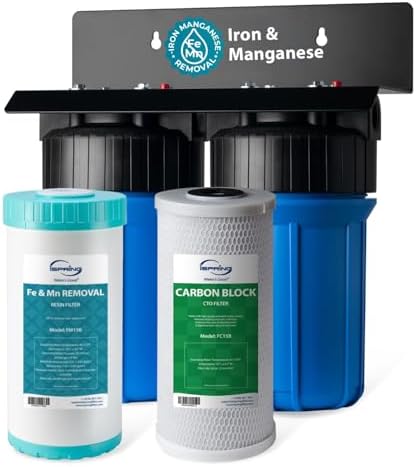
The WGB21BM pairs a carbon block cartridge with a second cartridge made to reduce iron and manganese. Its stated maximums are 3.0 ppm for iron and 1.0 ppm for manganese. The first stage also reduces chlorine, cloudiness, and certain tastes and odors, giving this model a broader role than an iron-only filter.
The system arrives assembled on a mounting bracket and uses 10-by-4.5-inch cartridges with 1-inch NPT connections. The manufacturer lists flow of up to 15 gallons per minute and a filtration capacity of up to 50,000 gallons, described as enough for a family of four for up to a year. Actual cartridge life will depend on your water and usage.
This is a practical choice if you are comfortable replacing cartridges and your test results are within the stated iron and manganese limits. It is less suited to very high iron or manganese levels; the product description recommends contacting the manufacturer for a customized solution in those cases. Like the other cartridge systems here, it does not reduce TDS.
Pros:
- Combines iron and manganese reduction with carbon filtration
- Preassembled mounting bracket and included filter wrench simplify setup and changes
- Listed flow rate is up to 15 GPM
- Does not require an automatic regeneration cycle
Cons:
- Requires periodic cartridge replacement
- Not presented as a solution for very high iron or manganese levels
Verdict: The WGB21BM is a solid match for households with iron and manganese at or below its stated limits that also want chlorine and taste reduction.
iSpring Iron, Manganese & H2S: Three stages for a wider range of concerns

This three-stage system adds a dedicated hydrogen sulfide-targeting compound filter to a sediment stage and an iron-and-manganese cartridge. The product description also lists reduction of chlorine, chloramine, lead, mercury, and other heavy metals. Its stated iron and manganese limits are 3.0 ppm and 1.0 ppm, respectively.
The cartridges measure 20 by 4.5 inches, and the system has 1-inch NPT connections. The manufacturer lists flow of up to 15 GPM and says the cartridges can last up to a year for a family of four, depending on water quality and use. Those are planning estimates, not a guarantee for every household.
This is the most comprehensive cartridge option in the group for households with several of the listed concerns, especially when hydrogen sulfide is also present. It still has the maintenance needs of a cartridge system, and it is not a TDS-reduction system. Check your test results carefully rather than assuming that its broad contaminant list covers every water issue.
Pros:
- Three stages include sediment, compound, and iron-focused filtration
- Specifically lists hydrogen sulfide reduction
- Also targets several listed chemicals and metals
- Designed for flow up to 15 GPM
Cons:
- More cartridges to replace than a two-stage system
- Iron and manganese limits remain 3.0 ppm and 1.0 ppm
Verdict: Choose this model if your test results point to iron plus hydrogen sulfide or several of its other listed targets, and you are prepared to replace three cartridges as needed.
iSpring Two-Stage Iron & Manganese: A simpler cartridge setup

This two-stage model combines a coconut-shell carbon block cartridge with a dedicated iron-and-manganese cartridge. The stated maximums for the iron stage are 3.0 ppm iron and 1.0 ppm manganese. The carbon stage is listed as reducing up to 99% of chlorine, as well as improving taste and odor.
It uses 20-by-4.5-inch cartridges and 1-inch NPT connections. The product description lists flow of up to 15 GPM and a capacity of 100,000 gallons, described as enough for a family of four for a year. Water quality and household use can affect how long the cartridges last, so plan to monitor performance and follow the manufacturer’s replacement guidance.
Compared with the WGB21BM, this model uses larger cartridges and has a higher stated capacity, while both target iron and manganese within the same listed limits. It does not include the three-stage model’s hydrogen sulfide-targeting compound filter. The manufacturer recommends looking at its backwashing systems for well or pond water above 3 ppm iron or 1 ppm manganese.
Pros:
- Two-stage design treats iron, manganese, and chlorine
- Uses 20-by-4.5-inch cartridges
- Listed capacity is 100,000 gallons
- Designed for flow up to 15 GPM
Cons:
- Requires cartridge replacement
- Not intended for high iron or manganese levels beyond its stated limits
Verdict: This is a good option if you want a two-stage cartridge system with a listed 100,000-gallon capacity and your iron levels fall within the stated range.
iSpring WGB32BM: Three-stage filtration with sediment prefiltration
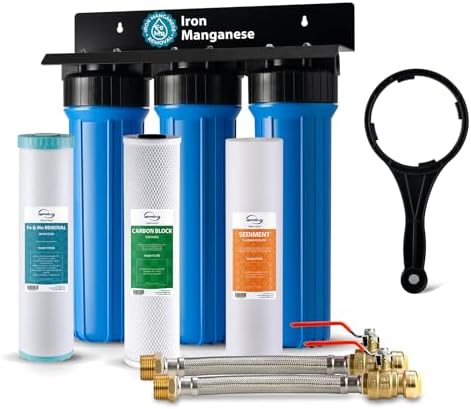
The WGB32BM uses three stages: a sediment filter, a carbon block, and a cartridge for iron and manganese. The product description states that the final stage can reduce iron from a maximum of 3.0 ppm to 0.01 ppm and manganese from a maximum of 1.0 ppm to 0.01 ppm. It also lists sediment, chlorine, rust, herbicides, and industrial solvents among the system’s targets.
The system uses 20-by-4.5-inch cartridges and 1-inch NPT inlet and outlet connections, with a listed flow rate of up to 15 GPM. Two push-fit hoses are included for compatible 3/4-inch copper, PEX, or CPVC pipes. The manufacturer lists a capacity of 100,000 gallons for the filters, though replacement timing depends on the water entering your home and your usage.
Its extra sediment stage may make this a better fit than a two-stage model if your water also contains visible particles or rust. However, it does not reduce TDS, and the product information supplied for this listing marks it as unavailable. Confirm that the listing is available before planning a purchase or installation.
Pros:
- Three stages cover sediment, carbon filtration, and iron and manganese reduction
- Stated reduction targets reach 0.01 ppm for iron and manganese within the listed maximums
- Includes push-fit hoses for compatible 3/4-inch pipes
- Listed capacity is 100,000 gallons
Cons:
- Requires replacing three cartridges over time
- Listing availability may be limited; the supplied product information marks it unavailable
Verdict: Consider the WGB32BM if you want sediment, carbon, and iron filtration together and can confirm the product is available; otherwise, the other iSpring cartridge models offer similar core iron treatment.
How to Choose a Whole-House Iron Filter
Test your water before choosing a system
Start with a water test that measures iron and manganese and checks for other concerns such as hydrogen sulfide. If you use well water, do not rely on appearance or taste alone to choose a filter. The right system depends on what is in your water and at what concentration. The products here list different limits, so compare your test results with the specific model’s stated range.
Match the treatment to the type and level of iron
These systems do not all work the same way. The WCFM400K is designed to reduce dissolved iron and manganese through a regenerating media bed. The cartridge models use dedicated iron-reduction filters, with stated limits that vary by model. If your iron level is higher than a system’s listed limit, ask the manufacturer or a qualified water-treatment professional about a suitable setup rather than assuming the filter will handle it.
Check for hydrogen sulfide and other water issues
Hydrogen sulfide can change which system is appropriate. The WCFM400K description specifically says it does not remove hydrogen sulfide and warns that water containing it can damage the system. The three-stage iSpring system lists hydrogen sulfide among its targets. If your water has a sulfur-like odor or a test confirms hydrogen sulfide, verify that the product is rated for your conditions before installing it.
Choose between automatic regeneration and cartridge changes
A backwashing system such as the WCFM400K regenerates its media automatically according to the control settings, using air for regeneration. Cartridge systems require you to replace filters when needed. Consider which routine suits you, and account for the space, plumbing, and maintenance involved in either setup. “Automatic” does not mean you can ignore the system; follow the manufacturer’s setup and service instructions.
Consider flow rate and household demand
Several cartridge models list flow of up to 15 GPM, but actual flow at your fixtures can depend on your home’s plumbing and water use. Think about how many bathrooms and water-using appliances may run at once, and check the manufacturer’s specifications for your installation. Proper sizing matters if you want whole-house treatment without an unwanted impact on water flow.
Look at the full treatment list, not just iron removal
If chlorine taste or odor is also a concern, a carbon stage may be useful. If sediment is present, a system with a dedicated sediment stage may better match your needs. The three-stage models target more categories than the simpler two-stage systems, but more stages also mean more cartridges to maintain. Choose based on test results and clear treatment goals, not just the longest contaminant list.
Understand what the system does not remove
The product descriptions state that these systems do not reduce TDS. A whole-house iron filter is not a substitute for a reverse-osmosis system when TDS reduction is your goal. Also check whether a listed certification applies to the filter media or the complete system; those are not necessarily the same claim.
Frequently Asked Questions
What is the best type of whole-house filter for iron?
There is no single best type for every home. An automatic backwashing filter may suit you if you want media regeneration and your water matches the system’s limits. A cartridge system may be a better fit if you prefer a simpler installation and do not mind scheduled filter changes. Test your water before deciding.
Can these systems remove both iron and manganese?
Yes. All five products in this roundup list iron and manganese treatment. The cartridge models specify maximums of up to 3.0 ppm iron and 1.0 ppm manganese. Check the exact model information and compare those limits with your water test.
Which option lists hydrogen sulfide treatment?
The iSpring three-stage Iron, Manganese & H2S system lists hydrogen sulfide among its targets. The WCFM400K specifically says it does not remove hydrogen sulfide and warns against using it when hydrogen sulfide is present.
Do whole-house iron filters reduce TDS?
No. The product descriptions state that these systems preserve TDS rather than reduce it. If lowering TDS is important to you, look into a separate system designed for that purpose, such as reverse osmosis.
How often do I need to replace the cartridges?
Replacement timing depends on water quality, usage, and the specific cartridge. Some product descriptions provide capacity or up-to-one-year estimates, but those are not guaranteed service intervals for every home. Follow the product manual and monitor performance.
Can I install one of these systems myself?
The cartridge systems are described as DIY-friendly and include installation guidance; some include mounting hardware or compatible hoses. Installation still requires working at the main water line, so check connection sizes, available space, and your comfort with plumbing before starting. Consider a qualified installer if the setup is outside your experience.
Final Recommendation
For an automatic option that targets dissolved iron and manganese, the iSpring WCFM400K is the standout choice when hydrogen sulfide is not present. For cartridge filtration, the WGB21BM offers a simpler two-stage setup, while the three-stage Iron, Manganese & H2S model covers more listed concerns. Base your decision on a current water test, the system’s stated limits, and the maintenance you are willing to do.