

For house washing, the best pressure washer is one you can control—not simply the one with the biggest advertised pressure number. A wide spray pattern, manageable water flow, and a suitable detergent option matter when cleaning siding, windows, porches, and outdoor furniture. These five electric models range from light-duty cleaners to higher-powered options, so you can match a washer to your home and the surfaces you plan to clean.
Quick Comparison
| Pressure washer | Listed specifications | Useful features | Best suited to |
|---|---|---|---|
| LWQ Portable Pressure Washer | Up to 2.5 GPM stated in the description | Four quick-connect nozzles, foam cannon, wheels | General outdoor cleaning and storage-conscious shoppers |
| Westinghouse ePX3100s | 1,800 rated PSI; 1.2 rated GPM | Compact design, foam cannon, long power cord | Light-to-medium jobs and easy storage |
| Westinghouse WPX3000e | 2,600 rated PSI; 1.1 rated GPM | Soap tank, five nozzles, steel frame | Frequent cleaning and a wider range of hard surfaces |
| FOTING Electric Pressure Washer | 4800 Max PSI in the product title; rated output not specified | Four nozzles, foam cannon, safety lock | Shoppers considering an option with multiple spray patterns |
| Greenworks 1600 PSI Electric Pressure Washer | 1,600 PSI; 1.2 GPM | GFCI power cord, two nozzles, soap applicator | Light-duty home and vehicle cleaning |
Our Picks: Best pressure washer for cleaning house reviews
LWQ Portable Pressure Washer: A Flexible Set of Nozzles for Outdoor Chores

The LWQ is a portable electric washer intended for a mix of home and vehicle cleaning. Its description lists four quick-connect spray tips, a foam cannon, and water flow of up to 2.5 GPM. Wheels and a stable base are designed to make it easier to move and park, while holders for the cord and nozzles help keep the parts together between jobs.
The four tips offer different spray angles, from a narrow 0-degree stream to a broader 40-degree pattern. For house washing, start with the widest suitable spray and a generous distance from the surface. A narrow, forceful stream can damage siding, paint, window seals, or wood if used carelessly. The included foam cannon can help apply detergent, but use only a cleaner approved for the surface and washer.
One detail to check before buying is the stated water-flow figure: the listing gives “up to” flow rather than a rated operating figure. That makes direct comparisons with products that provide rated PSI and GPM less certain. The washer’s nozzle range and storage features are clear advantages, but shoppers who need precise performance information may prefer one of the models with rated specifications.
Pros:
- Includes four quick-connect spray tips and a foam cannon.
- Wheels and an anti-tipping base support easier movement and storage.
- Designed for a range of outdoor surfaces, vehicles, and patio items.
- Onboard holders help organize the cord and nozzles.
Cons:
- The description does not provide a rated PSI figure for comparison.
- Use extra care with the narrow 0-degree tip around home finishes.
Verdict: Choose the LWQ if you want a versatile accessory set and a wheeled design, but compare its specifications carefully if you need a clearly stated rated output for house washing.
Westinghouse ePX3100s: Compact and Easy to Store Between Jobs
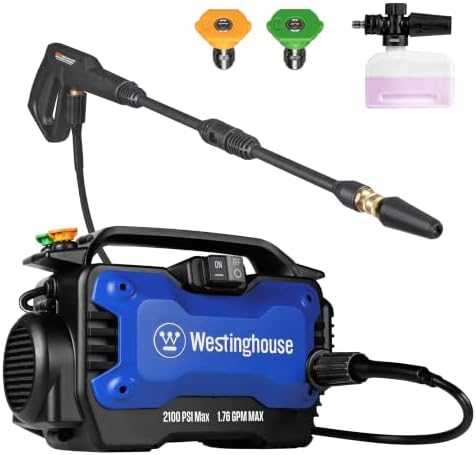
The ePX3100s is a compact electric washer for routine outdoor cleanup. Westinghouse lists 1,800 rated PSI and 1.2 rated GPM, along with higher maximum figures. Rated output is the more useful comparison point for planning a job, while maximum figures describe peak conditions rather than a steady operating level.
Its 10-pound stated weight, built-in accessory holders, and compact design make it appealing if you have limited storage or want to carry the washer between areas. The included adjustable foam cannon can apply soap to surfaces such as windows, decks, and vehicles. A 35-foot GFCI power cord and 20-foot pressure hose provide room to move around a work area, though you will still need access to a suitable water connection.
This model is a better fit for manageable jobs than for shoppers seeking a heavy-duty machine. Its rated output is lower than the WPX3000e, but the smaller design may be easier to handle and put away. For siding, use a broad spray pattern and follow the home and washer manufacturers’ care instructions.
Pros:
- Compact, lightweight design is convenient to carry and store.
- Includes an adjustable foam cannon for applying detergent.
- Long power cord and pressure hose help extend working reach.
- Built-in holders keep the spray accessories organized.
Cons:
- Its rated output is lower than that of the WPX3000e.
- The compact design may not be the best match for long, demanding cleaning sessions.
Verdict: The ePX3100s is a sensible choice if compact storage and easy handling matter more to you than higher rated pressure.
Westinghouse WPX3000e: A Higher-Rated Option with a Soap Tank

The WPX3000e is a wheeled electric washer with 2,600 rated PSI and 1.1 rated GPM, according to its description. It includes a 0.45-gallon onboard soap tank and five quick-connect nozzles: 0-degree, 15-degree, 25-degree, soap, and turbo. The manufacturer also lists an induction motor, an auto-stop pump, and a 35-foot GFCI power cord.
The steel frame and 10-inch wheels are intended to make the washer easier to move across outdoor spaces. Its 25-foot hose gives you room to work, and the soap tank offers a built-in way to apply detergent. For house siding, the higher rated pressure calls for careful nozzle selection and technique. Avoid using a concentrated or turbo spray on delicate finishes, and test an inconspicuous area first.
Compared with the compact ePX3100s, the WPX3000e offers a higher rated PSI and a more substantial wheeled frame, but it is a larger setup. Its rated water flow is slightly lower than the ePX3100s listed figure. This is the stronger choice on paper for shoppers who want more pressure for suitable hard surfaces, but the maximum PSI alone should not guide your decision.
Pros:
- Higher rated PSI than the other Westinghouse model in this selection.
- Includes an onboard soap tank and five nozzle options.
- Wheeled steel frame supports movement around outdoor work areas.
- Long GFCI power cord and 25-foot pressure hose are included.
Cons:
- Its larger wheeled frame takes more storage space than a compact washer.
- The 0-degree and turbo tips require caution around siding and other delicate surfaces.
Verdict: Pick the WPX3000e if you want a higher rated PSI, an onboard soap tank, and a wheeled frame, and you are prepared to adjust the spray carefully for each surface.
FOTING Electric Pressure Washer: Multiple Spray Patterns, Unclear Rated Output

The FOTING is an electric pressure washer with four quick-connect spray tips, a 500-milliliter foam cannon, and a safety lock on the spray gun. Its product title advertises 4800 Max PSI, but the description does not give a clear rated PSI or GPM figure. That missing information makes it difficult to judge how its working output compares with the other washers here.
The included nozzles span a range of spray angles, from a concentrated 0-degree stream to a wider 40-degree pattern. The description identifies the wider pattern for fragile surfaces such as windows and screens, while narrower tips are intended for harder surfaces. For house washing, start with the gentlest suitable setting, keep the spray moving, and avoid spraying directly into gaps, vents, or seals.
The listing also describes a total stop system, but its specifications and details are less complete than those for the Westinghouse and Greenworks models. The claimed maximum pressure should not be treated as a measure of steady cleaning performance. Consider this option only if the seller provides enough additional information to confirm the rated output, included hose, and other details you need.
Pros:
- Includes four spray tips and a foam cannon.
- Spray gun has a safety lock, according to the description.
- Offers several spray angles for different cleaning tasks.
Cons:
- The description does not state a rated PSI or GPM figure.
- Its advertised maximum pressure is not directly comparable with rated output.
Verdict: The FOTING has a useful-looking nozzle and foam-cannon package, but choose another model if you need clearly stated performance specifications before buying.
Greenworks 1600 PSI: A Straightforward Choice for Light-Duty Cleaning

The Greenworks is a 1,600 PSI, 1.2 GPM electric washer described as a light-duty option for residential cleaning. It comes with a 25-degree nozzle for general cleaning, a 40-degree nozzle for gentler work, a soap applicator, and a 20-foot hose. Its push-button start and lack of gas-engine maintenance needs keep the setup simple.
A 35-foot GFCI power cord adds reach and includes an electrical safety feature. The lower pressure makes this model a practical candidate for lighter chores such as patio furniture, windows, and routine cleanup, though the appropriate spray distance still depends on the surface. The listed accessories are simpler than the sets included with several competitors, and there is no foam cannon or extra narrow nozzle.
Compared with the Westinghouse WPX3000e, the Greenworks has a lower pressure rating and fewer included spray options. That is not automatically a disadvantage for delicate work: more pressure can increase the risk of damage if you use the wrong tip or technique. If your main goal is light home maintenance rather than stubborn grime on hard surfaces, the Greenworks’ straightforward setup may be a better fit.
Pros:
- Rated at 1,600 PSI and 1.2 GPM for light-duty residential cleaning.
- Includes a gentler 40-degree tip, a 25-degree tip, and a soap applicator.
- GFCI-equipped 35-foot power cord is included.
- Electric design avoids gas, oil, and spark-plug maintenance.
Cons:
- Lower pressure and fewer accessories than the WPX3000e.
- The included pressure hose is 20 feet long.
Verdict: Choose the Greenworks for light-duty home cleaning and a simple accessory set, rather than for frequent heavy-duty jobs.
How to Choose a Pressure Washer for Cleaning Your House
Match the washer to the surfaces you will clean
House exteriors vary: vinyl siding, painted wood, masonry, windows, and decks do not all tolerate the same spray. A broad fan pattern is generally easier to control than a narrow stream, but always follow the care instructions for your siding and washer. If you are unsure, begin at a distance on a hidden spot and stop if the finish changes or water gets behind the surface.
Compare rated pressure and water flow
Pressure is commonly listed in PSI, while water flow is measured in gallons per minute. Compare rated operating figures when available, rather than relying only on maximum PSI. Some product listings provide both rated and maximum numbers; others provide incomplete specifications. A higher maximum figure does not, by itself, tell you how quickly or safely a washer will clean your home.
Choose useful nozzle options
Nozzle angles affect how concentrated the spray is. Wider patterns spread the water over a larger area, while narrow patterns concentrate it. For home exteriors, having a gentler, wider option is useful. A 0-degree nozzle or turbo tip can be too aggressive for siding, paint, window seals, and wood, so do not assume every included tip is suitable for every job.
Decide how you want to apply detergent
A soap tank, soap applicator, or foam cannon can make detergent application more convenient. Check the washer instructions and the cleaner label to confirm that they are compatible. Use a detergent intended for the surface you are washing, and avoid assuming that a pressure washer can safely handle every household chemical.
Consider hose length, power access, and storage
A longer pressure hose or power cord can reduce how often you need to reposition the washer, but your workspace still needs a safe water and electrical setup. GFCI protection is a useful feature around outdoor water use; follow all electrical safety instructions. Compact models may suit a small storage area, while wheeled frames can be helpful when moving a larger unit around a yard.
Think about control and safe technique
Keep the spray moving, use a suitable distance, and avoid aiming into vents, gaps, electrical fixtures, or window seals. Do not use a pressure washer from a ladder, where the force of the spray could affect your balance. Before starting, connect the hoses and release trapped air as directed by the manufacturer. Wear appropriate eye protection and follow the product manual.
Frequently Asked Questions
What pressure washer is best for cleaning house siding?
The right choice depends on your siding, its condition, and the cleaning method allowed by the manufacturer. For delicate finishes, prioritize a washer with a wide spray option and good control rather than choosing by maximum PSI alone. Start gently, test a hidden area, and follow the siding maker’s guidance.
Is a higher PSI always better for house washing?
No. More pressure can remove stubborn dirt from suitable hard surfaces, but it can also damage paint, wood, siding, or seals if you use the wrong nozzle or get too close. Rated pressure, water flow, spray pattern, and technique all matter.
Can I use a pressure washer on windows?
Use caution. A concentrated stream can damage glass, frames, caulking, or seals. If the washer manufacturer permits window cleaning, use a gentle, wide spray from a safe distance and test a small area first. For fragile or older windows, hand cleaning may be safer.
What does GPM mean on a pressure washer?
GPM means gallons per minute and describes water flow. PSI describes pressure. Both figures help explain a washer’s output, but compare rated operating figures where possible because maximum figures may not represent steady performance.
Do I need a foam cannon or soap tank?
Not necessarily. These accessories can make it easier to apply compatible detergent, but they are not required for every cleaning task. A soap applicator, built-in tank, or foam cannon can be useful if you plan to wash surfaces with detergent regularly.
Is an electric pressure washer suitable for cleaning a house?
An electric model can suit many routine outdoor cleaning jobs, including some siding, patio, and furniture tasks. Check the washer’s specifications, cord and hose reach, and the care instructions for your home’s surfaces before you buy. For major or delicate siding work, a professional may be the safer option.
Final Recommendation
For a balanced combination of rated pressure, accessories, and a wheeled frame, the Westinghouse WPX3000e is the strongest choice in this group for shoppers who need more cleaning capability and are comfortable using a washer carefully. The Greenworks 1600 PSI is a better fit for light-duty jobs, while the compact Westinghouse ePX3100s stands out when easy carrying and storage matter most. Whichever you choose, use the gentlest effective spray pattern and follow the care instructions for your home’s exterior.