

If you need to run a well pump, a dryer, a welder or a central air conditioner, a standard 120V battery will not cut it. You need a portable power station with 240V output, and that narrows the field quickly. The five units below all offer 120V/240V power, but they differ a lot in output, battery size, charging speed and how easy they are to move. Some are built for camping and light backup, while others are closer to a whole-home system. We compared the specs and features of each so you can match the right one to your appliances and your budget.
| Product | Output | Capacity | Best For |
|---|---|---|---|
| EcoFlow DELTA Pro 3 | 4000W (6000W with X-Boost) | 4096Wh, expandable to 48kWh | Quiet, expandable backup |
| OUKITEL P5000 Pro | 3600W | 5120Wh | Solar bundle with a 400W panel |
| PowerMax 6000 | 6000W (9000W surge) | 3600Wh | High output, three panels included |
| ABOK Ark7200 Plus | 7200W at 240V | 9792Wh, expandable to 29.4kWh | Job sites and large capacity |
| EcoFlow TITAN 5000 Plus | 7.2kW, up to 10kW with solar | 5017Wh, expandable to 30kWh | Large home backup (via transfer switch) |
Our Picks: Best portable power stations with 240V output reviews
EcoFlow DELTA Pro 3: Expandable Power With Very Quiet Operation

The DELTA Pro 3 is the most flexible pick here if you are not sure how your needs will grow. It gives you 4000W at 120V/240V, with X-Boost lifting that to 6000W for tougher loads, and the 4096Wh battery expands to 48kWh with extra batteries or smart generators. That expansion path is what sets it apart from the fixed-size OUKITEL and PowerMax.
It also runs quietly, as low as 30 dB, so it can sit in a bedroom or home office during an outage. A 10 ms switch-over keeps a NAS, server or entertainment setup running, and you can monitor everything from the EcoFlow app. Seven charging methods, including solar and EV charging piles, make recharging easy. The catch is that its 4000W rating is lower than the ABOK and the TITAN, which matters if you want many big appliances running at once.
Pros:
- Up to 6000W with X-Boost for tougher loads
- Expands to 48kWh for longer outages
- Runs as quietly as 30 dB
- 10 ms switch-over for sensitive electronics
Cons:
- 4000W base rating is below the ABOK and TITAN
Verdict: Choose the DELTA Pro 3 if you want quiet, expandable backup you can grow over time, and you do not need the very highest output.
OUKITEL P5000 Pro: A Solar-Ready Bundle With a Panel Included

The OUKITEL P5000 Pro is the only pick here that lists a 400W solar panel in the box, so it is the quickest way to a working solar setup from a single purchase. Its listing shows 5120Wh and 3600W with 120V/240V output, plus 5 AC outlets among 15 total outputs. The supplied details do not say which outlets deliver 240V, so confirm the 240V connection on the listing before you count on it for a specific appliance.
It recharges from a wall outlet in 2.8 hours at 1800W, or in about 5 hours from the panel. The LiFePO4 battery is rated for 6000 cycles to 70%, and UPS switching protects a desktop PC or file server. A drawbar and two wheels help you move it. The trade-off is output: 3600W is the lowest of the five, so it fits lighter backup and camp use better than heavy tools. Availability on Amazon can change, so check the listing.
Pros:
- Includes a 400W solar panel in the box
- Recharges in 2.8 hours from a wall outlet
- UPS function for PCs and servers
- Wheels and a drawbar for moving it
Cons:
- 3600W is the lowest output of the five
Verdict: Choose the OUKITEL P5000 Pro if you want a panel included and your loads stay under 3600W.
PowerMax 6000: High Output and Three Solar Panels in the Box

The PowerMax 6000 is the value-minded middle option. It pairs 3600Wh with 6000W of output (9000W surge) across 4 AC outlets on 120V/240V split phase, and it ships with three 400W solar panels. Compared with the OUKITEL, you get far more output and three panels instead of one.
Charging is quick: 2200W from AC and up to 2400W from solar, with a full charge in about 1.96 hours on AC. The LiFePO4 pack has an eight-layer BMS and is rated for up to 3500 cycles, fewer than the OUKITEL or ABOK list. A 5-8 ms switchover, app control and a 5-year warranty round it out. Its 3600Wh capacity is the smallest of the five, so running near the full 6000W will drain it fast.
Pros:
- 6000W output with 9000W surge
- Three 400W solar panels included
- Full charge in about 1.96 hours on AC
- 5-year warranty
Cons:
- 3600Wh is the smallest battery of the five
- Rated for fewer cycles than the OUKITEL and ABOK
Verdict: Choose the PowerMax 6000 if you want 6000W and a three-panel solar kit without paying for the biggest battery.
ABOK Ark7200 Plus: The Biggest Battery for Job Sites and Home Backup

The ABOK Ark7200 Plus has the biggest battery here at 9792Wh, paired with 7200W at 240V and 3600W at 120V. It is aimed at job sites and forestry work as much as home backup, and its outlets match: four NEMA 5-20, one L14-30 and a 50A NEMA 14-50. No other pick lists that range of outlets, so check it first if you have a specific plug to power.
It recharges in about 2.5 hours from 240V AC at up to 5000W, or in about 2 hours when AC and solar are combined. IP54 protection and rugged wheels suit rough ground, and it is UL 2743 certified with 6000+ cycles. It also expands to 29.4kWh. The supplied details give no weight, so look at the listing for dimensions if you need to lift or load it.
Pros:
- 9792Wh capacity, expandable to 29.4kWh
- 7200W at 240V with a 50A NEMA 14-50 outlet
- IP54 protection and rugged wheels
- Fast 240V AC charging at up to 5000W
Cons:
- Weight is not listed, so portability is unclear
Verdict: Choose the ABOK Ark7200 Plus if you need the most stored energy and a wide outlet range for tools and home circuits.
EcoFlow TITAN 5000 Plus: Whole-Home Backup Built Around 7.2kW
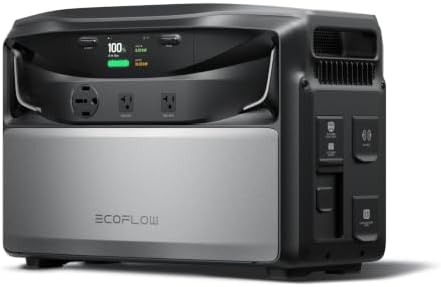
The TITAN 5000 Plus is built for whole-home backup more than portability. It delivers 7.2kW continuous, up to 10kW with solar PV input, on 120V/240V split phase, and it can run a 3-ton central air conditioner and a refrigerator together with no soft starter. The 5017Wh pack grows from 5kWh to 30kWh with up to five expansion batteries.
What separates it from the ABOK is the home-energy side. OASIS 3.0 charges during off-peak hours and powers your home at peak hours, and the unit is UL 9540 certified. It charges at up to 7.6kW from AC or 8kW from solar. The supplied details do not list wheels, outlet counts or weight, so it reads more like a home backup system than a grab-and-go unit. Generator charging goes through the EcoFlow Smart Home Panel 10. Any whole-home setup should be wired in by a licensed electrician.
Pros:
- 7.2kW continuous, up to 10kW with solar
- Expands to 30kWh with expansion batteries
- UL 9540 certified
- OASIS 3.0 shifts power use to off-peak hours
Cons:
- No outlet count, wheels or weight listed
- Generator charging needs the Smart Home Panel 10
Verdict: Choose the TITAN 5000 Plus if your goal is powering major home circuits, including central air, through an outage, and you plan to have a licensed electrician handle the home connection.
How to Choose a Portable Power Station With 240V Output
Start With the Watts You Need
Add up the running watts of everything you want to power at the same time, then pick a unit whose rated output clears that number with room to spare. A 240V appliance such as a well pump or a central air conditioner draws far more than a laptop or a lamp. Also look at surge ratings, because motors pull extra power when they start. Here the range runs from 3600W on the OUKITEL up to 7200W on the ABOK and 7.2kW on the TITAN.
Check How Voltage Is Delivered
A true 120V/240V split-phase unit gives you both voltages, which is what many home circuits and tools expect. Look at how much power is available at each voltage, since the ABOK, for example, lists 3,600W at 120V and 7,200W at 240V. Also check the plug types. A NEMA 14-50 or L14-30 outlet matters if you plan to power a 240V appliance or RV that uses that plug. Only the ABOK lists these outlets in the supplied details, and the OUKITEL listing does not say which of its outlets provide 240V, so check the outlet list before you buy.
Connect It to Your Home the Safe Way
Never plug a power station into a wall outlet or a dryer outlet to feed your house. That is called backfeeding, and it can send power back onto the grid and seriously injure utility workers, as well as start a fire in your wiring. To power home circuits, have a licensed electrician install a transfer switch or interlock, which isolates the house from the grid while the power station is in use. Otherwise, run appliances from the unit’s own outlets with properly rated cords. Also check local code and permit rules before any installation.
Match Battery Capacity to Your Runtime
Watts tell you how much you can run at once, while watt-hours tell you how long. A 5000Wh battery running a 1000W load lasts roughly five hours, before conversion losses. If you want multi-day backup, look for expandable models like the DELTA Pro 3, ABOK Ark7200 Plus or TITAN 5000 Plus, which accept extra batteries.
Look at Battery Chemistry and Lifespan
Every pick here uses a lithium iron phosphate (LiFePO4 or LFP) battery, which is known for safety and long life. Compare the listed cycle ratings, such as 3500 cycles for the PowerMax and 6000 or more for the OUKITEL and ABOK. Higher numbers generally mean more years of regular use before the battery fades.
Compare Charging Speed and Sources
A big battery is only useful if you can refill it. Look at maximum AC input, solar input and whether you can combine them. Some models recharge in under three hours from a wall outlet, while others rely on solar or a generator for the fastest speeds. If you plan to go off-grid, make sure the unit accepts enough solar input to match your panels.
Think About Weight, Noise and Where It Will Live
Large units are heavy, so wheels and handles matter if you will move them. If the unit will sit indoors during an outage, a low fan noise level helps, and the DELTA Pro 3 lists a hum as low as 30 dB. For job sites or rough ground, look at dust and splash protection such as the ABOK’s IP54 rating.
Do Not Skip Safety Certifications and Warranty
Look for certifications such as UL 2743 or UL 9540 and for a battery management system that guards against overcharge, short circuits and heat. A longer warranty, like the 5 years listed for the DELTA Pro 3 and PowerMax 6000, shows the maker expects the unit to last. Before you buy, read the listing for the exact terms.
Frequently Asked Questions
Can a portable power station really run a central air conditioner?
Some can. The DELTA Pro 3 lists support for a 3-ton central AC, and the TITAN 5000 Plus lists running one alongside a refrigerator with no soft starter. Smaller units like the OUKITEL are better suited to lighter loads, so match the unit to your air conditioner’s starting and running watts.
What does 120V/240V split-phase output mean?
It means the unit can supply both standard 120V outlets and a 240V circuit, like the one used by a dryer or a well pump. Split-phase units such as the PowerMax 6000, ABOK and TITAN are designed to work with household-style loads.
How long will the battery last during a power outage?
Divide the battery’s watt-hours by the watts you are using. A 4096Wh unit powering a 500W load would run roughly eight hours, minus some conversion loss. Expandable models such as the DELTA Pro 3 and TITAN can stretch that into days.
Can I charge a 240V power station with solar panels?
Yes, all five accept solar input. The OUKITEL comes with a 400W panel and the PowerMax 6000 with three, while the other three list solar input as a charging option.
Is LiFePO4 better than other lithium batteries?
LiFePO4 is known for strong safety and long cycle life, which suits a unit you may keep for many years. All five picks here use it, so the choice comes down to output, capacity and features.
Can I use a power station while it is charging?
Some models support it. The OUKITEL lists pass-through charging, so you can charge it and power devices at the same time. Check the listing for any model you are considering.
Can I plug a power station into my house wiring during an outage?
Not directly. Never backfeed your home through a wall or dryer outlet. Home connection should go through a transfer switch or interlock installed by a licensed electrician. Without one, power appliances straight from the unit’s outlets.
Final Recommendation
For most people shopping for 240V power, the EcoFlow DELTA Pro 3 is the safest all-around choice thanks to its expandable battery, quiet operation and fast switch-over. If you need more raw output and a larger battery for tools or a busy home, the ABOK Ark7200 Plus delivers the most stored energy, while the EcoFlow TITAN 5000 Plus is the strongest fit for home backup. For any of them, connect to your house only through a transfer switch or interlock installed by a licensed electrician, never by backfeeding. If you want a solar kit in one box, look at the PowerMax 6000 for higher output or the OUKITEL P5000 Pro for lighter loads. Whichever you pick, add up your wattage first and choose the unit that covers it comfortably.