

Finding the best organic weed killer for lawns depends on whether you want to treat weeds growing in the grass or clear unwanted growth from paths and beds. Many vinegar- and soap-based formulas are non-selective: they can damage lawn grass along with weeds. The picks below include one kit made for lawn use and several better suited to spot-treating areas where you do not want plants to grow.
Always check the product label before applying a herbicide to turf, and keep sprays off the grass and plants you want to protect. “Organic” does not automatically mean harmless to every plant, pet, or person.
Quick Comparison
| Product | Best For | Formula and Use | Key Consideration |
|---|---|---|---|
| ECO Garden PRO Organic Vinegar Weed Killer | Spot treatment around hard surfaces and beds | Ready-to-use vinegar and rock salt formula | Non-selective; can harm lawn grass |
| Bonide Captain Jack’s Deadweed Brew, Ready-to-Use | Convenient spot treatment | Ready-to-use, non-selective spray | Not intended to spare turf |
| Sunday Pre & Post-Emergent Lawn Weed Killer & Greening Kit | Lawn weeds plus separate hard-surface areas | Lawn formula and non-selective spot-treatment formula | Follow each formula’s coverage and application directions |
| Bonide Captain Jack’s Deadweed Brew Concentrate | Mixing larger batches for spot treatment | Concentrate for use with a sprayer | Requires measuring and mixing |
| Energen Carolina Vinegar Weed & Grass Killer | Non-selective treatment around paths and beds | Concentrated organic-acid formula | Can injure grass and other plants it contacts |
Our Picks: Best organic weed killer for lawns reviews
ECO Garden PRO: Ready-to-Use Vinegar for Spot Treatment

ECO Garden PRO is a ready-to-use spray made with white vinegar, organic rock salt, biodegradable plant activators, and fermentation-derived co-factors. It is presented as a broad-use weed killer for places such as driveways, sidewalks, mulch beds, and flower beds, and the product description lists weeds including clover, dandelions, and moss.
The main practical benefit is that it arrives ready to spray, so there is no concentrate to measure or dilute. The product claims results within 24 hours and describes its formula as biodegradable and phosphate-free. Those claims do not make it selective, however: it is intended to kill weeds and grass, so spraying it across a lawn could injure the turf you are trying to keep.
The brand also makes pet- and child-safety claims. Treat those as product claims, not a reason to skip the label. Keep people and animals away during application and follow the directions for when a treated area can be used again.
Pros:
- Ready to use without mixing.
- Lists several common weeds, including clover and dandelions.
- Designed for spot treatment around hard surfaces and beds.
- The formula description identifies its main ingredients.
Cons:
- Non-selective, so it can harm lawn grass and other contacted plants.
- Claims about safety do not replace label precautions.
Verdict: Choose ECO Garden PRO for targeted weed control outside the lawn, not as a blanket spray over living turf.
Bonide Captain Jack’s Deadweed Brew: Simple Ready-to-Use Spray
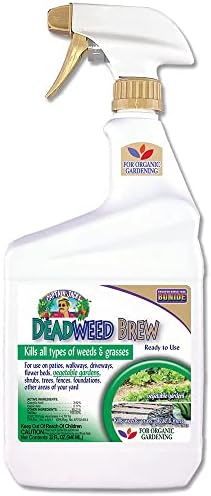
This 32-ounce Deadweed Brew comes ready to spray, with a nozzle for direct application. Bonide describes it as a non-selective herbicide for broadleaf and grassy weeds. Its listed uses include borders, driveways, sidewalks, fence lines, and other areas where unwanted growth can be treated without contacting plants you want to keep.
The no-mix format makes it a straightforward option for occasional spot jobs. The product is approved for organic gardening, and its description says it can work in temperatures as low as 40°F. It also states that the spray becomes waterproof after it dries. These features may be useful for outdoor applications, but they do not make the product suitable for spraying across a lawn: it can affect grass as well as weeds.
Compared with the ECO Garden PRO spray, this is another ready-to-use choice, but the supplied description does not specify its ingredients. Compared with the Bonide concentrate, it is simpler to apply but offers less flexibility for mixing larger batches.
Pros:
- Ready-to-use format with a spray nozzle.
- Approved for organic gardening.
- Listed for use in several non-lawn areas, including paths and fence lines.
- Product information gives a minimum working temperature.
Cons:
- Non-selective; it can damage turf and desirable plants it contacts.
- Not the right choice for treating weeds throughout a lawn.
Verdict: Pick this ready-to-use spray for small, controlled jobs away from grass you want to preserve.
Sunday Lawn Weed Killer & Greening Kit: The Lawn-Focused Pick

This two-formula kit is the most directly aimed at lawn care in this group. Weed & Green is described as a lawn treatment that uses iron (Iron HEDTA) to target weeds while greening the lawn. The product lists dandelion, oxalis, white clover, chickweed, thistle, and plantain among its targets. Its coverage depends on whether you use it for post-emergent treatment or pre-emergent use, so check the directions for the application you plan to make.
The kit also includes Weed Warrior, a separate non-selective spray for driveways, walkways, and garden beds. Its ammoniated-soap formula is described as acting on contact, and the product says weeds may wilt in 20 minutes. Weed Warrior is OMRI Listed for organic gardening, but its non-selective action means it can kill any plants it touches. Keep it separate from lawn applications.
For convenience, the lawn formula attaches to a hose, while Weed Warrior has a trigger sprayer. There is no mixing listed for either product. The distinction between the two formulas is important: this is more versatile than a single spot-treatment spray, but only Weed & Green is presented for use on the lawn itself. Larger, established weeds may need repeated applications, according to the product description.
Pros:
- Includes a formula specifically described for lawn weed control.
- Combines lawn treatment with a separate spot-treatment spray.
- Hose attachment and trigger sprayer avoid concentrate mixing.
- Lists common lawn weeds and provides separate coverage information.
Cons:
- Weed Warrior is non-selective and can damage grass or plants it touches.
- Coverage varies by formula and application, so directions matter.
Verdict: This is the best fit of the five for shoppers who want an organic-gardening lawn treatment, provided they use Weed & Green on turf and reserve Weed Warrior for suitable non-lawn areas.
Bonide Captain Jack’s Deadweed Brew Concentrate: For Larger Spot-Treatment Jobs

This 128-ounce Bonide option is a concentrate rather than a ready-to-use spray. It mixes with water and is applied using a standard handheld or backpack sprayer. The product is described as non-selective, with uses that include borders, sidewalks, fence lines, and other places where you want to remove weeds and grass.
The larger container and mix-your-own format may suit people who have repeated spot-treatment work or already own a compatible sprayer. It asks more of the user than the ready-to-use Bonide bottle: you need to follow the label for dilution and application, and you need to prevent spray from reaching wanted turf or plants.
Like the ready-to-use version, this product is described as approved for organic gardening and fast acting. Its non-selective action is the key limitation for lawn use. It should be treated as a weed-and-grass killer for appropriate areas, not as a selective treatment for weeds growing among healthy grass.
Pros:
- Concentrated format for use with a handheld or backpack sprayer.
- Useful for treating larger or recurring non-lawn areas.
- Approved for organic gardening.
- Product information describes fast action and use after the spray dries.
Cons:
- Requires dilution and a separate sprayer.
- Non-selective, so it can kill lawn grass and desirable plants.
Verdict: Choose the concentrate if you need a mixable spot-treatment option and are comfortable measuring and applying it carefully.
Energen Carolina Vinegar Weed & Grass Killer: Concentrated Organic-Acid Formula

Energen Carolina’s formula is a concentrated, quick-acting contact herbicide containing an organic acid. Its description names crabgrass, clover, dandelions, and ground ivy, and lists uses such as sidewalks, mulch beds, pavers, fence rows, and animal enclosures. The product is approved for organic production and is presented as an alternative to products containing glyphosate.
As a concentrate, it requires careful use according to the label rather than simply spraying it straight from a ready-to-use container. The product description says that foliar contact can rapidly desiccate annual weeds and grasses, and that treated areas can be used by pets and children once dry. Follow the label’s exact instructions and do not assume that this makes the spray appropriate for a lawn.
This option has a similar role to ECO Garden PRO: both are vinegar-based choices for treating unwanted growth in places where you do not want plants. The important trade-off is that Energen is concentrated, while ECO Garden PRO is ready to use. Neither is a selective lawn treatment, so avoid spraying across turf.
Pros:
- Concentrated formula for use where weeds and grass are unwanted.
- Lists several common weeds, including clover and dandelions.
- Approved for organic production.
- Product information explains when treated areas may be used again.
Cons:
- Non-selective, so it can injure lawn grass and other contacted plants.
- Requires careful label-directed application rather than a simple ready-to-use spray.
Verdict: Consider Energen for controlled treatment around hardscapes and beds, but choose a lawn-labeled formula for weeds growing in your grass.
How to Choose an Organic Weed Killer for Lawns
Check whether the product is selective
This is the most important factor. A non-selective product can kill grass along with weeds, making it a poor choice for spraying across a lawn. Vinegar-based sprays, ammoniated-soap formulas, and products labeled for killing weeds and grass are generally better suited to careful spot treatment where you want to remove all vegetation. Look for a formula specifically described for lawn use when treating weeds among turf.
Match the formula to the job
Ready-to-use sprays save you from measuring and mixing, which can be convenient for small areas. Concentrates may suit larger or recurring spot-treatment jobs, but they require a compatible sprayer and careful dilution according to the label. A kit with separate lawn and non-lawn formulas can cover more situations, as long as you keep the products and their directions distinct.
Identify the weeds you need to control
Product descriptions do not always list the same weeds. Check the label for the specific weed you have, and note whether it is an annual or perennial if that information is available. Some products state that larger, established weeds may need repeated treatment. A product that names clover or dandelions is not necessarily safe for spraying over the surrounding lawn.
Understand pre-emergent and post-emergent use
Post-emergent treatments target weeds that have already appeared. Pre-emergent use is intended to help prevent weeds before they emerge, but application timing and directions matter. Do not assume that a product offers both forms of control; confirm the intended use and coverage on its label.
Consider coverage and application tools
For a few weeds, a trigger spray or ready-to-use bottle may be practical. For broader coverage, check whether the product attaches to a hose or requires a separate handheld or backpack sprayer. Compare the stated coverage for the exact application you plan to make, and avoid applying a spot-treatment product over a larger lawn area unless the label permits it.
Read the safety directions carefully
Organic or natural ingredients can still harm plants and may require precautions around people, pets, and water. Follow the label for application, protective steps, and when an area can be used again. Keep spray off desirable grass, flowers, and vegetables unless the product specifically allows that use.
Frequently Asked Questions
Can I use vinegar weed killer directly on my lawn?
Do not assume that you can. Vinegar weed killers in this list are described as non-selective or as killing weeds and grass, so they can damage turf. Use a product specifically labeled for lawn application if you need to treat weeds growing among grass.
Which option is specifically intended for lawn weeds?
The Sunday Pre & Post-Emergent Lawn Weed Killer & Greening Kit is the clearest lawn-focused option in this group. Its Weed & Green formula is described for lawn use. The separate Weed Warrior spray is non-selective and should be reserved for suitable non-lawn areas.
Does “organic” mean a weed killer is safe for pets and children?
No. “Organic” describes the product or its intended use, but it does not mean every application is risk-free. Follow the label’s precautions and directions about keeping people and pets away during application and when they may return.
Will a contact weed killer remove the roots of established weeds?
The product descriptions focus on contact action, fast wilting, or drying of plant foliage. They do not guarantee that every established weed will be eliminated with one treatment. Check the label for guidance on repeat applications, especially for larger or perennial weeds.
Should I choose a concentrate or a ready-to-use spray?
A ready-to-use product is simpler for occasional, small spot treatments. A concentrate may be more suitable when you want to mix batches for a sprayer, but it requires careful measuring and dilution. In either case, use it only in areas and ways allowed by the label.
Can I use a non-selective spray on a driveway or walkway?
Several products here list driveways, sidewalks, or walkways as possible use areas. Apply carefully to the unwanted growth, keep the spray away from nearby plants and lawn grass, and follow all label directions.
Final Recommendation
For weeds growing in a lawn, the Sunday kit is the most directly relevant choice because its Weed & Green formula is described for lawn use. Its companion Weed Warrior spray serves a different purpose: it is non-selective and is meant for suitable areas such as walkways and beds. For the other four products, think of them as spot-treatment options for places where you do not want grass or other plants—not as blanket lawn sprays.