

If you’re looking for the best mini trampoline for heavy adults, start with the listed weight capacity, frame stability, and room to move—not just the trampoline’s size. The options below use bungee or elastic-cord systems rather than traditional springs, and several include adjustable handlebars for balance. Check the manufacturer’s capacity and assembly instructions before you buy, and use a rebounder with one person at a time.
Quick Comparison
| Product | Listed capacity | Standout features | Best fit |
|---|---|---|---|
| BCAN BT2 48-Inch Rebounder | 550 lbs | Bungee bounce; three-height handlebar | Stable-feeling support and quiet indoor workouts |
| JUMPZYLLA Mini Rebounder | 450 or 550 lbs, depending on configuration | Foldable design; four-level handlebar | Compact storage, if the model is available |
| SkyBound 40-Inch Mini Trampoline | 600 lbs | Elastic bungees; three-height handlebar | Shoppers prioritizing the highest listed capacity |
| HXD-ERGO Foldable Rebounder | 460 lbs | Folds to 14 by 30 inches; adjustable handlebar | Smaller storage spaces |
| ANCHEER 50-Inch Foldable Trampoline | 550 lbs | Large jumping surface; 48 bungee cords | More room for foot placement |
Our Picks: Best mini trampoline for heavy adults reviews
BCAN BT2 48-Inch Rebounder: A Strong All-Around Choice

The BCAN BT2 is a 48-inch rebounder with a listed capacity of 550 pounds. Its bungee system is designed for a quieter, smoother bounce than a spring-based setup, which may suit indoor workouts where noise and impact are concerns.
BCAN lists 32 mm alloy legs with reinforced threading, a strengthened handlebar, and a jumping mat stitched with nylon thread. The handlebar adjusts to three heights, from 2 feet 7 inches to 3 feet 2 inches. The product information says the rebounder arrives with most of its bungees pre-assembled and can be set up in about 10 minutes, though your actual setup time may vary.
Compared with the other picks, the BCAN combines a relatively large frame, a high listed capacity, and a handlebar that can be adjusted for different users. The SkyBound has a higher stated capacity, while the ANCHEER has a wider 50-inch surface. The BCAN may be a good middle ground if you want a bungee rebounder and a handhold without choosing the largest model.
Keep in mind that a supportive handlebar is not a substitute for a stable stance or following the assembly directions. Before each workout, check that the legs and handlebar are secured and that the unit is on a level surface.
Pros:
- Listed capacity of 550 pounds
- Quiet-style bungee system instead of metal springs
- Three adjustable handlebar heights
- Reinforced legs and handlebar are highlighted in the product specifications
Cons:
- The handlebar’s maximum height may not suit every user
- At 48 inches, it needs more floor space than a smaller rebounder
Verdict: Choose the BCAN if you want a 48-inch bungee rebounder with a 550-pound listed capacity and an adjustable handlebar.
JUMPZYLLA Mini Rebounder: Foldable Design with Flexible Handle Settings
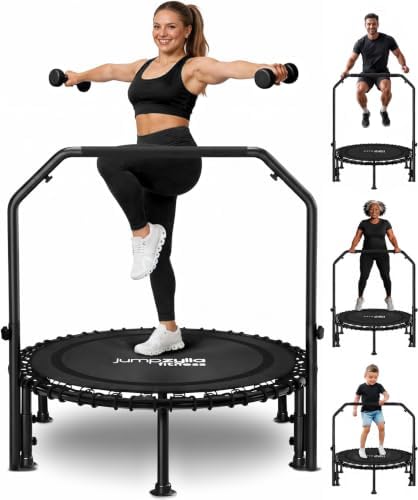
The JUMPZYLLA is a foldable adult rebounder with high-tensile bungees, a reinforced frame, and a padded handlebar with four height settings. Its product description lists capacity options of 450 or 550 pounds, so confirm which version is being offered before ordering.
The folding design is the main practical draw. The manufacturer says the rebounder arrives partly assembled, unfolds for use, and folds for storage. That can make it easier to put away in a smaller home than a trampoline that stays set up all the time. Its bungee system is also designed for quiet, lower-impact movement.
There is an important buying caveat: this product is marked unavailable in the supplied product information. Availability can change, but it is not the most reliable choice if you need a rebounder now. If it becomes available, compare the capacity of the exact configuration with your needs rather than relying on the range in the product title.
Pros:
- Foldable design intended for compact storage
- Four handlebar height settings
- Bungee system is designed for quieter bouncing
- Partly assembled design may reduce setup work
Cons:
- Marked unavailable in the supplied product information
- Capacity varies by configuration, so confirm the exact model
Verdict: Consider the JUMPZYLLA if it becomes available and you want a foldable design, but verify the exact capacity before choosing it.
SkyBound 40-Inch Mini Trampoline: Highest Listed Capacity

The SkyBound is a 40-inch rebounder with a listed capacity of up to 600 pounds, the highest stated figure among the five options here. It uses elastic bungee cords and has a foam-covered U-shaped handlebar for added support during a workout.
The handlebar has three height settings: 2 feet 7 inches, 3 feet 1 inch, and 3 feet 4 inches. The trampoline is described as about 70% pre-assembled and foldable after removing the handlebar and legs as directed. Its smaller diameter may make it easier to fit into a room than the 48- and 50-inch choices, but it also provides less jumping area.
Capacity is a key reason to consider this model, but it is not the only measure of fit. Check the assembled dimensions, handlebar position, and storage steps against your space and routine. If you want more room to move, the ANCHEER’s 50-inch surface or the BCAN’s 48-inch frame may be a better match.
Pros:
- Listed capacity of up to 600 pounds
- Three handlebar height options
- Foldable design for storage
- Mostly pre-assembled, according to the product description
Cons:
- The 40-inch frame offers less jumping space than larger picks
- Folding requires removing the handlebar and legs as directed
Verdict: The SkyBound is the clearest choice if the highest listed capacity is your priority and a 40-inch jumping area works for you.
HXD-ERGO Foldable Rebounder: Compact Storage for Smaller Homes

This HXD-ERGO rebounder comes in 42- or 48-inch sizing, depending on the option selected, and has a listed capacity of 460 pounds. Its 24 elastic bands replace metal springs, and the product description highlights a reinforced hexagonal frame and a tear-resistant jumping surface.
Storage is its main advantage: the maker says it folds to 14 by 30 inches. The padded handlebar adjusts across three levels, from 40.5 to 44.5 inches, and the feet have rubber pads intended to reduce slipping and floor vibration. Those features make it worth considering if you need to pack the trampoline away between sessions.
Its 460-pound capacity is lower than the other available options in this comparison. If you are near that limit, leave a margin rather than treating the stated maximum as a target. Also check which size you are selecting, since the product is offered in two diameters.
Pros:
- Folds to a compact stated storage size
- Two size options are listed
- Three adjustable handlebar levels
- Elastic bands and rubber foot pads are designed for quieter indoor use
Cons:
- Listed capacity is lower than the other available picks
- Confirm the size option before ordering
Verdict: Pick the HXD-ERGO when compact storage matters most and its 460-pound listed capacity is comfortably above your needs.
ANCHEER 50-Inch Foldable Trampoline: More Room on the Jumping Surface

The ANCHEER stands out for its 50-inch hexagonal jumping surface, the largest listed size in this comparison. It has a 550-pound stated capacity, a heavy-duty steel frame, and 48 bungee cords securing the mat. The wider surface can be useful if you prefer more room to place your feet, but you will need to allow for its larger footprint when it is open.
The handlebar adjusts to three heights, from 43.2 to 51.2 inches. The product description says the trampoline arrives about 80% pre-assembled and folds down to less than a quarter of its full size. Those details make it an option for people who want a larger workout surface but also need a way to store it.
Compared with the BCAN, the ANCHEER offers a larger listed jumping area, while the BCAN describes thicker alloy legs and reinforced handlebar construction. The ANCHEER could suit a user who values room to move, but check the folded dimensions and the selected handlebar setup before deciding whether it works for your home.
Pros:
- Large 50-inch jumping surface
- Listed capacity of 550 pounds
- Three-level adjustable handlebar
- Foldable design and partly pre-assembled setup
Cons:
- Requires more open floor space than smaller models
- Product information does not provide the folded dimensions
Verdict: Choose the ANCHEER if a larger jumping surface matters more to you than having the smallest possible rebounder.
How to Choose a Mini Trampoline for Heavy Adults
Check the Listed Weight Capacity
Start with the manufacturer’s stated capacity for the exact size and configuration you plan to buy. Do not assume that similar-looking models share the same limit; the JUMPZYLLA, for example, is described with two capacity options. It is sensible to leave room below the listed maximum rather than choosing a trampoline that is right at your body weight. If the product page does not clearly identify the capacity for your configuration, ask the seller or choose a model with clearer specifications.
Look at the Frame and Leg Design
A sturdy frame and securely attached legs are important for a rebounder used regularly. Compare the product details for frame material, leg construction, reinforcement, and how the handlebar attaches. The descriptions here mention features such as reinforced steel or alloy frames, thicker leg tubing, and locking screws. These details can help you compare designs, but they do not replace correct assembly or regular checks for loose parts.
Choose a Jumping Surface That Fits Your Movement
A larger surface can give you more room for foot placement, while a smaller trampoline may be easier to fit into a tight workout area. The options here range from 40 to 50 inches. Measure the open floor space you can safely use, leaving room around the trampoline rather than measuring only the mat. Also consider your intended movement: gentle, controlled bouncing needs less room than workouts with more varied steps.
Decide Whether You Want Bungees or Elastic Bands
These models use bungees or elastic bands instead of traditional metal springs. Product descriptions present these systems as quieter and more forgiving for indoor exercise. The actual feel can differ by design, so consider how the cords attach and whether the manufacturer provides clear care or replacement guidance. Avoid choosing based on claims of “low impact” alone if you have a health concern; ask a medical professional whether rebounding is appropriate for you.
Make Sure the Handlebar Fits Your Height and Needs
An adjustable handlebar can offer a place to hold while you get used to the motion or work on balance. Compare the stated height range with your own height and preferred grip position. A handlebar should be firmly secured before use, but it is not a guarantee against a fall. If you need significant support to stand or move, ask a healthcare professional whether a rebounder is a suitable exercise option.
Think Through Setup and Storage
Some rebounders arrive partly assembled, while others require you to remove the legs or handlebar before folding. Read the setup and folding steps before buying, especially if you plan to move the trampoline often. Check the product’s folded dimensions when available, and make sure you have a safe place to store it where the frame cannot fall or create a trip hazard.
Use It Safely Indoors
Set the rebounder on a level surface with enough clear space around it. Follow the manufacturer’s assembly and use instructions, inspect the frame and cords regularly, and stop using the unit if parts look damaged or loose. Use it with one person at a time, wear suitable footwear or follow the manufacturer’s guidance, and begin with controlled movements rather than high jumps.
Frequently Asked Questions
What weight capacity should I look for?
Choose a model whose stated capacity is higher than your body weight, with some room to spare. Confirm the limit for the exact size or configuration you are buying, and follow the manufacturer’s instructions.
Which option has the highest listed capacity?
The SkyBound 40-inch rebounder has the highest stated capacity in this group, at up to 600 pounds. Capacity alone does not determine whether a trampoline is the right fit, so also check its size, handlebar, and storage needs.
Are bungee rebounders quieter than spring trampolines?
The product descriptions for these bungee and elastic-band models emphasize quieter use than traditional spring designs. Noise can still depend on assembly, flooring, and the condition of the cords and frame.
Is a larger mini trampoline better for a heavy adult?
Not always. A wider surface can provide more room for foot placement, but size does not tell you the capacity or stability of a rebounder. Compare the listed capacity, frame details, and the space available in your home.
Can I leave the handlebar on while folding the rebounder?
Folding steps vary by product. The SkyBound description says to remove the handlebar and legs as directed, while other models describe different folding designs. Follow the instructions for your specific trampoline rather than forcing it closed.
Can more than one person use a mini rebounder at once?
No. Use a mini trampoline with one person at a time. A stated weight capacity does not mean the surface is designed for multiple people jumping together.
Which rebounder is best for a small home?
The HXD-ERGO lists a folded size of 14 by 30 inches, and the JUMPZYLLA is also described as foldable, though it is marked unavailable in the supplied product information. Check the exact folded dimensions and storage steps before choosing.
Final Recommendation
For a balance of capacity, a bungee bounce, and an adjustable handlebar, the BCAN BT2 is a strong all-around option. Choose the SkyBound if its 600-pound listed capacity is your main priority, or the ANCHEER if you want the widest listed jumping surface. Whichever you select, confirm the capacity for your exact model, make sure it fits your space, and follow the assembly and safety instructions.