

Choosing the best fertilizer for trees and shrubs starts with knowing what your plants need. Some products deliver nutrients through slow-release spikes, while others combine plant food with insect control. The options below cover both approaches, so you can compare the formula, application style, and intended use before choosing.
Quick Comparison
| Product | Type and formula | Best for | Standout feature |
|---|---|---|---|
| BioAdvanced 12 Month Tree & Shrub Protect and Feed Concentrate | Concentrate; slow-release plant food with insect control | Those who need feeding and listed-insect protection | Mix-and-pour application; protection for up to 12 months |
| Jobe’s Tree Fertilizer Spikes, 16-4-4 | Pre-measured fertilizer spikes | Deciduous trees and shrubs | No mixing or measuring |
| Jobe’s Slow Release Tree and Shrub Fertilizer Spikes, 15-3-3 | Slow-release spikes | Those who want a planned seasonal feeding routine | Pre-measured spikes; described for use twice a year |
| Winchester Gardens Landscaper Pack Tree and Shrub Fertilizer Spikes, 15-10-9 | Pre-measured spikes; 70 per case | Landscapes with several trees or shrubs | Bulk case with no-mess application |
| SimplyGro Tree & Shrub Fertilizer Spikes, 8-8-8 | Five-inch TruSpikes | General feeding for varied tree and shrub types | Designed to feed for up to three months |
Our Picks: Best fertilizer for trees and shrubs reviews
Best for Feeding and Listed-Insect Protection: BioAdvanced 12 Month Concentrate

BioAdvanced combines slow-release plant food with insect control in a liquid concentrate. The mix-and-pour format is different from the solid spikes in this guide: you prepare the product as directed and apply it around the plant rather than placing individual pieces in the soil.
The product is intended to kill listed insects, including Japanese beetles, emerald ash borers, adelgids, leafminers, and aphids, and to prevent new infestations for up to 12 months. That makes it a more specialized choice than a fertilizer meant only to supply nutrients. Its insect-control claims apply to the pests listed on the product, not to every insect that might affect a tree.
This option may suit you if you have a tree or shrub that needs feeding and you are also dealing with a listed pest. The trade-off is that you are choosing a product with insect-control ingredients, not just plant food. Read and follow the product label, including its directions and precautions, before applying it.
Pros:
- Combines slow-release plant food with insect control.
- Targets several listed insects that can damage trees and shrubs.
- Mix-and-pour application does not require spraying.
- One application is described as providing protection for up to 12 months.
Cons:
- Not the best fit if you want fertilizer without insect control.
- Requires mixing and careful label-directed use.
Verdict: Choose BioAdvanced when listed-insect control is part of your goal; for straightforward feeding without that added function, one of the spike options is a better match.
Best Higher-Nitrogen Spike Option: Jobe’s 16-4-4 Tree Fertilizer Spikes
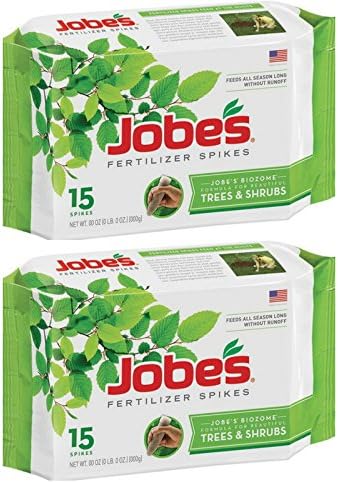
These Jobe’s spikes use a 16-4-4 formula and are intended for deciduous trees and shrubs. Their pre-measured format gives you a ready-to-place dose without mixing fertilizer in water or measuring loose material. The product description says nutrients are delivered below the surface, near the area where active roots are growing.
Spikes can be a practical choice when you want to avoid liquid mixing and reduce the chance of runoff or a messy application. They also require less preparation than a concentrate. You will still need to follow the package directions for how many spikes to use and where to place them for your particular plant.
Compared with the 15-3-3 Jobe’s spikes, this formula has a higher nitrogen number and lower phosphorus and potassium numbers. That distinction may help you compare labels, but it does not make one formula automatically right for every yard. Consider the needs of your plants and any soil-test guidance before choosing.
Pros:
- Pre-measured spikes eliminate mixing and measuring.
- Made for deciduous trees and shrubs.
- Designed to supply nutrients below the soil surface.
- The product description says it feeds all season.
Cons:
- Spikes need to be placed in the soil, so application involves more than scattering fertilizer.
- Its 16-4-4 formula may not suit every plant or soil condition.
Verdict: This is a convenient option for feeding deciduous trees and shrubs if its 16-4-4 formula fits your needs and you prefer pre-measured spikes.
Best for a Twice-a-Year Routine: Jobe’s 15-3-3 Slow-Release Spikes

These slow-release spikes have a 15-3-3 formula and come in a package of nine. They are described for use with a range of plants, including oak, maple, dogwood, and boxwood. Each spike is pre-measured, which makes the format straightforward for people who want to avoid handling loose fertilizer.
The product directions call for two applications a year, in early spring and late fall. That set schedule may appeal if you prefer a recurring routine, but it means you should plan for two feeding sessions rather than one. As with any spike product, placement and quantity matter, so use the label directions for your plant instead of guessing.
Compared with Jobe’s 16-4-4 option, this product has a lower nitrogen figure and is presented with a specific twice-yearly schedule. It may suit you if that formula and routine align with your needs. The package has fewer spikes than the Winchester Gardens case, so it may be more practical for a smaller number of plants.
Pros:
- Pre-measured spikes make dosing simpler.
- Slow-release formula is designed to provide a continuous supply of nutrients.
- Described for several familiar tree and shrub types.
- Includes a clear twice-a-year application schedule.
Cons:
- The package contains nine spikes, which may not go far for a large landscape.
- Requires following a seasonal application routine and placing spikes in the soil.
Verdict: Pick these Jobe’s spikes if you want a pre-measured product with a stated twice-a-year schedule and the 15-3-3 formula suits your planting needs.
Best Bulk Pack for Larger Landscapes: Winchester Gardens 15-10-9 Spikes

Winchester Gardens packages 70 fertilizer spikes in a case, making this the largest pack in the lineup. The listed formula is 15-10-9, and the product description says the spikes contain macronutrients for plant growth. Pre-measured doses are intended to make application tidier and reduce waste from runoff.
The larger quantity may be useful if you care for multiple trees and shrubs or want more spikes on hand. It is less appealing if you have only one small plant or want to try a fertilizer before committing to a bulk case. The product description calls the spikes child- and pet-friendly, but you should still follow the package instructions and keep any fertilizer safely stored.
Unlike the SimplyGro option, the supplied description does not specify how long each spike feeds or give a seasonal schedule. That makes the label especially important when deciding how many spikes to use and how often to apply them. The 15-10-9 formula also differs from the other spike choices, so compare the numbers rather than choosing on pack size alone.
Pros:
- Large case of 70 pre-measured spikes.
- Designed for a no-mess application with no runoff, according to the product description.
- Uses a 15-10-9 formula.
- Less packaging per spike than smaller packs, as described by the manufacturer.
Cons:
- The bulk quantity may be more than needed for a small yard.
- The supplied product details do not state a feeding duration or application schedule.
Verdict: Winchester Gardens is worth considering when you need many spikes, but check the label and compare its formula with your plants’ needs before buying a full case.
Best Balanced Formula for Many Plant Types: SimplyGro 8-8-8 TruSpikes

SimplyGro uses an 8-8-8 formula and is described for deciduous, coniferous, decorative, flowering, and fruiting trees and shrubs. The package contains 24 spikes, each five inches long. The product calls them TruSpikes and says they can be driven into the ground without a plastic cap or special equipment.
The balanced formula makes this a broad-use option if you want one product for different types of trees and shrubs. Each spike is designed to feed continuously for up to three months. The product recommends applying twice a year, once in spring and once in fall, so follow its label when planning your schedule and amounts.
Compared with the other spike products here, SimplyGro provides the clearest description of its formula, intended plant range, spike size, and feeding duration. Its 8-8-8 numbers are not a guarantee that it is the right choice for every soil or plant, though. A soil test or plant-specific guidance can help you avoid applying nutrients your yard does not need.
Pros:
- Balanced 8-8-8 formula for a broad range of tree and shrub types.
- Twenty-four spikes per package.
- Designed to feed for up to three months per application.
- Product description says no special equipment or plastic cap is needed.
Cons:
- Requires driving spikes into the soil rather than using a simple liquid application.
- The recommended twice-yearly routine may not suit someone seeking a single annual application.
Verdict: SimplyGro is a strong general-purpose spike option if you want a balanced formula for several kinds of trees and shrubs and are comfortable applying it twice a year.
How to Choose Fertilizer for Trees and Shrubs
Start with the plant and soil
Different plants and growing conditions can call for different nutrients. Before buying, identify which trees and shrubs you plan to feed and look for any plant-specific guidance. A soil test can help show whether your yard needs added nutrients, which may be more useful than choosing a fertilizer based only on its label numbers.
Compare the NPK numbers
The three numbers on a fertilizer formula represent nitrogen, phosphorus, and potassium. The products here include 16-4-4, 15-3-3, 15-10-9, and 8-8-8 formulas. Compare these figures with your plant and soil needs; a higher number or a more balanced formula is not automatically better for every garden.
Choose spikes or concentrate
Spikes come pre-measured and are placed in the soil, so they avoid mixing and can help limit loose fertilizer runoff. They do require you to position them as directed. A concentrate, such as BioAdvanced, must be mixed and applied according to its label, but it combines plant food with insect control. Choose the format that fits the work you are willing to do and the purpose you have in mind.
Decide whether you need insect control
Fertilizer and pest control are not the same thing. BioAdvanced is the only option in this group that also targets listed insects. If you only want to feed your plants, a fertilizer spike may be a more direct choice. If you are considering insect control, confirm that the pest affecting your plant is listed on the product label and follow all label directions and precautions.
Check application timing and coverage
Some products provide a stated schedule or duration, while others require you to rely on the package directions. Jobe’s 15-3-3 spikes are described for use twice a year, and SimplyGro recommends spring and fall applications, with feeding for up to three months per application. Check how many plants you need to treat and how many spikes the package contains before choosing a pack size.
Consider storage and safe handling
Read the label before use and store fertilizer as directed. Even when a product is described as child- or pet-friendly, do not assume that it can be handled or stored without precautions. Keep products in their original packaging and follow any instructions about application, access, and cleanup.
Frequently Asked Questions
What is the best fertilizer for trees and shrubs?
The best choice depends on your plants, soil, and application preferences. SimplyGro offers a balanced 8-8-8 formula for many plant types, while the Jobe’s and Winchester Gardens options provide different formulas in spike form. BioAdvanced adds insect control for pests listed on its label.
Are fertilizer spikes easier to use than liquid fertilizer?
Spikes avoid mixing and measuring, and the products in this guide are pre-measured. However, they must be placed in the soil as directed. A concentrate requires mixing but may be preferable if you want a mix-and-pour product.
Can I use one fertilizer for both trees and shrubs?
Several products here are made for both trees and shrubs, but that does not mean every formula suits every plant. Check the product label and consider the needs of your specific plants and soil before applying it.
How often should I fertilize trees and shrubs?
Follow the schedule on the product label. The products in this guide do not all have the same timing: some descriptions give a twice-a-year routine, while BioAdvanced describes insect protection for up to 12 months. Protection duration and feeding instructions are not interchangeable, so check the label for application guidance.
Does a higher NPK number mean a better fertilizer?
No. The NPK numbers show the proportions of nitrogen, phosphorus, and potassium, but higher numbers do not make a product right for every plant or soil. Match the formula to your plants’ needs and use soil-test guidance when available.
Should I choose a fertilizer that also controls insects?
Only if you need that added function and the pest is listed on the product label. BioAdvanced combines feeding with control for several listed insects. If your goal is nutrition alone, a fertilizer-only spike is a more focused option.
Final Recommendation
For a broad-use fertilizer spike, SimplyGro stands out for its 8-8-8 formula and stated use across many tree and shrub types. Choose Jobe’s 16-4-4 or 15-3-3 spikes if their formulas and application details better match your needs, or Winchester Gardens if you need a larger case. BioAdvanced is the specialized pick when you want plant food along with control of insects listed on its label. In every case, check the product directions and choose based on your plants and soil rather than applying more fertilizer than needed.