

Cutting metal with a grinder throws sparks and leaves rough edges, while a portable band saw is built for straighter, more controlled cuts in pipe, tube, bar, and angle iron. The four saws below all list a 10 amp motor, a cutting capacity of about 5 inches, and a removable base that lets you switch between handheld and benchtop work. They differ in speed range, included extras, and base capacity. Use the table for a quick look, then read each pick to see which one matches the metal you cut most often.
| Product | Motor | Cutting Capacity | Speed | Angle | Best For |
|---|---|---|---|---|---|
| VEVOR Portable Band Saw | 10 amp, 1100W | 5 inch round, 4.7 by 4.7 inch rectangular (base off) | 137.8 to 472.4 ft/min | 0 to 45 degrees | Mixed materials, high top speed |
| Anbull Portable Band Saw | 10 amp, 1100W | 5 inch round, 5 by 4-3/4 inch rectangular (base off) | 100 to 350 ft/min | 0 to 45 degrees | Steel cutting with speed guidance |
| DOVAMAN Portable Band Saw | 10 amp | 5 inch | 2.3 to 7.9 ft/s, six speeds | 0 to 45 degrees | Beginners wanting a full kit |
| PowerSmart Portable Band Saw | 10 amp | 5 inch width and depth | 0 to 435 ft/min, six speeds | 0 to 45 degrees | Work light and tool-free blade changes |
Our Picks: Best portable band saws for metal cutting reviews
VEVOR Portable Band Saw: High Top Speed for Mixed Materials

VEVOR stands out for its top speed. The listed cutting speed runs from 137.8 to 472.4 feet per minute, so you can slow down for tougher steel or speed up for aluminum, PVC, and other softer stock. Only DOVAMAN lists a comparable top end. The 1100W, 10 amp pure copper motor is in the same class as Anbull’s, and the listing says it cuts without sparks or burrs.
Capacity is the other draw. With the base off, it handles rectangular stock up to 4.7 inches by 4.7 inches and round stock up to 5 inches. Bolt the base on and that drops to 3.9 by 3.2 inches for rectangular stock and 3.93 inches for round. The base swivels from 0 to 45 degrees, so the saw can double as a small benchtop cutoff saw. The soft grip rear handle and adjustable blade guard are sensible touches, but the listing mentions no work light or tool-free blade change. Pick it if you cut a mix of materials and want the broadest speed range.
Pros:
- High top speed of 472.4 feet per minute
- Large 5 inch round capacity with the base removed
- Soft grip handle and adjustable blade guard
- Base swivels from 0 to 45 degrees
Cons:
- No work light or tool-free blade change mentioned
Verdict: A strong all-rounder if you cut steel, aluminum, and PVC and want plenty of speed headroom.
Anbull Portable Band Saw: Clear Speed Guidance for Cutting Steel
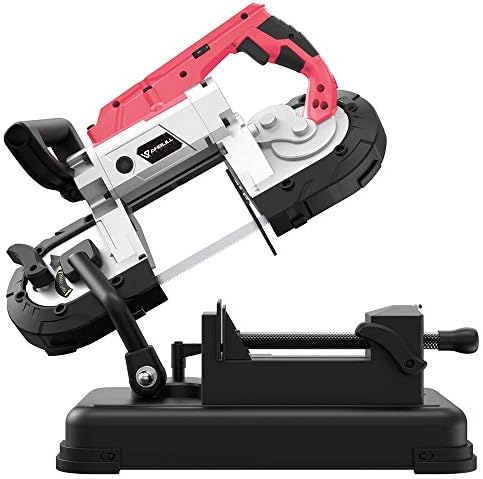
Anbull is the most guided saw here. Its listing spells out which gear to use: start hard materials at the third speed, keep stainless steel at third gear or lower, use fourth or fifth for 45# steel, and sixth for galvanized pipe. If you have never set a band saw’s speed before, that cheat sheet saves guesswork. Its six speeds run from 100 to 350 feet per minute, the lowest ceiling in this group, which suits steel work better than fast cuts in softer stock.
The base is described as upgraded and weighs 14.6 pounds, which is meant to keep the work from sliding during precision cuts but adds heft when you carry it. Without the base you get 5 by 4-3/4 inches for rectangular stock; with it, 4 by 3.2 inches. It ships with one 14 TPI blade, and you can swap in 10-14, 14-18, or 24 TPI blades for other materials. A steel shroud and rubber bumpers are meant to handle jobsite knocks. Choose it if you mostly cut steel and want clear speed guidance.
Pros:
- Listing gives gear-by-gear speed advice by material
- Accepts three blade TPI ranges for different jobs
- Steel shroud and rubber bumpers for jobsite use
- Base weighs 14.6 pounds, which keeps the work steady
Cons:
- Top speed of 350 feet per minute is the lowest here
Verdict: Best for steel-focused work and for buyers who want help choosing the right speed.
DOVAMAN Portable Band Saw: A 2-in-1 Kit With Two Blades Included

DOVAMAN is the kit-focused pick. The box includes two blades, a detachable base, a hex wrench, a socket component, and a manual, so you have a spare blade from the start. It is billed as a 2-in-1: use it handheld for flexible cutting, or mount it to the base for stable benchtop work, with the angle adjustable from 0 to 45 degrees for bevel and angle cuts.
Its six speeds run from 2.3 to 7.9 feet per second, which works out to a range close to VEVOR’s. The handle is non-slip and ergonomic, and the built-in blade guard helps contain debris. The listing names metal pipes, steel, wood, and plastic as target materials. What it leaves out matters, though: there is no rectangular capacity, no base weight, and no capacity figure with the base attached. Its stock status can also change, so check the listing before you plan a job around it. It suits first-time buyers who want everything in one box.
Pros:
- Two blades, a wrench, and a manual in the box
- Works handheld or mounted to the base
- Six speeds with a non-slip ergonomic handle
- Angle adjusts from 0 to 45 degrees
Cons:
- Listing omits rectangular capacity and base weight
- Stock status can change
Verdict: A good grab-and-go kit for beginners, provided you can find it in stock.
PowerSmart Portable Band Saw: Work Light and Tool-Free Blade Changes

PowerSmart packs the most convenience features into this lineup. You get an LED work light, a dual bearing blade guide, and a tool-free blade changing lever, none of which the other listings mention. Two 14 TPI blades come in the box, and the speed dial covers 0 to 435 feet per minute across six settings. The 10 amp motor is described as lower noise, with no sparks or burrs.
Cutting width and depth are both listed at 5 inches for round or rectangular stock, which is more square capacity than the other listings state for the bare saw. The listing does not give a separate figure with the base on. The base is removable alloy steel and rotates from 0 to 45 degrees. The catch is weight: 30 pounds with the base, which is easier on a bench than held up for long. Pick this one if you change blades often or work in dim spaces.
Pros:
- LED work light and dual bearing blade guide
- Tool-free blade changing lever
- Two 14 TPI blades included
- Speed dial reaches 435 feet per minute
Cons:
- 30 pounds with the base attached makes overhead work tiring
Verdict: The best pick for convenience features, and the one to choose if you swap blades often.
How to Choose a Portable Band Saw for Metal Cutting
Check the cutting capacity with and without the base
Every saw here advertises about 5 inches, but that number usually applies to round stock with the base removed. Once you attach the base, capacity drops. VEVOR lists 3.9 by 3.2 inches for rectangular stock with the base on, and Anbull lists 4 by 3.2 inches. Measure the thickest pipe, tube, or bar you cut, then compare it to the figure for the way you plan to use the saw.
Match the speed range to your material
Harder metals like stainless steel need slower blade speeds, while aluminum and plastic can take faster ones. A wider range gives you more room to adjust. VEVOR and DOVAMAN reach about 472 to 474 feet per minute, the PowerSmart saw reaches 435, and Anbull tops out at 350. If you only cut steel, a lower ceiling is fine. If you cut many materials, a wider range helps.
Think about the base and the angle
A removable base turns a handheld saw into a benchtop cutoff saw, which keeps the work steady and makes repeat cuts easier. All four saws let the angle swing from 0 to 45 degrees. Weight matters here. Anbull’s base alone is 14.6 pounds, and the PowerSmart weighs 30 pounds with the base attached. If you work overhead or carry the saw between jobs, pick a saw you can comfortably lift.
Look at blades and how easily you can change them
Anbull and PowerSmart list 14 TPI blades, a common choice for general metal cutting. Anbull’s listing says you can also fit 10-14, 14-18, or 24 TPI blades for different materials. DOVAMAN and PowerSmart include two blades, so you have a spare. PowerSmart also lists a tool-free blade changing lever, which saves time if you swap blades often.
Consider handling, safety, and extras
A soft or non-slip grip, an adjustable blade guard, and good balance all help you control the cut. PowerSmart adds an LED work light and a dual bearing blade guide. Anbull and PowerSmart both list a steel shroud, and Anbull adds rubber bumpers for rough jobsites.
Protect yourself and secure the work
Metal cutting calls for more care than wood. Wear safety glasses or goggles, because chips and fragments can fly, and wear hearing protection during longer cuts. Clamp the workpiece firmly in a vise or to the bench before you start, since a loose piece can twist and jam the blade. Freshly cut edges can be sharp and hot even when a listing says the cut is burr-free, so wear work gloves when you handle them and let the metal cool before you pick it up. Keep your hands clear of the blade and let it reach full speed before it touches the work.
Frequently Asked Questions
Can a portable band saw cut steel?
Yes. All four saws here are listed for cutting metal or steel, and most also list aluminum, PVC, or pipe. Choose a lower speed setting for harder metals like stainless steel.
Do these saws make sparks?
The listings for VEVOR, Anbull, and PowerSmart say cuts come out without sparks or burrs. Even so, treat fresh cuts as sharp and hot until the metal cools, and wear eye protection.
What is the difference between using the base and going handheld?
The base holds the saw steady for benchtop cuts and makes repeat cuts easier. Handheld use gives you more flexibility for long or awkward pieces. Keep in mind that capacity is smaller with the base on.
Which saw is best for beginners?
DOVAMAN includes two blades and the tools to get started, and Anbull gives clear speed advice by material. Both make setup easier, though DOVAMAN’s stock status can change, so check its listing.
What safety gear do I need for cutting metal?
Wear safety glasses or goggles and hearing protection, and use work gloves for handling cut pieces. Clamp the work before cutting, and remember that freshly cut edges can be sharp and hot.
Can I use these saws on wood or plastic?
The VEVOR and DOVAMAN listings mention wood, plastic, or PVC, and the Anbull listing mentions PVC pipe. For any material, match the blade and the speed to the job.
Final Recommendation
For most buyers, VEVOR is the best starting point because of its high top speed and generous capacity with the base off. Choose Anbull if you mostly cut steel and want speed guidance, DOVAMAN if you want a complete kit and can find it in stock, and PowerSmart if you value an LED light and tool-free blade changes more than saving weight. Measure your thickest stock first, decide how often you will use the base, and clamp your work and wear eye and ear protection whichever saw you pick.