

Choosing a portable battery generator for off-grid living means balancing power capacity, appliance needs, recharge options, and how far you need to carry it. A compact unit can keep phones and laptops charged, while a larger power station can handle a refrigerator or several household devices. These five picks range from lightweight backup power to high-capacity systems with solar panels, so you can match the setup to your daily needs.
Quick Comparison
| Power station | Battery capacity | Continuous AC output | Portability and solar |
|---|---|---|---|
| Daran CUBUS 350M | 230.4Wh | 350W | 6.9 lb; solar panels sold separately |
| CTOLITY AP1000 | 1,024Wh | 1,800W | Under 30 lb; solar panels sold separately |
| EF ECOFLOW DELTA 3 Classic Solar Generator | 1,024Wh | 1,800W | Includes two 100W solar panels |
| SolarPlay Q3600 | 3,840Wh | 3,600W | 93.7 lb with wheels; includes two 400W solar panels |
| Dabbsson DBS3500 | 3,430Wh | 3,600W | 90.5 lb with wheels; solar panels sold separately |
Battery capacity estimates how much energy a station stores, while AC output helps determine what it can run at one time. Actual runtime varies with the device, power draw, and conversion losses.
Our Picks: Best portable battery generators for off grid living reviews
Best lightweight option for charging small essentials: Daran CUBUS 350M

The Daran CUBUS 350M is a small LiFePO4 power station built for lighter loads. Its 230.4Wh battery and 350W rated output suit phones, cameras, laptops, lights, and other devices that stay within the power limit. It also has two AC outlets, USB-A ports, a USB-C port, and a 12V DC output, making it useful when several small devices need charging.
At 6.9 pounds, it is the easiest pick here to move between a vehicle, campsite, or small off-grid space. A built-in LED light has several brightness modes, including SOS. You can recharge it from a wall outlet, a car socket, or compatible solar panels; the panels are sold separately.
The main trade-off is capacity. This is a compact backup for electronics, not a strong choice for running a refrigerator or other high-draw appliance for long periods. Its 350W output also sets a firm limit on what you can plug in. Compared with the larger stations here, it is much easier to carry but stores far less energy.
Pros:
- Lightweight, compact design with a foldable handle
- LiFePO4 battery rated for 3,000 or more charge cycles
- Multiple output types for charging small devices
- Built-in LED light with an SOS mode
Cons:
- Limited 230.4Wh capacity and 350W rated output
- Solar panels are sold separately
Verdict: Choose the CUBUS 350M if low weight and simple device charging matter more than powering household appliances.
Best balance of capacity and carry weight: CTOLITY AP1000

The CTOLITY AP1000 has a 1,024Wh LiFePO4 battery and 1,800W of continuous AC output, with a 3,600W peak rating. That combination makes it more versatile than a small electronics-focused unit: it can support devices such as refrigerators, routers, and small appliances, as long as their power needs fit the station’s limits.
It has 11 output ports and can recharge through an AC wall outlet, compatible solar panels, or a car connection. The manufacturer describes fast AC charging, with a stated 80% charge in 45 minutes and a full charge in about an hour. It also has an under-20-millisecond UPS function for devices that need a quick switch to battery backup.
The unit weighs under 30 pounds, making it easier to move than the two high-capacity stations below, though it is still a substantial piece of gear to carry over distance. Solar panels are sold separately, so factor in the extra equipment if you plan to recharge away from the grid. Its capacity is also much smaller than the 3,430Wh and 3,840Wh options in this guide.
Pros:
- 1,024Wh capacity with 1,800W continuous output
- 11 ports for connecting several devices
- AC, solar, and car charging options
- Under-20-millisecond UPS switching
Cons:
- Solar panels are sold separately
- Heavier and less convenient to carry than a compact power station
Verdict: The AP1000 is a practical middle-ground pick if you want more appliance capability than a small station offers but do not need a 3,000Wh-plus battery.
Best ready-to-recharge solar bundle: EF ECOFLOW DELTA 3 Classic

The EF ECOFLOW DELTA 3 Classic combines a 1,024Wh power station with two 100W solar panels. It offers 1,800W of continuous AC output and a 3,600W surge rating, making it a capable option for everyday electronics and some household appliances. Its X-Boost feature is designed to support certain loads up to 2,600W, but that should not be treated as the same as 2,600W of standard continuous output.
For off-grid use, the included panels make this a more complete starting setup than a station sold on its own. EcoFlow states that the two panels can recharge the unit in about 6.4 hours under its stated conditions. AC charging is another option, with a stated 0–80% charge time of 45 minutes. The station also has a UPS function that switches in under 10 milliseconds.
The capacity is the same as the CTOLITY AP1000, so neither is the best fit for long runtimes with several power-hungry appliances. The EcoFlow bundle’s advantage is that it includes solar panels, while the CTOLITY is described as weighing under 30 pounds. The station and panels may arrive separately, so plan for the possibility that they will not come at the same time.
Pros:
- Includes two 100W solar panels
- 1,800W continuous AC output and 1,024Wh capacity
- Fast AC charging and under-10-millisecond UPS switching
- LiFePO4 battery cells designed for long-term use
Cons:
- Its 1,024Wh capacity may be limiting for longer off-grid stays
- The station and panels may arrive separately
Verdict: Pick the DELTA 3 Classic if you want a mid-capacity power station with solar panels included and value quick AC charging and UPS support.
Best high-capacity package with solar panels: SolarPlay Q3600
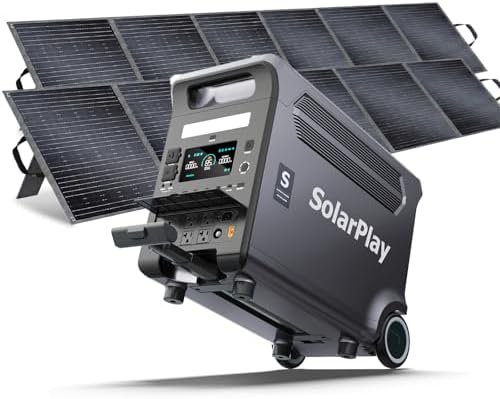
The SolarPlay Q3600 is a high-capacity system for people who need more than occasional phone and laptop charging. Its 3,840Wh LiFePO4 battery and 3,600W pure sine wave AC output can support a wider range of household and outdoor equipment than the smaller stations here. It includes two 400W solar panels and supports up to 2,000W of solar input.
At 93.7 pounds, it is not a station you will want to lift often. Integrated wheels and a telescopic handle help with moving it across a campsite or around a home, but rough ground and steps can still make transport difficult. It has 15 ports, including four AC outlets, a TT-30 outlet, USB-A and USB-C ports, and 12V outputs.
The large capacity and included solar panels make this a stronger fit for extended stays or more demanding backup needs than the 1,024Wh models. Its size and weight are the trade-offs, and it takes more effort to move than either the CTOLITY or EcoFlow. The manufacturer also describes a UPS mode with a switch time of 8 milliseconds or less.
Pros:
- Large 3,840Wh battery and 3,600W continuous AC output
- Includes two 400W solar panels
- Wheels and a telescopic handle help with transport
- 15 ports, including a TT-30 outlet
Cons:
- Heavy at 93.7 pounds, despite its wheels
- Large size is less convenient for frequent lifting or tight spaces
Verdict: The Q3600 is a strong choice if you want a high-capacity station with substantial solar panels included and can manage its bulky, wheeled design.
Best expandable high-capacity station: Dabbsson DBS3500

The Dabbsson DBS3500 pairs a 3,430Wh battery with 3,600W of continuous AC output. The manufacturer describes its battery as semi-solid LiFePO4 and rates it for up to 4,500 charge cycles. It also supports several recharging methods, including AC, solar, a car connection, and a generator.
One of its biggest strengths for off-grid living is its expansion path. The system can be paired with DBS5300B battery packs, and the manufacturer describes a configuration that can expand to 28,140Wh. That may suit a more established off-grid setup, though extra batteries and compatible equipment add to the size and complexity of the system.
The station weighs 90.5 pounds and has wheels and dual handles. Like the SolarPlay, it is portable in the sense that it can be moved, but it is not an easy option to carry by hand over distance. Unlike the SolarPlay package, this station does not include solar panels, so you will need to plan for compatible panels if solar recharging is important to you.
Pros:
- 3,430Wh capacity and 3,600W continuous AC output
- Can be expanded with compatible battery packs
- Supports AC, solar, car, AC-plus-solar, and generator charging
- Wheels help move the 90.5-pound unit
Cons:
- Heavy for frequent lifting or transport over rough ground
- Solar panels and expansion batteries are separate equipment
Verdict: Choose the DBS3500 if expandable storage matters more than having solar panels included in the initial package.
How to Choose a Portable Battery Generator for Off-Grid Living
Match battery capacity to your daily energy use
Capacity, measured in watt-hours (Wh), indicates how much energy a battery stores. Make a list of the devices you expect to run and check their wattage and estimated daily use. A 230.4Wh station can suit a few small electronics, while a 1,024Wh or larger model offers more room for longer use or additional devices. Actual runtime is usually lower than a simple capacity calculation suggests because power conversion uses energy too.
Check both continuous output and surge output
Continuous AC output determines the load a station can support during normal operation. Surge output is a temporary peak, which can matter when some appliances start up. Check the power needs of each device and compare them with the station’s limits. Do not assume a high surge rating means the unit can run that load continuously.
Plan how you will recharge
For off-grid use, solar charging can reduce reliance on wall outlets, but panels must be compatible with the power station. Check the station’s solar input limits and the panel setup you plan to use. Bundles that include panels, such as the EcoFlow and SolarPlay options here, provide a more direct starting point. Other models require you to choose panels separately. Sunlight, panel placement, and weather affect charging time.
Think about weight and where you will move it
A compact station is easier to carry, but it stores less energy. Larger units can power more equipment, but models weighing around 90 pounds are best moved with wheels on suitable ground. Consider whether you will need to lift the station into a vehicle, carry it down steps, or move it over uneven terrain. A wheeled design helps, but does not make a heavy unit easy to lift.
Choose the right outlets for your equipment
Count the devices you may want to connect at once, then check the station’s mix of AC outlets, USB-A, USB-C, and 12V outputs. Also check the output rating of each port and whether your device needs a particular connection. If you are considering a CPAP machine, refrigerator, or other essential device, verify its power draw and test the complete setup before relying on it for extended off-grid use.
Consider battery chemistry and long-term use
Each model in this guide uses LiFePO4 battery technology, but cycle-life claims differ. A cycle rating is a guide to battery durability, not a guarantee of how long the whole station will last. Use the manufacturer’s guidance for charging, storage, temperature, and maintenance to help protect the battery over time.
Decide whether UPS support matters
A UPS function can switch a connected device to battery power during an interruption. The models in this guide state switch times ranging from under 10 milliseconds to under 20 milliseconds, depending on the unit. Check whether that timing works for your equipment, and follow the manufacturer’s instructions when using the power station as backup power.
Frequently Asked Questions
Can a portable power station run a refrigerator off-grid?
It depends on the refrigerator’s starting and running power, the station’s continuous and surge limits, and how long you need it to run. The CTOLITY, EcoFlow, SolarPlay, and Dabbsson models offer more output and capacity than the compact CUBUS. Check your refrigerator’s power requirements and allow for reduced runtime when it cycles on and off.
Which pick is easiest to carry?
The Daran CUBUS 350M is the lightest option in this group at 6.9 pounds. It is also the lowest-capacity model, so it is best suited to smaller devices rather than extended appliance use.
Which options include solar panels?
The EF ECOFLOW DELTA 3 Classic package includes two 100W solar panels, and the SolarPlay Q3600 package includes two 400W panels. Solar panels are sold separately for the Daran CUBUS 350M, CTOLITY AP1000, and Dabbsson DBS3500.
Is 1,024Wh enough for off-grid living?
It may be enough for a limited set of devices or shorter periods, but the answer depends on your daily energy use. For longer stays or more demanding loads, consider a higher-capacity option such as the SolarPlay Q3600 or an expandable Dabbsson DBS3500 setup.
Can I use one of these stations indoors?
These are battery power stations rather than fuel-burning generators. Follow the manufacturer’s placement and operating instructions, including any guidance about ventilation, temperature, and charging. Do not use a separate fuel generator indoors.
Do I need a power station with UPS support?
UPS support can help keep compatible electronics powered during an interruption. If you need backup for a computer, router, or other sensitive device, check the stated switch time and confirm that the station’s instructions support your intended use.
Final Recommendation
For light, portable charging, the Daran CUBUS 350M is the simplest choice. The CTOLITY AP1000 and EF ECOFLOW DELTA 3 Classic offer more output and capacity, with the EcoFlow bundle including solar panels. For longer off-grid use, the SolarPlay Q3600 is a compelling package with a large battery and panels included, while the Dabbsson DBS3500 stands out for its expansion options. Choose based on the appliances you need to run, how you will recharge, and whether you can manage a heavier unit.