

Portable battery generators can keep phones, lights, routers, and selected appliances running during an outage without the noise or exhaust of a gas generator. The right choice depends on what you need to power: a compact unit can cover small electronics, while a higher-capacity model is better suited to a refrigerator or a planned home-backup setup. These five options range from lightweight power stations to larger systems designed for more demanding backup needs.
Quick Comparison
| Portable power station | Capacity | Continuous output | Best for |
|---|---|---|---|
| Jackery Explorer 300 | 292Wh | 300W | Phones, laptops, and small devices |
| EcoFlow DELTA 3 | 1,024Wh | 1,800W | Fast charging and broader emergency power |
| Anker SOLIX S2000 | 2,010Wh | 1,500W | Longer backup for a refrigerator and essentials |
| Jackery HomePower 3600 Plus | 3,584Wh | 3,600W | Higher-capacity home backup |
| MARBERO 300W Portable Power Station | 237Wh | 300W | Compact backup for small electronics |
Our Picks: Best portable battery generators for home backup power reviews
Jackery Explorer 300: A lightweight pick for small essentials

The Explorer 300 is a small power station for keeping personal electronics working through a short outage. Its 292Wh battery and 300W rated output are suited to devices such as phones, laptops, cameras, and lights—not large household appliances. At 7.5 pounds, it is also one of the easiest options here to carry between rooms or take along on a trip.
It has two AC outlets, a 100W USB-C PD port, two USB-A ports, and a 120W car port, so several small devices can connect at once. The LiFePO4 battery is rated for more than 4,000 charge cycles before reaching 70% capacity. For recharging away from an outlet, it can pair with Jackery solar panels; the panels are sold separately.
The main trade-off is its modest capacity. It can be useful for communication and lighting, but it is not a practical choice for running a refrigerator or backing up a home circuit for long. Choose it when portability and small-device charging matter more than extended runtime.
Pros:
- Lightweight at 7.5 pounds with an integrated handle
- Multiple ports, including 100W USB-C PD
- LiFePO4 battery rated for more than 4,000 charge cycles to 70% capacity
- Can recharge with compatible solar panels
Cons:
- 292Wh capacity limits how long it can power devices
- Solar panel is sold separately
Verdict: Pick the Explorer 300 for portable backup of small electronics, not as the main power source for household appliances.
EcoFlow DELTA 3: Fast recharging with room for more devices

The DELTA 3 sits between compact personal power stations and larger home-backup units. Its 1,024Wh LiFePO4 battery and 1,800W AC output give it more headroom for everyday appliances than the smaller Jackery and MARBERO models. EcoFlow says it can charge from empty in 56 minutes using AC and solar input together, with 80% charge in 30 minutes.
It has enough ports to power up to 13 devices at once, and its battery can expand with compatible EcoFlow extra batteries, up to 5kWh within the DELTA 3 system. That flexibility can be useful if your backup needs grow. The battery is rated for 4,000 cycles to 80% capacity, and the battery pack has an IP65 rating for splash, dust, and oil protection.
Capacity is still a key limit: 1,024Wh may cover a selection of essentials, but runtime depends on what you connect and how much power those devices draw. A high output rating does not mean every appliance can run for a long time. Consider the DELTA 3 if quick recharging and expansion matter more than having the largest built-in battery.
Pros:
- 1,800W AC output for a broader range of devices
- Fast AC-and-solar charging option
- Expandable capacity with compatible EcoFlow batteries
- LiFePO4 battery rated for 4,000 cycles to 80% capacity
Cons:
- Its 1,024Wh capacity may be limiting for longer outages
- Expansion requires compatible extra batteries
Verdict: The DELTA 3 is a strong middle-ground choice if you want fast recharging, substantial output, and a path to add capacity.
Anker SOLIX S2000: More stored energy for longer essential backup
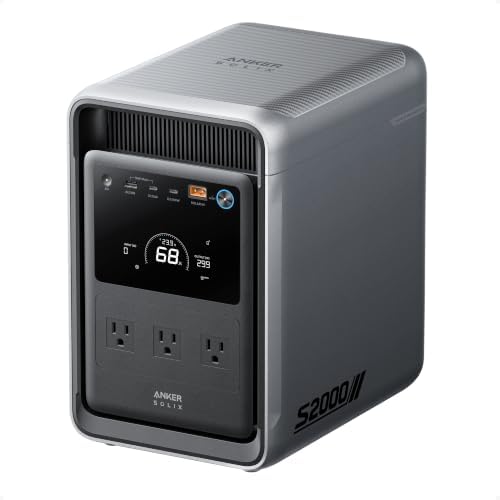
The SOLIX S2000 has a 2,010Wh LiFePO4 battery and 1,500W continuous output, making it better suited to home essentials than the smaller units in this group. Anker estimates up to 35 hours of refrigerator backup, but actual runtime depends on the refrigerator, its use, and the surrounding temperature. Treat that figure as a best-case guide, not a guarantee.
At 35.7 pounds, it is still movable, though it is heavier than a small personal power station. The design includes eight AC outlets arranged at the front and rear, but it has no 12V DC port. Anker also describes a UPS function with a switchover time under 10 milliseconds, which may suit home-office equipment; check your device’s requirements before relying on it for uninterrupted power.
The 1,500W output and 3,000W peak output suit many essentials, but they do not make this a whole-home solution. It supports up to 400W of solar input and several other charging methods. Its reported 10,000-cycle battery rating is a notable longevity claim, though the battery’s real-world service life will also depend on use and care.
At the time of writing, this product was unavailable.
Pros:
- 2,010Wh capacity for longer backup than compact models
- 1,500W continuous output and 3,000W peak output
- Eight AC outlets and a UPS function with under-10ms switchover
- Supports solar, wall, car, alternator, and generator charging methods
Cons:
- No 12V DC port
- At 35.7 pounds, it is less convenient to carry than smaller options
Verdict: Consider the SOLIX S2000 if refrigerator backup and a larger battery are priorities, while keeping its output and runtime limits in mind.
Jackery HomePower 3600 Plus: High output for a larger backup setup
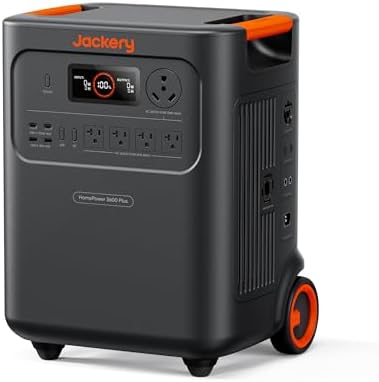
The HomePower 3600 Plus is the most substantial option here, with a 3,584Wh LFP battery and 3,600W AC output. That combination gives it more capacity and output headroom than the other picks, making it worth considering for a planned home-backup setup. It can be expanded to 21kWh per unit, with multiple units supporting a higher combined capacity.
Jackery says the unit can support 120V and 240V output when configured in parallel. It can also recharge using AC, solar, a gas generator, or a hybrid AC-and-DC method. The unit has a luggage-style design with wheels and a telescoping handle, which helps with moving it around, though its large capacity makes it less suited to frequent carrying.
For home use, plan the connection before an outage. The product is described as pairing with a manual transfer switch, so confirm the setup and electrical requirements for your home rather than assuming it connects directly to household wiring. Its 3,600W rating is not a promise that every appliance can run at once; check appliance starting and running wattage, especially for pumps and motors.
At the time of writing, this product was unavailable.
Pros:
- Largest built-in capacity in this group at 3,584Wh
- 3,600W AC output with expansion options
- Supports 120V and 240V output when configured in parallel
- Wheels and telescoping handle make it easier to move than a carry-only design
Cons:
- Its size and capacity make it less convenient for casual transport
- A home circuit setup requires planning and compatible equipment
Verdict: Choose the HomePower 3600 Plus for a higher-capacity backup plan, provided you are ready to manage its larger size and home-connection requirements.
MARBERO 300W: A compact option for lights and personal devices

At 4.6 pounds, the MARBERO is the lightest pick here. Its 237Wh battery and 300W output make it a small backup option for phones, tablets, lights, cameras, and some other low-wattage electronics. It has two AC outlets, USB-A and USB-C ports, a DC output, and built-in LED lights with several brightness and lighting modes.
The unit can recharge from a wall outlet, a car adapter, or a compatible solar panel. The solar panel is sold separately. Its compact size is useful when you want a power source that is easy to store or carry, but the small battery capacity limits how long it can run connected devices. The stated 300W output also means it is not intended for high-draw household appliances.
Compared with the Jackery Explorer 300, the MARBERO is lighter and includes built-in lights, while the Explorer has a larger battery and a higher-power USB-C PD port. The MARBERO may suit a simple outage kit, but it is not the best fit if your main goal is keeping major appliances running.
Pros:
- Compact and lightweight at 4.6 pounds
- Includes AC, USB, and DC outputs
- Built-in lights include SOS and other lighting modes
- Can recharge by wall outlet, car adapter, or compatible solar panel
Cons:
- 237Wh capacity is limited for extended backup
- Solar panel is sold separately
Verdict: The MARBERO is a handy small-device backup for a tight space, but choose a larger unit for appliances or longer outages.
How to Choose a Portable Battery Generator for Home Backup
Start with the devices you need to keep running
Make a short list of outage essentials, such as a phone, router, lights, medical equipment, or refrigerator. Check each device’s wattage and any startup surge requirement in its manual or on its label. Add the loads you may run at the same time and compare the total with the power station’s continuous output. Devices with motors, including pumps and refrigerators, can need extra power when starting.
Match battery capacity to the runtime you need
Capacity, measured in watt-hours, gives you a rough sense of how long a battery may run your devices. A simple estimate is to divide the station’s watt-hours by the device’s watt draw, then allow for power-conversion losses and changes in how the device operates. A small battery may keep a phone and a light going, but it will not provide the same runtime as a larger system. For refrigerator estimates, use the appliance’s actual energy use rather than assuming it draws its full rated wattage continuously.
Choose an output level that fits your appliances
The continuous-watt rating shows how much power a station can deliver during normal operation. Peak or surge output is a short-term figure and should not be treated as its ongoing capacity. Check both ratings against the appliances you plan to use. A high capacity does not make up for a low output limit, and a high output limit does not guarantee long runtime.
Consider battery chemistry and cycle life
Several picks here use LiFePO4 or LFP batteries, which manufacturers rate by charge cycles to a remaining-capacity threshold. Compare cycle-life claims using the stated threshold, since a cycle rating to 70% is not directly the same as one to 80%. The MARBERO uses a lithium battery, but its battery chemistry is not identified here. Follow the manufacturer’s storage, charging, and care instructions for whichever model you choose.
Think through recharging during an outage
Wall charging is useful before an outage, while solar input or car charging can help when power stays off. Check the station’s maximum solar input and make sure any panel you choose is compatible. Solar charging time depends on conditions, and panels may be sold separately. A system that can recharge from multiple sources gives you more flexibility, but only if you have access to those sources.
Check ports, portability, and placement
Count the outlets and USB ports you need, and note whether the station has the right connection for each device. Weight and handles matter if you expect to move it between rooms. Larger units may have wheels, but still need a suitable place to sit and enough clearance for safe use. Keep the power station dry unless its manufacturer’s instructions say otherwise, and do not block its cooling vents.
Plan any connection to household circuits
A portable power station can power devices plugged directly into its outlets, but connecting it to home wiring is a separate matter. Use only a connection method and equipment approved for the system, and consult a qualified electrician when needed. Never try to energize household wiring through an ordinary outlet or an improvised connection. Confirm whether a transfer switch is required for your intended setup.
Frequently Asked Questions
Can a portable battery generator power an entire home?
Some larger systems can support selected home circuits or multiple appliances when properly configured, but none should be assumed to power an entire home without checking the load and setup requirements. Smaller models are intended for individual devices. Add up the wattage of the loads you want to run and plan any home-wiring connection safely.
Can these power stations run a refrigerator?
A larger model may run a refrigerator, but runtime depends on the refrigerator’s energy use, startup demand, temperature, and how often its compressor runs. Check the appliance label and the power station’s continuous and peak output ratings before connecting it. The Anker SOLIX S2000 manufacturer estimate is up to 35 hours, but actual performance can differ.
How do I estimate how long a power station will last?
Divide the battery capacity in watt-hours by the device’s power draw in watts for a rough estimate, then account for conversion losses and changing usage. For example, a device that cycles on and off may use less energy over time than its maximum wattage suggests. Treat estimates as planning tools, not guaranteed runtimes.
Are solar panels included with these power stations?
The Jackery Explorer 300 and MARBERO descriptions say their solar panels are sold separately. For the other models, check the package contents and panel compatibility before purchasing. Solar charging speed also depends on sunlight and the panel setup.
Can I leave a portable power station plugged in all the time?
Follow the manufacturer’s instructions for charging, storage, and standby use. Battery care guidance can vary by model, so check the manual rather than assuming every unit should stay plugged in continuously.
What is the difference between watt-hours and watts?
Watt-hours measure stored energy and help estimate runtime. Watts measure the power a device draws or the amount a station can deliver at once. For a useful backup plan, check both the station’s capacity in watt-hours and its continuous output in watts.
Final Recommendation
For small electronics and easy carrying, the Jackery Explorer 300 is a practical balance of capacity and portability. The EcoFlow DELTA 3 is the most flexible middle-ground pick, with fast charging, higher output, and expansion options. If you want more stored energy for essential appliances, consider the Anker SOLIX S2000; for a larger, planned backup setup, the Jackery HomePower 3600 Plus offers the most capacity and output in this group. Choose based on the devices you need to run, the runtime you expect, and how you will recharge the unit during an outage.