

A portable power station can keep essential devices running during an outage, but the right choice depends on what you need to power and for how long. Battery capacity determines how much energy you have; output wattage limits which appliances you can run at once. The picks below range from compact backup for small electronics to larger systems designed for home circuits.
Quick Comparison
| Power station | Capacity | Continuous output | Best for |
|---|---|---|---|
| Anker SOLIX S2000 | 2,010Wh | 1,500W | Longer backup for essential appliances |
| EF ECOFLOW DELTA 3 | 1,024Wh | 1,800W | Fast recharging and expandable capacity |
| Jackery Explorer 1000 v2 | 1,024Wh | 1,500W | Portable backup with UPS capability |
| MARBERO M823 | 237Wh | 300W | Phones, lights, and other small devices |
| Jackery HomePower 3600 Plus | 3,584Wh | 3,600W | Higher-demand home backup |
Our Picks: Best portable power stations for home backup power reviews
Anker SOLIX S2000: A compact 2kWh option for essential appliances
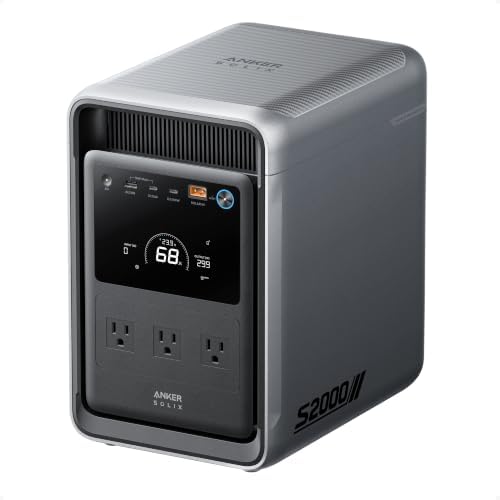
The SOLIX S2000 pairs a 2,010Wh LiFePO4 battery with 1,500W of continuous AC output and 3,000W of peak output. That capacity makes it a better fit for keeping selected household essentials going than a small emergency battery, while its 35.7-pound weight is relatively manageable for a unit in this capacity class.
Anker says the unit can run a refrigerator for up to 35 hours, but actual runtime depends on the refrigerator’s energy use, temperature, and how often its compressor runs. The station has eight outlets split between the front and rear for a tidier setup, though it does not have a 12V DC port. It supports up to 400W of solar input and several other charging methods, including wall power and a generator.
The LFP battery is rated for up to 10,000 cycles, and the unit includes a UPS function with a claimed switchover time under 10 milliseconds. That can be useful for a home office, but confirm that the devices you want to protect work with the station’s UPS behavior. Its 1,500W output also means it cannot run every high-wattage appliance.
At the time of writing, this product was unavailable.
Pros:
- 2,010Wh capacity for longer backup than compact units
- 3,000W peak output for startup surges
- Supports solar, wall, car, generator, and alternator charging
- UPS function with a claimed switchover under 10 milliseconds
Cons:
- No 12V DC port
- At 35.7 pounds, it is heavier than the smaller options here
Verdict: Choose the SOLIX S2000 if you want substantial battery capacity in a comparatively compact package and your essential appliances stay within its output limit.
EF ECOFLOW DELTA 3: Fast recharge and room to expand

The DELTA 3 has a 1,024Wh LFP battery and 1,800W of AC output. Its output rating is higher than the Jackery Explorer 1000 v2, despite the two units having the same listed capacity. That can make it a useful middle ground if you need to run several devices or an appliance with a higher operating wattage, while still checking startup demands and total load.
One of its main advantages is recharge flexibility. EcoFlow says the unit can reach a full charge in 56 minutes using a combination of up to 1,500W AC input and 500W solar input; it also supports up to 500W of solar input. Actual charging time depends on the charging setup. Compatible battery packs can expand the system up to 5kWh, which gives you a path to more stored energy without moving straight to a much larger base unit.
The station can power up to 13 appliances at once, but the number of outlets alone does not determine how much you can run: the combined load still needs to stay within the station’s limits. Its IP65 rating applies to the battery pack, not necessarily the whole power station, so keep the main unit protected from moisture unless its manual says otherwise. The expansion option is useful, but it adds equipment and complexity compared with using a single unit.
Pros:
- 1,800W AC output in a 1,024Wh class station
- Fast AC and solar charging support
- Can expand to 5kWh with compatible batteries
- LFP battery rated for 4,000 cycles to 80% capacity
Cons:
- Base capacity may be limiting for long outages or high-energy appliances
- Expansion requires compatible extra batteries
Verdict: The DELTA 3 is a strong fit if quick recharging and the option to expand matter more to you than getting the largest battery in one package.
Jackery Explorer 1000 v2: Portable backup with a UPS feature

The Explorer 1000 v2 stores 1,024Wh and delivers up to 1,500W of AC power, with a 3,000W peak rating. At 23.3 pounds, it is easier to move than the larger-capacity models here. Its foldable handle and mix of AC, USB, and DC connections make it suitable for both outage essentials and portable use away from home.
For backup use, the 10-millisecond UPS switchover is a notable feature for compatible electronics. It also has two USB-C ports, one USB-A port, a DC car port, and two pure sine wave AC ports. That outlet selection is more limited than on some larger stations, so consider how many devices you need to connect at once.
Jackery says the unit can charge fully in 50 minutes when emergency charging is enabled in its app. The default charging mode is slower, at about 1.25 hours, to support battery health. The LFP battery is rated for 4,000 cycles to 70% of its original capacity. A solar panel is not included, so using solar charging requires a compatible panel purchased separately.
At the time of writing, this product was unavailable.
Pros:
- Relatively light for a 1,024Wh station
- 10-millisecond UPS switchover for compatible equipment
- 1,500W output and 3,000W peak rating
- App controls for charging modes, including quiet overnight charging
Cons:
- Only two AC ports
- Solar panel is not included
Verdict: Pick the Explorer 1000 v2 if portability and UPS capability are priorities and its two AC outlets are enough for your backup setup.
MARBERO M823: Lightweight backup for small devices

The MARBERO M823 is a small 237Wh station with 300W of continuous output and a 375W peak. At 4.6 pounds, it is easy to carry, but its modest capacity makes it better for phones, laptops, lights, and other low-draw devices than for running a refrigerator or major household appliance through a long outage.
It has two AC outlets, USB-A and USB-C ports, and a 12–16.8V DC output. Two built-in lights, including one with SOS modes, may be handy if the power goes out after dark. You can recharge it from a wall outlet, a car adapter, or a compatible solar panel; the panel is sold separately.
The M823 is a practical small backup to keep close at hand, but it is not a substitute for a larger home power station. Check the wattage and startup needs of any device before plugging it in. Some equipment, including certain medical devices, may need a particular output or runtime, so confirm compatibility with the device maker.
Pros:
- Lightweight and compact for easy storage
- Multiple USB, AC, and DC connection options
- Built-in lights include SOS modes
- Supports wall, car, and solar charging
Cons:
- 237Wh capacity is small for extended home backup
- 300W continuous output rules out many larger appliances
Verdict: The M823 makes sense as a portable source for small electronics and lighting, but choose a higher-capacity model for refrigerator or home-circuit backup.
Jackery HomePower 3600 Plus: High output for larger backup needs
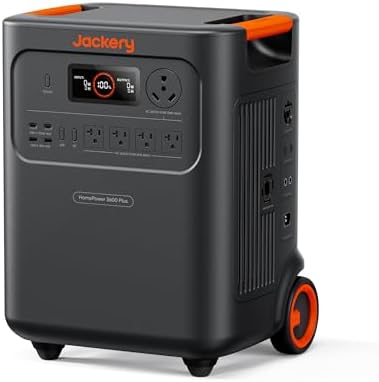
The HomePower 3600 Plus is the largest-capacity option in this selection, with a 3,584Wh LFP battery and 3,600W of AC output. That combination gives it more room for higher-demand equipment than the smaller portable stations. Jackery says the system can expand to 21kWh per unit, or up to 43kWh with multiple units.
It has a luggage-style design with wheels and a telescoping handle, which is useful because a 3.6kWh station is not a casual carry. The unit supports AC, solar, and generator charging, as well as hybrid AC-plus-DC charging. Jackery says hybrid charging can fully recharge it in two hours, though charge time depends on the power sources and conditions.
This model is designed for more involved home backup than a compact power station. The manufacturer describes using it with a manual transfer switch (MTS) to power home circuits; follow the equipment instructions and use a qualified electrician where required. Its 120V and 240V support is described for parallel operation, so check the setup requirements before planning to power 240V appliances. The unit’s size and expansion options may be more than you need if your goal is only to charge phones and a few small devices.
At the time of writing, this product was unavailable.
Pros:
- 3,584Wh capacity and 3,600W AC output
- Expandable storage for longer backup needs
- Wheels and telescoping handle help with moving it around
- Supports AC, solar, generator, and hybrid charging
Cons:
- Larger and less convenient to carry than the smaller options
- Home-circuit use requires careful attention to MTS and parallel setup requirements
Verdict: Choose the HomePower 3600 Plus if you need substantially more stored energy and output, and are prepared to plan a proper home-circuit setup.
How to Choose a Portable Power Station for Home Backup
Match battery capacity to your outage plan
Capacity, measured in watt-hours (Wh), is the amount of energy stored in the battery. Make a short list of the devices you want to keep running and estimate their energy use over the time you need. A 237Wh station can suit small electronics and lights, while a 1,000Wh-class unit offers more reserve. Larger capacities are more useful when you want to run several essentials for longer, but they take up more space and can be harder to move.
Check continuous output and startup demand
Output wattage determines which devices a station can run at the same time. Add the running wattage of the appliances you plan to use and compare the total with the station’s continuous rating. Motors and compressors, such as those in refrigerators, can draw more power when starting. A peak or surge rating may help with brief startup demands, but it does not raise the unit’s continuous output.
Plan for realistic runtime
Battery capacity is not the same as usable energy at an appliance’s outlet. Conversion losses, device power draw, and how often an appliance cycles all affect runtime. A refrigerator that cycles on and off may use power differently from a device that draws a steady load. Treat manufacturer runtime estimates as a starting point, then check the wattage label or manual for your own equipment.
Choose a charging method that works during an outage
Wall charging is useful before an outage, but solar or generator charging can help replenish a station when the grid stays down. Compare the supported input wattage and charging methods, and remember that solar panels may be sold separately. Fast charging can restore capacity quickly when power is available, while solar charging depends on panel size, placement, and sunlight.
Consider battery chemistry and expected use
Several models here use lithium iron phosphate (LFP or LiFePO4) batteries. Manufacturers often give cycle-life ratings, but those figures depend on their test conditions and do not guarantee a particular lifespan in every home. If you plan to store a station for emergencies, follow the manufacturer’s instructions for storage, charging, and temperature.
Think through outlets and placement
Count the AC outlets and other ports you need, then consider where the station will sit during an outage. A larger model with wheels may be easier to move across a home than one you need to lift, while a compact unit can fit in a closet or vehicle. Keep the station’s ventilation and moisture guidance in mind, and avoid running cords in ways that create trip hazards.
Know the limits of UPS and home-circuit backup
A UPS feature can switch some connected devices to battery power when utility power drops, but switchover time and device compatibility matter. Test the setup with non-critical equipment before relying on it. To power household circuits through a transfer switch, follow the power station and switch instructions and make sure the system is installed and used safely. Never connect a power station to home wiring in a way that can send power back to utility lines.
Frequently Asked Questions
What size power station do I need to run a refrigerator?
It depends on the refrigerator’s running and startup wattage, how often it cycles, and how long you need backup. Check the appliance label or manual, then choose a station whose continuous output and peak rating can handle those demands. More battery capacity generally means more potential runtime.
Can a portable power station run a whole house?
Most portable stations are intended for selected devices or circuits, not every household load at once. Larger expandable systems can support more demanding backup setups, but the station’s output, capacity, and connection method still set limits. Check the manufacturer’s instructions and use an appropriate transfer switch for home circuits.
Can I recharge a power station with solar panels?
Several models support solar charging, but solar panels may need to be purchased separately. Confirm that the panel’s output and connectors are compatible with the power station, and keep in mind that charging speed changes with sunlight and panel placement.
What does a UPS switchover time mean?
It is the time a power station takes to switch a connected device from wall power to battery power when utility power is interrupted. A shorter switchover can help compatible electronics stay on, but not every device handles every UPS setup the same way. Check compatibility before relying on it for critical equipment.
Is a smaller power station enough for an outage?
A small unit can be useful for phones, lights, and other low-power electronics. Its limited capacity and output make it less suitable for running larger appliances for long periods. Choose based on the devices you need to power, not just the station’s portability.
Should I leave a power station plugged in all the time?
Follow the manufacturer’s guidance for charging and storage, since recommendations can differ by model. Store the unit in the conditions described in its manual and check its charge level periodically so it is ready when you need it.
Final Recommendation
For a balance of capacity and manageable size, the Anker SOLIX S2000 stands out on paper for essential-appliance backup, while the EcoFlow DELTA 3 offers faster recharge options and expansion flexibility. The Jackery HomePower 3600 Plus is the more suitable direction for higher-output, home-circuit plans, provided you follow its setup requirements. For a small backup focused on phones and lights, the MARBERO M823 is the compact choice; match any model to your actual appliance loads and outage needs before deciding.