

An infant life jacket should fit snugly, match your child’s current weight, and stay securely in place when fastened. For boating and other water outings, look for a U.S. Coast Guard–approved personal flotation device (PFD) with infant-focused features such as a supportive collar, a crotch strap, and a grab handle. The five options below cover different weight ranges and designs, but no life jacket replaces close, constant adult supervision.
Quick Comparison
| Life jacket | Weight range | Notable features | Best fit for |
|---|---|---|---|
| Dark Lightning Baby/Infant Life Vest | Under 30 lb | Headrest, leg strap, grab handle | Families seeking a simple infant-focused design |
| O’Neill Infant Superlite Life Vest | Up to 30 lb | Type II, two buckles, leg strap, grab handle | Boating and active water outings |
| Airhead Infant Type II Life Jacket | Infants 15–30 lb | Closed sides, zipper, buckles, crotch strap, rescue handle | Parents who want multiple closure points |
| Full Throttle Infant Baby-Safe Life Jacket | Under 30 lb | Oversized collar, leg strap, grab strap | Families prioritizing a supportive collar |
| Stohlquist Infant Type II PFD | 20–30 lb | Support collar, zipper, over-buckle, grab handle | Infants within its narrower weight range |
Our Picks: Best life jackets for infants reviews
Dark Lightning Baby/Infant Life Vest: A straightforward choice with a headrest

This Coast Guard–approved vest is made for infants and toddlers under 30 pounds, with the fit especially aimed at children around 20–30 pounds. Its foam construction includes a headrest, an adjustable leg strap, and a top grab handle. Those features make it a practical option for parents who want an infant-style vest with several familiar safety details.
The main consideration is the broad “under 30 pounds” range: a vest that is within the weight limit still needs to fit your child correctly. Check the label and adjust the straps each time you use it. Compared with the O’Neill and Airhead options, this model’s listed features are simpler, and a specific PFD type is not identified here. Confirm the certification details on the vest before use.
Pros:
- Coast Guard–approved design for children under 30 pounds
- Headrest and top grab handle
- Adjustable leg strap helps secure the vest
Cons:
- Does not identify a specific PFD type in the product information
- The weight limit alone does not confirm a proper fit
Verdict: Consider this vest if your child is under 30 pounds and you want a headrest, leg strap, and grab handle in a straightforward design.
O’Neill Infant Superlite: Lightweight construction with a secure strap setup

The O’Neill Infant Superlite is a Type II Coast Guard–approved PFD for children up to 30 pounds. It uses a polyethylene foam core with a polyester shell, and its design includes two buckles, a lower through-leg strap, neck support, and an integrated pull handle. Drain holes are intended to help water escape after use.
Its lightweight construction and ability to layer over clothing or swimwear may be useful for varied outings, though you should always check the fit over the clothing your infant will actually wear. The vest’s multiple fastenings help it stay positioned, but they also mean you’ll need to check every buckle and strap before heading out. Compared with the Airhead, it has two safety buckles rather than a zipper plus buckles.
Pros:
- Type II certification for infants up to 30 pounds
- Through-leg strap and two safety buckles
- Neck support with an integrated pull handle
- Drain holes and lightweight foam construction
Cons:
- Requires careful adjustment of several straps and buckles
- Check the fit with any clothing or layers your child will wear
Verdict: The O’Neill is a strong option for families who want a Type II infant vest with neck support, a leg strap, and multiple buckle closures.
Airhead Infant Type II: A closed-sided design with zipper and buckle closures
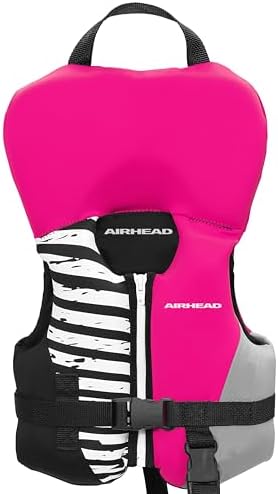
The Airhead Infant Type II is sized for infants from 15 to 30 pounds. Its closed sides, front zipper, double-buckle closure, crotch strap, and rescue handle give it a more enclosed setup than a basic vest. The quick-drying Neolite fabric is designed to feel soft against the skin, while the less bulky shape allows a wider range of motion.
With several ways to secure the vest, this model may suit parents who want more than a single closure. Those same closures need to be fastened and checked correctly before each outing. The product also covers a child-size range beyond infancy, but select the infant sizing by your child’s weight and the vest’s label rather than assuming the larger range applies to an infant.
Pros:
- Infant sizing covers 15–30 pounds
- Closed sides, zipper, buckles, and crotch strap
- Rescue handle for a quick grip
- Quick-drying fabric and less bulky design
Cons:
- Several closures require a careful fit check
- Its broader child sizing can make it important to confirm the infant-specific range
Verdict: Choose the Airhead if your infant is within the 15–30-pound range and you prefer closed sides with both a zipper and buckle closures.
Full Throttle Baby-Safe: An oversized collar and simple recovery handle

This Coast Guard–approved infant jacket fits children under 30 pounds. Its oversized collar is designed to provide head support, while an elasticized leg strap helps hold the vest in place. A grab strap offers a convenient point for an adult to hold when helping a child out of the water.
The design keeps the feature set focused on collar support and a leg strap rather than listing several buckle or zipper details. That may appeal if you want a simple infant-specific style, but check how it closes and how it fits your child before relying on it. Unlike the O’Neill, Airhead, and Stohlquist options, a specific PFD type is not identified here.
Pros:
- Coast Guard–approved for infants under 30 pounds
- Oversized collar designed for head support
- Elasticized leg strap and grab strap
Cons:
- Does not identify a specific PFD type in the product information
- Check the closure and fit carefully before use
Verdict: This is worth considering if your infant is under 30 pounds and collar support is a key feature for your search.
Stohlquist Infant Type II: A narrower fit range and cushioned neck support

The Stohlquist is a Type II infant PFD for children weighing 20–30 pounds. Its support collar is shaped to help keep the head supported, and its foam panels are designed with comfort in mind. The vest uses a front zipper with an over-buckle and includes a reinforced grab handle at the back.
The 20–30-pound range is narrower than the under-30-pound ranges on several other picks, so it may be a better match once your infant is within that window. Its zipper-and-buckle combination gives you two closure steps to check, while its design focuses on a soft feel and neck support. As with any infant PFD, the stated range is only a starting point; the vest must fit snugly and stay in place.
Pros:
- Type II infant PFD for children weighing 20–30 pounds
- Support collar and comfort-focused foam panels
- Front zipper with an over-buckle
- Reinforced rear grab handle
Cons:
- Narrower weight range than some other infant options
- Zipper and over-buckle both need to be secured correctly
Verdict: The Stohlquist is a good candidate if your child weighs 20–30 pounds and you want a Type II design with a supportive collar and zipper-plus-buckle closure.
How to Choose an Infant Life Jacket
Start with your child’s weight and the vest label
Choose a vest based on your child’s current weight and the size range printed on the PFD, not age alone. The options here have different ranges: some are intended for children under 30 pounds, while others begin at 15 or 20 pounds. If your child is close to a range boundary, check the manufacturer’s guidance and try the vest on before your outing.
Look for the right certification and type
Check the label for U.S. Coast Guard approval and the PFD type. Several picks here are identified as Type II infant PFDs, while others are described as approved without a type named in the product information. Follow the label and manufacturer’s instructions for the vest you choose, and make sure it is suitable for your planned activity.
Check fit and closures every time
A life jacket should fit snugly without riding up when you lift gently at the shoulders. Fasten every buckle, zipper, and leg strap according to the instructions. A grab handle is useful for an adult to hold, but it does not replace a secure fit or attentive supervision.
Consider head and neck support
Many infant vests include a collar or headrest designed to support the head. The shape and feel vary between models, so consider your child’s comfort and how the vest sits when fastened. Do not assume that a collar alone guarantees a particular position in the water; use the PFD as directed and keep your child within arm’s reach.
Match the PFD to the outing
Think about where and how you will use the vest, such as on a boat or during another supervised water activity. A life jacket is not a swim lesson tool or a substitute for adult attention. Follow local rules, the manufacturer’s directions, and any activity-specific safety guidance.
Inspect and care for the vest
Before each use, check the fabric, seams, foam, closures, and straps for damage or wear. Make sure the vest is dry and stored according to its care instructions after use. Replace it if it is damaged or no longer fits your child properly.
FAQs About Infant Life Jackets
What weight should I use to choose an infant life jacket?
Use your child’s current weight and the range printed on the vest label. Age ranges can be less useful because infants of the same age can weigh different amounts.
Does a life jacket mean I can step away from my infant?
No. A PFD does not replace close, constant adult supervision. Keep your infant within arm’s reach around water and follow the vest’s instructions.
What is the benefit of a leg or crotch strap?
A properly adjusted leg or crotch strap helps keep the vest from riding up. Fasten and adjust it as directed, and check that it does not rub or cause discomfort.
Are all five picks Type II infant PFDs?
No. The O’Neill, Airhead infant version, and Stohlquist are identified as Type II infant PFDs. For the Dark Lightning and Full Throttle options, check the vest label and manufacturer’s guidance for the specific PFD type.
Can I use an infant life jacket as a pool float or swim aid?
A life jacket is not a pool float or a substitute for swimming instruction and supervision. Use it only as directed by its manufacturer and for activities it is intended to support.
How should an infant life jacket fit?
It should fit snugly, with all closures fastened and straps adjusted according to the instructions. If it rides up, shifts, or feels too loose, do not use it until you confirm the correct size and fit.
Final Recommendation
For a Type II option with multiple closures, the O’Neill Infant Superlite and Airhead Infant Type II are useful starting points; choose between them based on your child’s weight range and preferred closure setup. The Stohlquist is a focused alternative for children weighing 20–30 pounds, while the Dark Lightning and Full Throttle options offer head-support features for infants under 30 pounds. Whichever you choose, confirm the approval label, test the fit before your outing, and keep your infant under constant adult supervision.