

A bed and chair alarm can alert a caregiver when someone gets up, giving you a chance to respond before an unattended transfer becomes a fall. The right choice depends on where you need coverage, whether you want a wired or wireless setup, and how the alert sounds in your home. These five systems use pressure-sensing pads, but they differ in monitor placement, power options, included equipment, and availability.
Quick Comparison
| Product | Connection | Included pads and monitors | Notable details |
|---|---|---|---|
| Smart Caregiver Bed and Chair Exit Alarm System | Pad connects to monitor by cord | Bed pad, chair pad, and monitor | Two volume levels; sealed pads |
| Smart Caregiver Wireless Bed & Chair Exit Alert System | Wireless pads and monitor | Bed pad, chair pad, and monitor | Three volume levels; compatible with additional sensors |
| Secure Safety Solutions Bed & Chair Exit Alarm | Pressure-sensing pads | Bed pad, chair pad, two monitors | Flashing lights; batteries included |
| Smart Caregiver Wireless Bed & Chair Exit Alarms | Wireless pads and monitor | Bed pad, chair pad, and monitor | Up to 100-foot range; AC adapter included |
| Secure Safety Solutions Chair & Bed Alarm | Pressure-sensing pads | Bed pad, chair pad, two monitors | Adjustable volume; nurse-call connection option |
Our Picks: Best Bed And Chair Alarm reviews
Smart Caregiver Bed and Chair Exit Alarm: A Simple Dual-Pad Setup

This Smart Caregiver system includes one monitor, a 10-by-30-inch bed pad, and a 10-by-15-inch chair pad. The pads connect to the monitor by cord, so the monitor needs to stay close enough for the connection. It can be clipped to a headboard or chair, or placed on a nearby table.
The bed pad goes under the fitted sheet. The supplied instructions suggest placing it near the shoulder blades for earlier alerts, or lower under the hips if a restless sleeper is likely to trigger it too easily. The chair pad rests on the seat. Both pads have a soft vinyl surface, a foam interior, and a sealed design intended to protect against incontinence.
The monitor has high and low volume settings, status lights for the sensor and battery, and a front reset button. A phone-style clip makes it easier to switch the monitor between the bed and chair pads. The practical trade-off is that this is not a fully wireless setup: the pad cord may need careful routing to keep it out of the way.
Pros:
- Includes both bed and chair pads with one monitor.
- Sealed pads are designed for incontinence protection.
- Two volume choices and status lights support basic monitoring.
- Monitor can be moved between the included pads.
Cons:
- The pad connects to the monitor by cord, which can limit placement.
- Only high and low volume settings are listed.
Verdict: Choose this model if you want a straightforward bed-and-chair kit and can manage a corded pad connection; consider a wireless option if monitor placement flexibility is more important.
Smart Caregiver Wireless Exit Alert System: Expandable Sensor Options

This kit pairs a wireless monitor with a 10-by-30-inch bed pad and a 10-by-15-inch chair pad. Since the pads send a signal to the monitor, you can place the monitor where a caregiver is more likely to hear it rather than keeping it beside the bed or chair.
The monitor offers low, medium, and high volume settings. It needs three C batteries, which are not included, or the separately sold AC-04 power adapter. The bed pad is placed under the fitted sheet around shoulder height. For chair use, the pad should sit on a flat surface and should not be pinched under a cushion.
A key distinction is that this monitor is also compatible with several optional Smart Caregiver sensors, including a floor mat, nurse-call button, motion sensor, and door or window sensor. Those accessories are not part of the listed kit, so factor them in only if you need a broader monitoring setup. The supplied listing data marks this product unavailable; confirm its availability before choosing it.
Pros:
- Wireless pads allow more flexible monitor placement.
- Three volume settings offer more adjustment than basic two-level monitors.
- Compatible with several optional sensors for a larger system.
- Includes both bed and chair pads.
Cons:
- Batteries and the AC adapter are not included.
- Optional sensors must be purchased separately, and the supplied data marks the product unavailable.
Verdict: This is a good fit on paper for caregivers who want wireless monitoring and possible sensor expansion, but check availability and plan for a power source before relying on it.
Secure Safety Solutions Exit Alarm: Two Monitors and Included Batteries
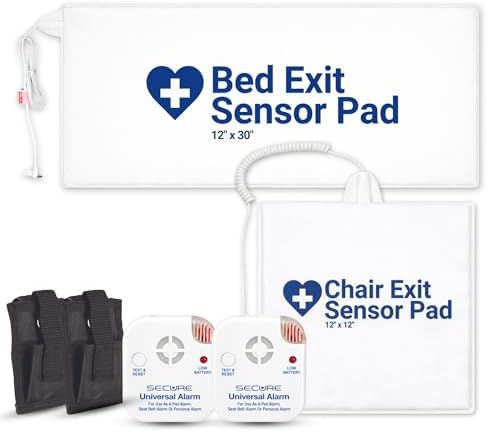
This kit includes two monitors, a 12-by-30-inch bed pad, a 12-by-12-inch chair pad, two mounting holders with straps, and two 9V batteries. Having two monitors may be useful if you want separate alert units near different care areas, rather than moving a single monitor back and forth.
When pressure is removed from a pad, its monitor gives an audible alert and flashing light. The product description lists an 80 dB alarm, a low-battery indicator, and automatic reset when weight returns to the pad. The pads are described as thin, liquid-proof, latex-free, and foldable. Metal connecting pins are also specified as a durability feature.
The kit is designed for bed, chair, or wheelchair monitoring, but pad placement and fit still matter. A sensor pad cannot prevent someone from falling by itself; it alerts a caregiver who must be able to respond. The supplied listing data marks this model unavailable, so verify that it can be purchased before making it your preferred option.
Pros:
- Two monitors are included, along with batteries and mounting holders.
- Audible and flashing alerts provide two ways to notice an alarm.
- Liquid-proof, latex-free pads are designed for everyday care settings.
- Automatic reset is listed when pressure returns to the pad.
Cons:
- The supplied data lists only one bed pad and one chair pad for the two monitors.
- The listing is marked unavailable in the supplied product information.
Verdict: If available, this kit may suit caregivers who value two monitors and visual alerts, but confirm the included setup and availability before buying.
Smart Caregiver Wireless Alarm: Flexible Placement and Included Adapter

This Smart Caregiver system includes a wireless bed sensor pad, a wireless chair pad, and a monitor. The monitor can be placed with the caregiver up to 100 feet from the pads, according to the product description. That arrangement can be more convenient than keeping an alarm unit right beside the person being monitored.
The bed pad is 30 inches across and sits under the fitted sheet. The description suggests placing it under the shoulder blades to alert when someone sits up, or under the hips to alert closer to the point of getting out of bed. The chair pad belongs on a firm seat. Both pads arrive pre-programmed, and the monitor offers low, medium, and high volume settings plus a gentle chime option.
The included AC adapter is a useful advantage if you plan to keep the monitor near an outlet. Three C batteries can also power it for portability, but those batteries are not included. Wireless operation reduces the need to run pad cords to the monitor, though the stated range does not guarantee the same performance in every home or through every layout.
Pros:
- Wireless pads let you place the monitor away from the bed or chair.
- Product information lists a range of up to 100 feet.
- AC adapter is included, with battery operation as another option.
- Three volume levels and a gentle chime offer alert choices.
Cons:
- Three C batteries are not included.
- Wireless range can be affected by the home environment.
Verdict: This is the most convenient choice in this group if you want a wireless monitor, multiple alert settings, and an included adapter.
Secure Safety Solutions Chair and Bed Alarm: Adjustable Alerts and Nurse-Call Option

This Secure Safety Solutions kit comes with two monitors, a 12-by-30-inch bed pad, a 12-by-12-inch chair pad, two holders with straps, and six AAA batteries. The monitors are described as tamper-resistant, with no standard on/off switch that could be used to disable the alarm.
When pressure leaves a pad, the monitor alerts with an audible tone and flashing light. The product description lists adjustable volume from 80 to 120 dB, two alert tones, and low-battery alerts that are both visual and audible. The pads have liquid-proof, latex-free covers and fold for storage. An optional cable and wall adapter can connect the monitor to a nurse-call system, but those accessories are not included in the described kit.
This model has a wider stated volume range and more alert features than the simpler Smart Caregiver corded system. However, a loud alarm is not automatically better in every home: consider the person’s comfort, nearby household members, and whether a caregiver will hear it. The supplied listing data marks the product unavailable, so check the listing before planning around its nurse-call compatibility or other features.
Pros:
- Two monitors, mounting holders, pads, and batteries are included.
- Adjustable volume and two alert tones allow more configuration.
- Audible and flashing alerts, plus low-battery warnings, are listed.
- Optional nurse-call connection may suit some care settings.
Cons:
- The nurse-call cable and wall adapter are optional, not included accessories.
- The listing is marked unavailable in the supplied product information.
Verdict: Consider this model for its adjustable alerts and potential nurse-call connection if it becomes available, but verify accessory needs and alarm volume before choosing it.
How to Choose a Bed and Chair Alarm
Decide Where You Need Coverage
Think about whether the main concern is getting out of bed, rising from a chair, or both. If you need both locations monitored, look for a kit that includes the matching bed and chair pads. Also check the pad dimensions and the available seating or mattress area so the sensor can sit flat and in the intended position.
Choose Wired or Wireless Based on Monitor Placement
A corded pad connects directly to its monitor. This can be a simple arrangement, but the monitor needs to stay near the pad and the cord should be routed safely. With wireless pads, the monitor can be placed farther away, which may help a caregiver hear the alert from another spot. Check the stated range and consider your home layout when deciding whether wireless placement will work.
Check Power and Battery Needs
Power details differ across these systems. Some require batteries that are not included, while others include an adapter or batteries. Before you buy, confirm what powers the monitor, whether you need an outlet nearby, and whether battery operation is important for your setup. A low-battery light or alert can help you know when the system needs attention.
Compare Alert Types and Volume Controls
Consider whether you need a basic audible alarm, a flashing light, a chime option, or several volume levels. A caregiver should be able to hear or see an alert from the place where they will be working. At the same time, the loudest setting may not be comfortable for every household. Think about who will hear the monitor and where it will be placed.
Look at Pad Placement, Comfort, and Care Needs
Bed pads are generally placed under a fitted sheet, while chair pads sit on the seat. Placement can affect when the alarm sounds, so follow the product instructions and adjust for the person’s movement and sleeping habits. If spills or incontinence are a concern, check whether the pad is described as sealed or liquid-proof. Keep cords, pads, and holders arranged so they do not create a tripping or entanglement hazard.
Confirm What Comes in the Box
Do not assume every kit includes the same accessories. Compare the number of monitors, pads, holders, batteries, and power adapters. Optional items such as nurse-call cables, floor mats, or door sensors may add useful functions, but they are not necessarily part of the base package.
Use an Alarm as One Part of a Safety Plan
A bed or chair alarm alerts a caregiver when pressure is removed from a pad; it does not stop someone from standing or prevent a fall on its own. Consider how quickly a caregiver can respond, whether the alert can be heard from their location, and what other safety steps are appropriate for the person’s needs. Ask a qualified care professional for guidance when choosing monitoring equipment for a specific condition or care plan.
Frequently Asked Questions
How does a bed and chair alarm work?
A pressure-sensitive pad sits under bedding or on a chair seat. When the person gets up and pressure is removed, the system sends an alert to its monitor. Corded systems connect the pad directly to the monitor, while wireless systems send a signal without that pad-to-monitor cord.
Can one monitor cover both a bed and a chair?
Some kits include both pads and a single monitor that can be used with them. Check the product instructions to understand how to connect or switch between pads. Other kits include two monitors, which can provide separate alert units for different locations.
Where should a bed sensor pad go?
Follow the manufacturer’s instructions. The products in this guide describe placing the pad under the fitted sheet, with some suggesting shoulder height for an earlier alert or lower near the hips for an alert closer to getting out of bed. The best position depends on the person and the system.
Do these alarms prevent falls?
They can alert a caregiver when someone gets up, but they do not physically prevent a fall. Their usefulness depends on the caregiver hearing or seeing the alert and being able to respond. They should be treated as one part of a broader safety plan.
Are wireless bed and chair alarms always the better choice?
Not necessarily. Wireless pads can make it easier to place the monitor farther away, while corded systems may be simpler if the monitor can stay close by. Compare placement needs, power options, and the home layout before choosing.
Do the alarm systems include batteries or power adapters?
It varies by model. The products in this guide have different power requirements: some need batteries that are not included, while others list included batteries or an AC adapter. Check the specific kit contents before ordering.
Can I connect a bed alarm to a nurse-call system?
One Secure Safety Solutions model lists nurse-call compatibility with an optional cable. The cable and power adapter are not included in the described kit, so confirm compatibility and accessory requirements with the product listing and the care facility before purchase.
Final Recommendation
For most caregivers who want flexible monitor placement and an included power adapter, the Smart Caregiver Wireless Bed & Chair Exit Alarms system is the most practical pick in this group. If a corded setup is acceptable, the Smart Caregiver Bed and Chair Exit Alarm offers a simpler alternative with sealed pads. Compare the power needs, pad sizes, and alarm features against your care routine, and remember that an alarm works best when a caregiver can respond promptly.