

Choosing the best exercise bike for seniors starts with comfort, easy access, and a resistance level that matches your fitness and mobility. A recumbent bike can offer a supported riding position, while a folding upright bike may suit people who want a more compact option. The five picks below cover both styles, with differences in seat support, resistance, and extra features to help you find a bike that fits your home and routine.
Quick Comparison
| Exercise bike | Style | Resistance | Standout feature |
|---|---|---|---|
| Goimu 5-in-1 Folding Exercise Bike | Folding upright | 16 levels | Space-saving design and multiple workout modes |
| XVGVSV Recumbent Exercise Bike | Recumbent | 16 levels | Backrest and 400-pound capacity |
| MERACH Recumbent Exercise Bike | Recumbent | 8 levels | App connection and tablet holder |
| USLIM Recumbent Exercise Bike | Recumbent | 16 levels | Adjustable seat and stated 400-pound capacity |
| Birdfeel Recumbent Bike with Arm Exerciser | Recumbent with arm movement | 8 levels | Combined arm and leg exercise |
Our Picks: Best exercise bike for seniors reviews
Goimu 5-in-1 Folding Bike: Best for Saving Space

The Goimu is a folding upright bike for people who want an indoor pedaling option without giving a permanent spot to a larger machine. It has a heavy-duty steel frame with an X-shaped structure, magnetic resistance with 16 levels, and a stated user capacity of 330 pounds. The listing also describes five workout modes and transport wheels for moving the bike around the home.
Its upright position is more compact than a recumbent setup, but it does not offer the same broad backrest support. That makes it a better fit for riders who can get on and off an upright bike comfortably and prefer to sit more vertically. The padded seat and ergonomic handlebars are intended to make longer sessions more comfortable, though seat comfort is personal and can depend on fit.
The folding design is its key advantage over the recumbent choices here. Magnetic resistance is also a practical feature for home use, since there is no friction pad pressing against the flywheel. Check the bike’s fit and folding storage needs before buying, and remember that its 330-pound stated capacity is lower than the 400-pound limits listed for several recumbent models.
Pros:
- Folding design can help save floor space.
- 16 magnetic resistance levels provide a range of workout settings.
- Transport wheels make it easier to move between rooms.
- Five workout modes add flexibility beyond basic pedaling.
Cons:
- Upright seating does not provide the backrest support of a recumbent bike.
- Its stated capacity is lower than those of the 400-pound-capacity options in this guide.
Verdict: Choose the Goimu if compact storage and an upright riding position matter more to you than a supportive recumbent seat.
XVGVSV Recumbent Bike: Best for a Supportive Seat and Backrest

This recumbent bike puts the rider in a seated position with a padded seat and backrest. A lever adjusts the seat to fit different users, and the frame has a stated capacity of 400 pounds. The magnetic resistance system offers 16 levels, so you can start gently and increase the effort as your routine develops.
The backrest can be useful if you prefer more support while pedaling, and the reclined position may feel more comfortable than an upright bike for some riders. The LCD display tracks speed, time, distance, calories, odometer, and heart rate. Pulse sensors are built into the handles. These are helpful tracking features, but they do not replace medical advice or a dedicated heart-rate monitor when one is needed.
The listing says the bike arrives 85% pre-assembled and typically takes about 30 minutes to set up. It also has front transport wheels. Compared with the MERACH, it offers more resistance levels; compared with the USLIM, both list 16 levels and a 400-pound capacity. The product information does not give a seat-height range, so check the fit carefully if you are especially tall or short.
Pros:
- Padded seat and backrest support a reclined riding position.
- 16 resistance levels allow small changes in workout effort.
- Stated capacity of 400 pounds.
- LCD display includes several workout metrics and pulse-sensor readings.
Cons:
- The listing does not specify a rider-height range.
- Its resistance system has more settings than the MERACH and Birdfeel, but no listed app connection.
Verdict: The XVGVSV is a sensible option if you want a backrest, many resistance settings, and a high stated weight capacity.
MERACH Recumbent Bike: Best for App and Tablet Features

The MERACH is a recumbent bike with a mesh backrest, thicker seat, and eight seat positions to adjust for different inseam lengths. It has eight resistance levels controlled by a lever, a dual-belt drive, and a display that tracks time, distance, speed, calories, and heart rate. A tablet holder provides a place for a device during a workout.
One feature that sets it apart is its app connectivity. The listing says the bike syncs with the MERACH app and describes a game-style app option. If you like digital workout tracking or want entertainment nearby, these additions may make regular rides more engaging. If you would rather keep things simple, the bike can still be used without making app features the focus.
Its eight resistance levels offer fewer steps than the 16-level models in this comparison, which may matter if you want more gradual adjustments. The listing does not provide a maximum user weight, so confirm that specification with the seller before purchase if capacity is an important factor. Its seat positions are described in terms of inseam fit, but a hands-on fit check is still useful when possible.
Pros:
- Eight seat positions help adjust the bike for different inseam lengths.
- Mesh backrest and thicker seat are designed for seated comfort.
- Tablet holder and app connection add entertainment and tracking options.
- Display includes heart-rate information and common ride metrics.
Cons:
- Eight resistance levels offer fewer settings than the 16-level options.
- The supplied product details do not state a maximum user weight.
Verdict: Consider the MERACH if app features and a tablet holder appeal to you, and verify the capacity and fit details before ordering.
USLIM Recumbent Bike: Best for Seat-Range Details and Resistance Variety
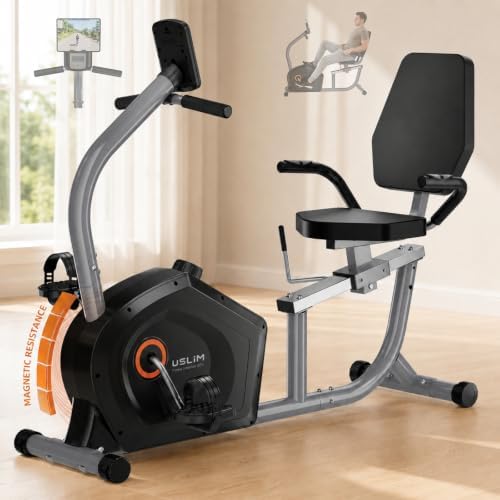
The USLIM is a recumbent model with 16 magnetic resistance levels, a padded seat, and a backrest. Its quick-adjust seat is listed as fitting riders from 4 feet 9 inches to 6 feet 2 inches. The product information also gives a 400-pound capacity, which may help shoppers compare it with other bikes when weight limits are a priority.
The LCD monitor displays speed, heart rate, time, distance, calories, and odometer readings. Handle sensors provide pulse readings, and a phone or tablet holder keeps a device within reach. The listing describes a quiet belt-driven system and says the bike is 90% pre-assembled, with setup typically taking about 30 minutes. It also includes front transport wheels.
Among these picks, the USLIM provides particularly useful fit information by listing a rider-height range. Still, a stated range cannot guarantee a comfortable fit for every body type, so check that your knees have a comfortable bend at the far point of each pedal stroke. The bike has a more straightforward feature set than the MERACH’s app-connected setup, but more resistance levels than the MERACH and Birdfeel.
Pros:
- 16 resistance levels offer a range of effort settings.
- Stated rider-height range of 4 feet 9 inches to 6 feet 2 inches.
- Backrest, padded seat, and phone or tablet holder.
- Stated 400-pound capacity and front transport wheels.
Cons:
- Does not include the app features listed for the MERACH.
- Heart-rate readings come from handle sensors, which require you to hold the sensors during use.
Verdict: The USLIM is a strong match if you want a recumbent bike with 16 resistance levels and clearly stated rider-height guidance.
Birdfeel Recumbent Bike: Best for Adding Arm Movement

The Birdfeel combines a recumbent bike with arm exercisers, allowing you to pedal and move your arms from a seated position. The listing describes synchronized arm and leg movement, an adjustable padded seat and backrest, and footrests designed to help keep feet in place. Its steel frame has a stated 400-pound capacity.
Resistance is magnetic and adjusted with a knob across eight levels. The product information describes the system as quiet and says the bike has transport wheels and leveling feet. A dual LCD monitor is included, though the supplied details do not list every metric it displays. The frame is also described as 80% pre-installed, with assembly instructions included.
This model stands out for people who want arm movement as part of a seated workout, rather than simply pedaling. That added motion may not be right for everyone, especially if you have shoulder, arm, or balance concerns. Its eight resistance levels provide fewer choices than the 16-level recumbent bikes, and the supplied details do not give a specific rider-height range. Ask a clinician whether combined arm-and-leg exercise is appropriate if you are recovering from an injury or have health concerns.
Pros:
- Arm exercisers add upper-body movement while pedaling.
- Adjustable seat and backrest support a recumbent position.
- Stated 400-pound capacity and transport wheels.
- Eight magnetic resistance levels suit a range of workout efforts.
Cons:
- Eight resistance levels offer fewer settings than the 16-level models.
- The supplied details do not specify a rider-height range or all monitor metrics.
Verdict: Choose the Birdfeel if you specifically want arm movement along with seated pedaling and are comfortable using its combined-motion design.
How to Choose an Exercise Bike for Seniors
Choose the Riding Position That Feels Secure
A recumbent bike places you in a reclined seat with a backrest, while an upright bike has a more vertical posture. Think about how easily you can sit down, reach the pedals, and get off the bike. A supported seat may be preferable if you want back support, while an upright or folding design may better suit you if you are comfortable with that posture and need to save space.
Check the Seat Fit and Adjustment Range
The seat should let you pedal without stretching your leg fully or crowding your knee. Look for a clear seat-adjustment method and a stated rider-height or inseam range when available. The USLIM lists a height range, and the MERACH describes multiple seat positions for inseam fit. If possible, confirm the fit before committing, especially if the bike will be shared by people of different heights.
Match Resistance to Your Current Ability
Magnetic resistance can be adjusted to change how hard pedaling feels. More levels can provide smaller steps between settings, but the total number of levels does not tell you exactly how difficult the highest setting will be. If you are beginning or returning to exercise, prioritize a comfortable low setting and simple adjustments. Ask a health professional for guidance on exercise intensity if you have a medical condition or are recovering from an injury.
Confirm Capacity and Frame Stability
Check the listed maximum user weight and compare it with your needs before buying. The products here list capacities ranging from 330 to 400 pounds, while the MERACH details supplied for this article do not state a capacity. A capacity figure is only one part of stability; also consider the frame design, leveling feet, and whether the bike can sit securely on your floor.
Consider Access, Storage, and Moving the Bike
Measure the area where you plan to ride and store the bike. A folding model may help in a small home, while recumbent bikes generally require a dedicated spot while in use. Transport wheels can make a bike easier to move, but they do not replace checking whether you can move and position it safely. Keep a clear path around the bike and place it on a stable, level surface.
Decide Which Tracking Features You Will Use
Basic displays may show time, speed, distance, and calories. Some models also include pulse sensors, device holders, or app connections. These extras can help you track a routine or stay entertained, but they are not essential for everyone. If you want heart-rate tracking, remember that handle sensors require contact with the grips and should not be treated as a substitute for medical monitoring.
Look at Setup and Ongoing Convenience
Assembly details can affect how quickly you get started. Some listings describe the bike as mostly pre-assembled and include tools or instructions, but the actual process may still require lifting, fastening, and adjusting parts. Consider whether you will need help with setup. Also check the seller’s current product information for warranty, support, and return details before ordering.
Frequently Asked Questions
Is a recumbent bike a good choice for seniors?
A recumbent bike may suit people who prefer a seated, reclined position with back support. Fit and comfort vary, so check the seat adjustment, pedal reach, and how easy it is to get on and off. A clinician can help you decide whether this style is appropriate for your needs.
Is a recumbent or upright exercise bike easier to use?
Neither style is automatically easier for everyone. Recumbent bikes offer a backrest and a more reclined position, while upright bikes have a more vertical riding posture and may take up less storage space when folding. Choose based on your mobility, comfort, and ability to mount and dismount safely.
How many resistance levels should an exercise bike have?
There is no single best number. More levels can offer finer adjustments, but the feel of the resistance matters too. Look for a bike with an easy-to-use control and a low setting that feels manageable for your starting point.
Can I use an exercise bike for rehabilitation?
Some low-impact cycling routines may be part of a rehabilitation plan, but the right movement and effort depend on the injury and your health. Ask your doctor or physical therapist whether a bike is suitable, and follow their guidance on duration and resistance.
What should I check before buying a recumbent bike?
Check the maximum user weight, seat adjustment, rider-height or inseam guidance, resistance controls, and the space needed for the bike. Also consider the display, device holder, assembly requirements, and how you will move it if needed.
Do exercise bike heart-rate sensors replace a medical monitor?
No. The handle sensors on some bikes provide exercise readings, but they are not a replacement for a medical device or advice from a clinician. If you have been told to monitor your heart rate, ask your health professional which method to use.
Which bike in this guide is best for a small home?
The Goimu is the only folding model in this group, so it is the clearest choice to consider when storage space is limited. Check the product details and measure your available space to make sure its folded and in-use footprint will work for your home.
Final Recommendation
For a supportive recumbent ride with many resistance settings and stated fit guidance, the USLIM is the most balanced choice in this group. The XVGVSV is another good option if you want a backrest and 16 resistance levels, while the Goimu makes more sense when folding storage is a priority. Choose the Birdfeel for added arm movement or the MERACH for app and tablet features. Before ordering, confirm the fit, capacity, and setup needs that matter most to you.